
Guide · For managers
How to support a colleague who may be burned out
A five-move check-in conversation, wording you can use, and what to do next. For managers and peers who are not sure what to say.

If a colleague or team member seems exhausted, withdrawn, or less effective than usual, start a private, unhurried conversation: say what you have noticed without guessing why, listen, ask what is making work hard, and agree one step and a date to talk again. HSE's signs of stress include taking more time off, arriving late, mood swings, pulling away from others, and losing motivation. [1] You are not there to diagnose. You are there to listen, look at the work, and point to support. [2][3]
What might you notice?
HSE lists signs of stress in an individual: taking more time off, arriving late, or seeming twitchy or nervous; mood swings, pulling away from others, losing motivation, commitment, or confidence, and stronger emotional reactions such as crying more easily or becoming oversensitive or aggressive. [1] None of these is proof of burnout, and each has other possible causes, including health and personal circumstances.
HSE also describes signs in a team or organisation: more arguments, higher turnover, more reports of stress, higher sickness absence, lower performance, and more complaints and grievances. [1] If you see several of these, the cause may sit in the work, not in one person.
What should you do before you speak?
Check what you know and what you are assuming. Look at the person's recent workload and what has changed, such as a new project, a reorganisation, or a colleague leaving. Look at what support your organisation offers, such as an employee assistance programme, occupational health, flexible working, and HR. Decide what you can offer and what you must refer on.
- I have a private place and enough time, ideally 30 minutes, and not just before a deadline.
- I know two or three specific things I have noticed, not general impressions.
- I have looked at their workload and what has changed recently.
- I know what support exists and how to reach it.
- I am prepared to listen more than I speak.
How do you run the conversation?
HSE's Working Minds approach starts with reaching out, which means starting conversations using structured prompts such as the Stress Talking Toolkit. HSE says the toolkit provides structured questions and prompts to help managers talk with workers, but should not be used in isolation. [3] The five moves below follow the same spirit.
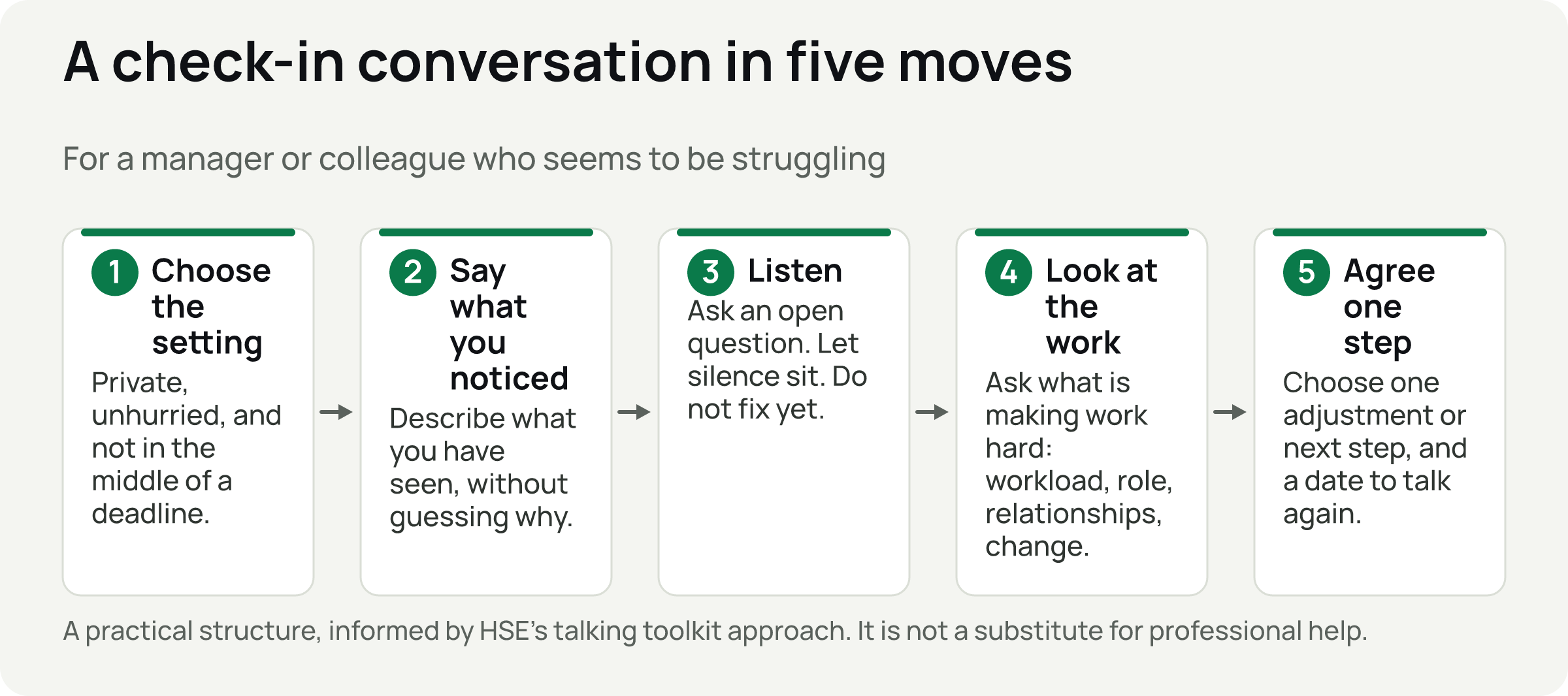
- Choose the setting. Invite them privately, say what the meeting is about, and do not make it formal or surprising.
- Say what you noticed. Describe, do not interpret: "You have seemed tired in the last few weeks and you have not joined the team lunch."
- Listen. Ask one open question and then wait. Do not fix, argue, or compare. A pause is fine.
- Look at the work. Ask what is making work hard right now. Use the six areas as prompts: workload, control, support, relationships, role, and change. [6]
- Agree one step and a date. Choose one adjustment, such as moving a deadline, and a time to talk again. Write it down and do it.
What should you say and not say?
The words matter less than the attention behind them, but some phrases open a conversation and some close it. These are suggestions, not research findings.
| Instead of | Try |
|---|---|
| "What is wrong with you lately?" | "I have noticed you seem tired and quieter. How are things going for you?" |
| "Everyone is stressed right now." | "It sounds like this has been a lot. What has been hardest?" |
| "You just need to manage your time better." | "Let us look at what is on your plate and what could move." |
| "Do you think you are depressed?" | "Is there anything I can do, or anyone you would like to speak to?" |
| "I am sure it will pass." | "Thank you for telling me. Let us decide one thing we can change this week." |
What changes to the work can help?
The WHO's recommendations for supporting workers include reasonable accommodations such as flexible hours, extra time for tasks, or time off for appointments. [4] Which changes are possible depends on your workplace and local law. Ask the person what would help, offer options, and agree a review date.
- Reduce or re-prioritise the workload, and say which tasks are deprioritised.
- Move a deadline, or split a large task.
- Offer flexibility in hours or location, where the job allows.
- Clarify a role or a decision that is causing friction.
- Offer an introduction to occupational health or an employee assistance programme, if you have one.
What are your limits as a manager or colleague?
You are not a clinician. Do not diagnose or give medical advice. Do not promise to keep everything confidential if you may need to involve HR or act on safety concerns, and say so at the start. Do not ask for health details you do not need. Keep records factual and limited.
If the person mentions thoughts of harming themselves, do not leave them alone, and help them reach urgent support. In the UK, the NHS says to call 999 for immediate danger or NHS 111 for urgent help that is not an emergency, and Samaritans are on 116 123. [5] In the United States, call or text 988. Elsewhere, findahelpline.com lists services by country.
What happens after the conversation?
Do what you agreed, and keep the date. If the adjustment does not help, say so and try another. Look beyond one person: if others show the same signs, look at the team's workload, roles, and support. HSE's Working Minds steps for employers include recognising causes of stress such as workloads and working patterns, responding with recorded actions, reflecting on whether they work, and making it routine. [3]
Common questions
Should I ask directly whether someone is burned out?
It is usually better to describe what you have noticed and ask how they are. Burnout is a label with a specific meaning, the WHO treats it as an occupational phenomenon and not a medical condition, and the person may not recognise it or want to use the word. [2]
What if they say nothing is wrong?
Accept it, say the door stays open, and keep an eye on the workload. People often need time. Do not push, and do not pretend you did not notice.
What if I am a peer, not their manager?
You can still check in privately. Say what you noticed, listen, and offer to help them reach their manager, HR, or other support. HSE suggests talking to a manager, colleague, or GP when stress is hard to manage. [1]
Can I tell their manager?
Be careful. Ask the person first, and explain who you would speak to and why. Share only what is necessary, unless there is a safety concern.
Keep reading
Sources and further reading
These links open external research and health-information websites.
- HSE: Signs of stress
Signs of stress in individuals and in teams or organisations. - WHO: Burn-out an "occupational phenomenon" (2019)
ICD-11: burn-out is not classified as a medical condition. - HSE: Working Minds, World Mental Health Day 2026
The five steps for employers and the Stress Talking Toolkit, with HSE's caution not to use it in isolation. - WHO: Mental health at work (fact sheet)
Manager training and reasonable accommodations. Page dated 15 September 2026 when checked. - NHS: Get help with stress
Urgent help routes in the UK: 999, NHS 111, and Samaritans. - HSE: What are the Management Standards?
The six areas of work design: demands, control, support, relationships, role, and change.
Educational guidance, not clinical, legal, or HR advice. If you need a person, skip the rest of the steps and talk to one.