
For employers
How employers can reduce burnout: what the evidence supports
Wellbeing perks do not fix an unmanageable workload. This is what WHO and HSE guidance, and the research on interventions, say employers should do first.

Employers reduce burnout most reliably by changing the work: workload, staffing, control, role clarity, and how change is handled. The WHO recommends organisational interventions first, then manager training, then support for individuals. [1][2] In a meta-analysis of burnout interventions for physicians, organisation-directed interventions had larger effects than those aimed at the individual, although the overall benefit was small. [3] Wellbeing perks can sit alongside this, but cannot replace it.
Why does burnout matter to an organisation?
The costs are visible in absence and turnover. HSE lists higher staff turnover, more sickness absence, more complaints, and lower performance among the signs of stress in a team or organisation. [9] The numbers below show the scale of the wider problem.
964,000
workers in Great Britain with work-related stress, depression or anxiety, 2024/25 [7]
22.1 million
working days lost to these conditions in Great Britain, 2024/25 [8]
12 billion
working days lost worldwide each year to depression and anxiety, at a cost of about US$1 trillion in lost productivity [2]
What does the WHO recommend?
The WHO's guidelines on mental health at work, published in September 2022, give recommendations in six categories: organisational interventions, manager training, worker training, individual interventions, return to work, and gaining employment. [1] Its fact sheet summarises the main actions for organisations. [2]
| Category | What the WHO says | In practice |
|---|---|---|
| Organisational interventions | Assess and reduce workplace risks, such as flexible working and frameworks for handling violence and harassment. [2] | Workload review, staffing, flexible working, a clear process for harassment. |
| Manager training | Help managers recognise distress, communicate openly, and manage job stressors. [2] | Training in how to have a check-in conversation, and time to do it. |
| Worker training | Mental health literacy to reduce stigma. [2] | Information on signs of stress, where to get help, and what the employer offers. |
| Individual interventions | Psychosocial support and leisure-based physical activity. [2] | EAP, counselling access, support for exercise. |
| Return to work | Workplace adjustments combined with ongoing clinical care. [2] | A phased plan agreed with the person, and a named contact. |
Does fixing the work really work better than supporting people?
The best evidence we checked is from healthcare. A systematic review and meta-analysis of controlled interventions to reduce burnout in physicians found that interventions yielded small benefits overall, and that organisation-directed interventions had a greater impact than those aimed at individual physicians. [3]
That review covered physicians only. It does not prove the same pattern holds in every sector, but it matches the logic of the research on the causes of burnout. Maslach and Leiter note that organisational factors drive burnout, yet most intervention research has focused on individuals, and that few approaches have been rigorously evaluated. [10]
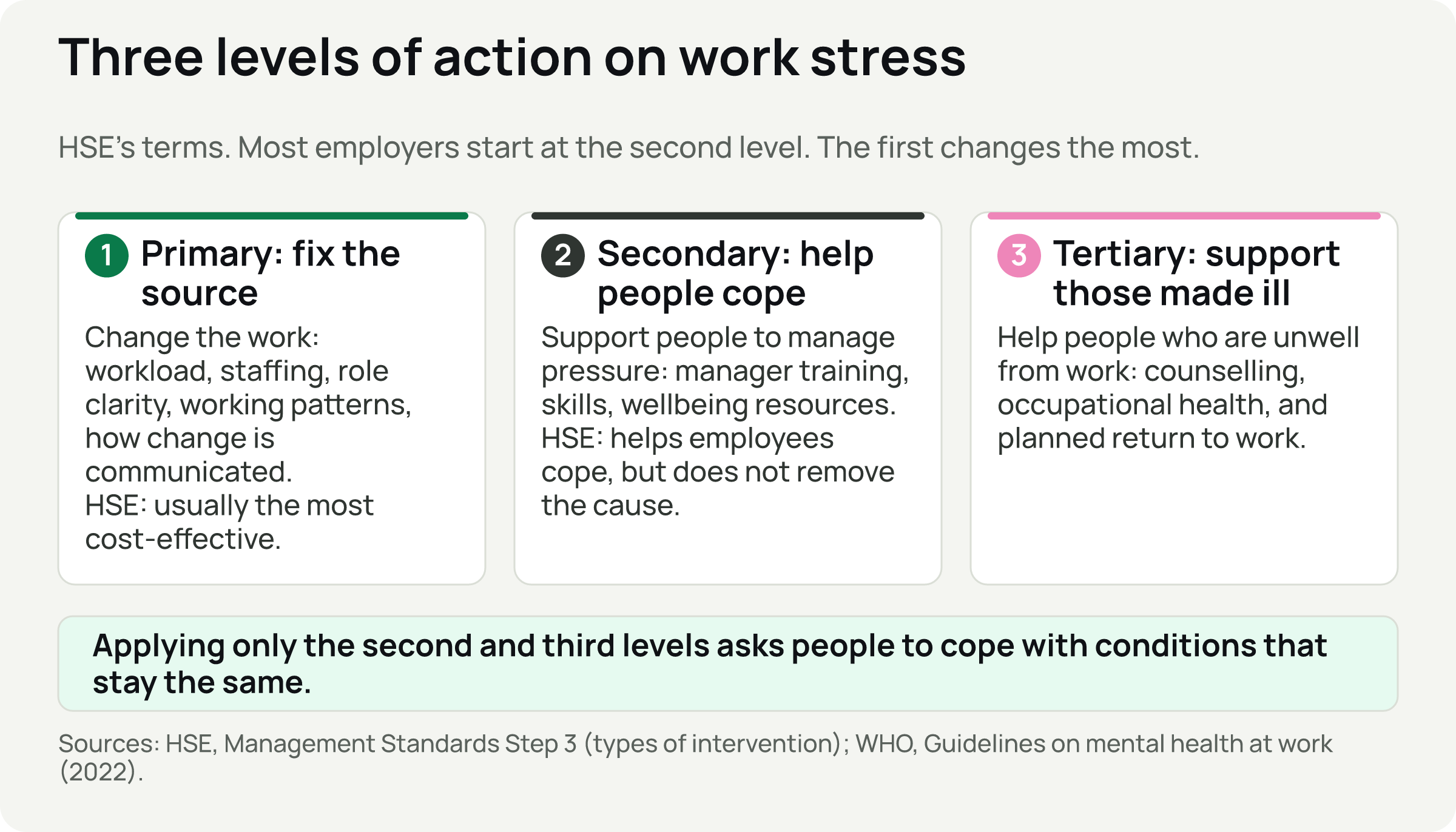
HSE's guidance makes the same distinction in its own words. It describes primary interventions as addressing the source of stress, usually the most cost-effective. Secondary interventions help employees cope but not the cause. Tertiary interventions support employees made ill by work and their return to work. [5]
What are the first steps?
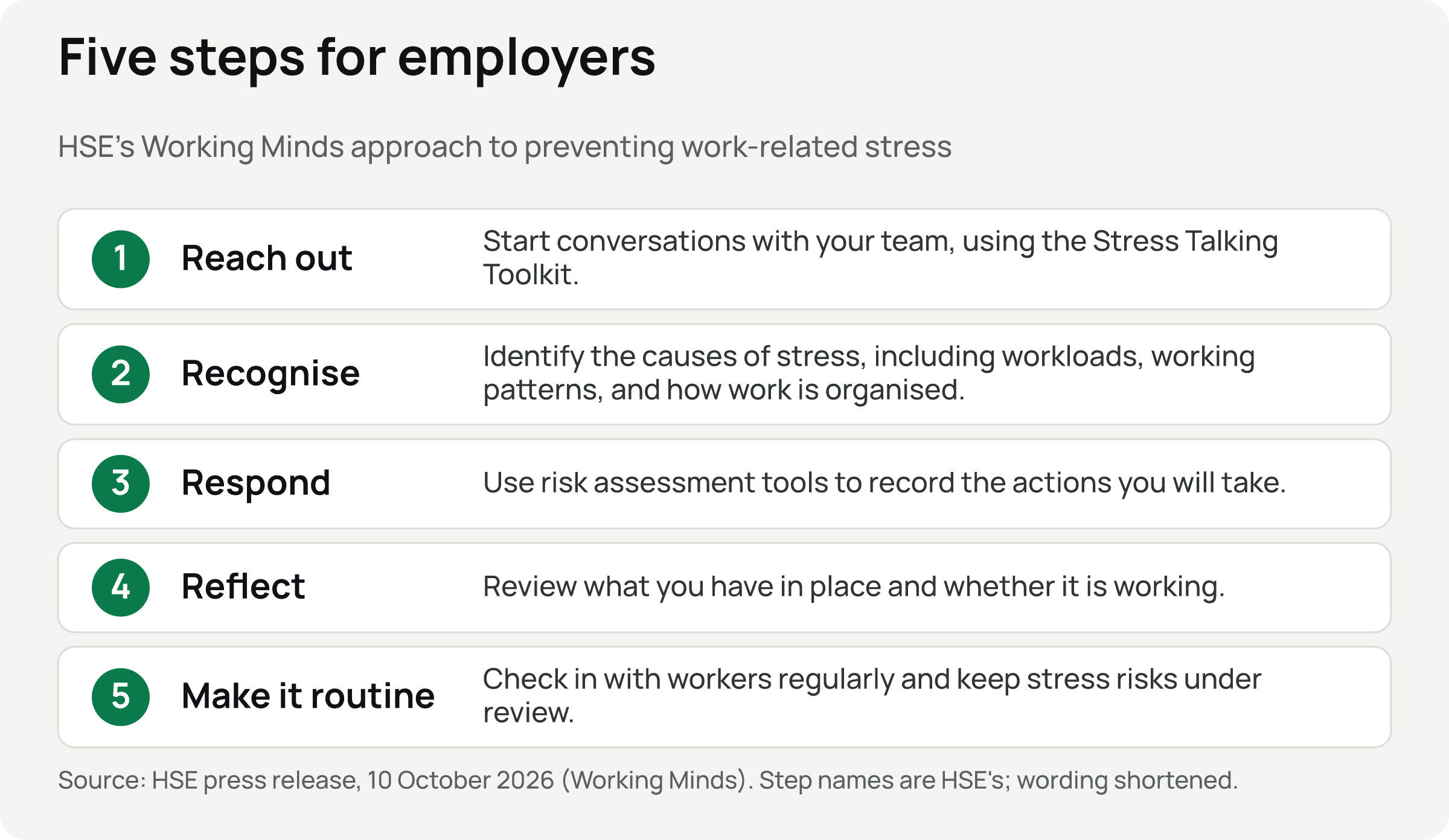
HSE's Working Minds approach gives employers five steps: reach out, recognise, respond, reflect, and make it routine. [9] They are designed to be repeated, not completed once.
How do you find out what is causing it in your organisation?
Ask people, and look at data together. HSE says that data gives only a broad picture, so "if you want to know what is affecting employees, you have to ask them." Its guidance suggests focus groups of about six to ten people, with employees and their representatives involved, structured around the six areas. [5] HSE's Indicator Tool is a 35-item questionnaire mapped to the six areas, and HSE says it should be used alongside other data, not alone. [5]
Pair survey data with what you already hold, such as sickness absence, turnover, grievances, overtime, and exit interviews. HSE lists higher turnover, more sickness absence, more arguments, and more complaints as signs that something may be wrong. [9]
What is the role of line managers?
Managers control much of the day-to-day causes: workload, deadlines, feedback, and flexibility. The WHO recommends training managers to recognise distress, communicate openly, and manage job stressors. [2] HSE offers the Stress Talking Toolkit, which provides structured questions and prompts to help managers talk with workers, with a warning that it should not be used in isolation. [9]
Give managers time as well as training. A manager with an unmanageable load of their own is not in a position to adjust anyone else's.
What should employers avoid?
A few patterns waste effort or cause harm.
- Offering resilience workshops or a meditation app while workload, staffing, and role problems stay the same. HSE calls this secondary action, helping people cope without addressing the cause. [5]
- Using a questionnaire score to judge an individual. Burnout is not a medical condition, and the questionnaires explained on this site describe answers, not diagnoses.
- Collecting data and not acting on it. Share what you found and what you will do, and check back. [9]
- Treating a team's problem as one person's problem. HSE describes signs of stress in teams as well as individuals. [9]
- Promising confidentiality you cannot keep, or asking about health details you do not need.
Is this a legal duty?
Whether it is a legal duty depends where you operate. In Great Britain, HSE states that employers have a legal duty to protect workers from stress at work by doing a risk assessment and acting on it, and that with five or more workers the assessment must be written down. [6] Other countries have their own rules, and you should check them with a local adviser. This article is not legal advice.
Common questions
Do wellbeing programmes reduce burnout?
They can help individuals, but the evidence we checked suggests they work less well than changing the work. In the physician meta-analysis, organisation-directed interventions had larger effects than individual-directed ones. [3] HSE describes help for coping as secondary action. [5]
Should we use a burnout questionnaire with our staff?
Use one only as part of a wider approach, never to judge individuals. HSE says its own Indicator Tool should be used alongside other data. [5] Anonymity, group-level reporting, and a commitment to act are essential, and you need to check data protection rules where you operate.
What is the cheapest thing we can do first?
Start conversations. HSE's first step is to reach out and talk to your team, using free structured prompts. [9] Then act on what you hear, starting with the cause that is easiest to change.
Is burnout covered by employment law?
It varies by country. The WHO classifies burnout as an occupational phenomenon, not a medical condition. [11] Legal duties on work-related stress and on disability adjustments differ, so take local advice.
Keep reading
Sources and further reading
These links open external research and health-information websites.
- WHO: Guidelines on mental health at work (2022)
Publication page: purpose and the six recommendation categories. Published 28 September 2022. Full guideline text not read. - WHO: Mental health at work (fact sheet)
Risk factors, working days lost, and recommendations for organisations. Page dated 15 September 2026 when checked. - Panagioti et al. (2017): Controlled interventions to reduce burnout in physicians. JAMA Internal Medicine, 177(2), 195-205
Systematic review and meta-analysis in physicians. Summary checked on the AHRQ PSNet record; full paper not opened. - HSE: What are the Management Standards?
The six areas of work design that affect stress. - HSE: Management Standards Step 3, evaluate the risks
Primary, secondary, and tertiary interventions; focus groups; the Indicator Tool. - HSE: Work-related stress and how to manage it
Employers' legal duty to assess the risk of stress and act on it. - HSE: Key figures for Great Britain 2024 to 2025
The 964,000 estimate. - HSE: Working days lost in Great Britain
22.1 million days lost in 2024/25. Labour Force Survey estimates based on self-reports. - HSE: Working Minds, World Mental Health Day 2026
The five steps, the Stress Talking Toolkit, and HSE's estimates. - Maslach and Leiter (2016): Understanding the burnout experience. World Psychiatry, 15(2), 103-111
Organisational factors in burnout, and the state of intervention research. - WHO: Burn-out an "occupational phenomenon" (2019)
ICD-11: burn-out is not classified as a medical condition.
This article is educational. It is not a diagnosis or a treatment plan. If stress is affecting sleep, eating, or safety, talk to a GP, an occupational health service, or a local mental health service.