
Guide · For HR and employers
How to run a work stress risk assessment, step by step
HSE's five steps for assessing and acting on work stress, adapted into a plan any HR team or small employer can follow, with a record template to copy.

To assess work stress risks, prepare the organisation, identify the risk factors in six areas of work design, gather data and test it with employees, record the findings and an action plan, then monitor and review. This follows HSE's Management Standards approach in Great Britain, where employers have a legal duty to assess the risk of stress and act on it, and where the assessment must be written down if there are five or more workers. [1] The same logic is useful anywhere, but check local law.
What is a work stress risk assessment?
It is the same idea as any health and safety risk assessment, applied to the way work is designed and managed. HSE says employers have a legal duty to protect workers from stress at work by doing a risk assessment and acting on it, and that stress and its effects on mental and physical health should be assessed like other work-related risks. [1] The Management Standards describe six areas to assess: demands, control, support, relationships, role, and change. [8]
This guide describes the approach so HR teams and small employers can use it. It is not legal advice. Duties differ by country, and in Great Britain you should read HSE's own guidance as well.
What are the steps?
HSE structures the approach as preparation followed by five steps. [2] The list below adds practical detail.
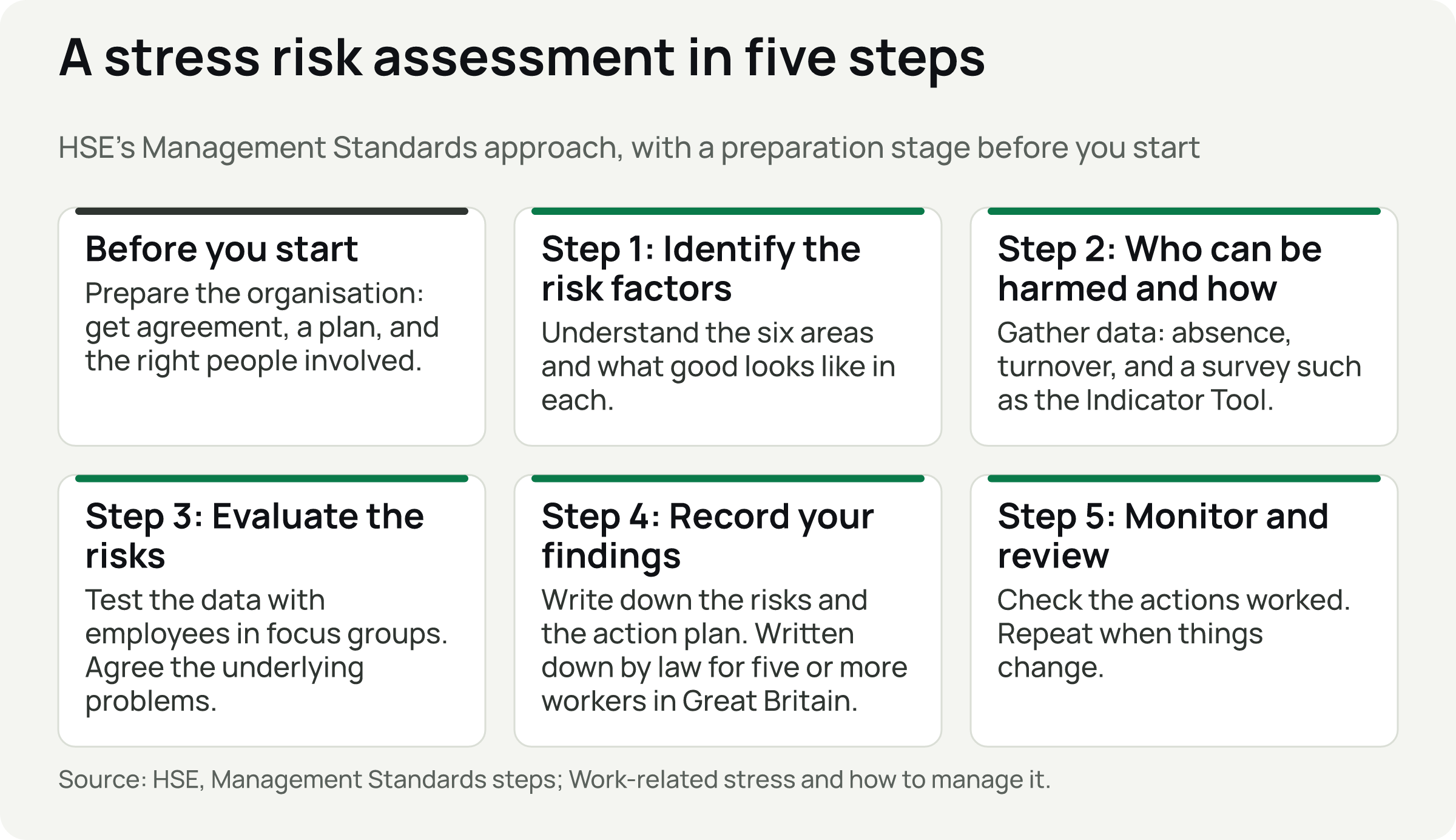
- Prepare the organisation. Get commitment from leaders, name an owner, agree what will be assessed, and tell employees what is happening and why. [2]
- Step 1: Identify the risk factors. Learn what good looks like in each of the six areas, so you know what you are measuring. [2][8]
- Step 2: Work out who can be harmed and how. Gather data: sickness absence, turnover, and a survey such as HSE's Indicator Tool. [2][3]
- Step 3: Evaluate the risks. Test the data with employees in focus groups, and agree the underlying problems and solutions with them. [3]
- Step 4: Record your findings. Write down the significant risks and the decisions, and merge the group action plans into one organisational plan. [1][3]
- Step 5: Monitor and review. Check whether the actions worked, keep people informed, and review when circumstances change. [1][2]
What evidence should you gather?
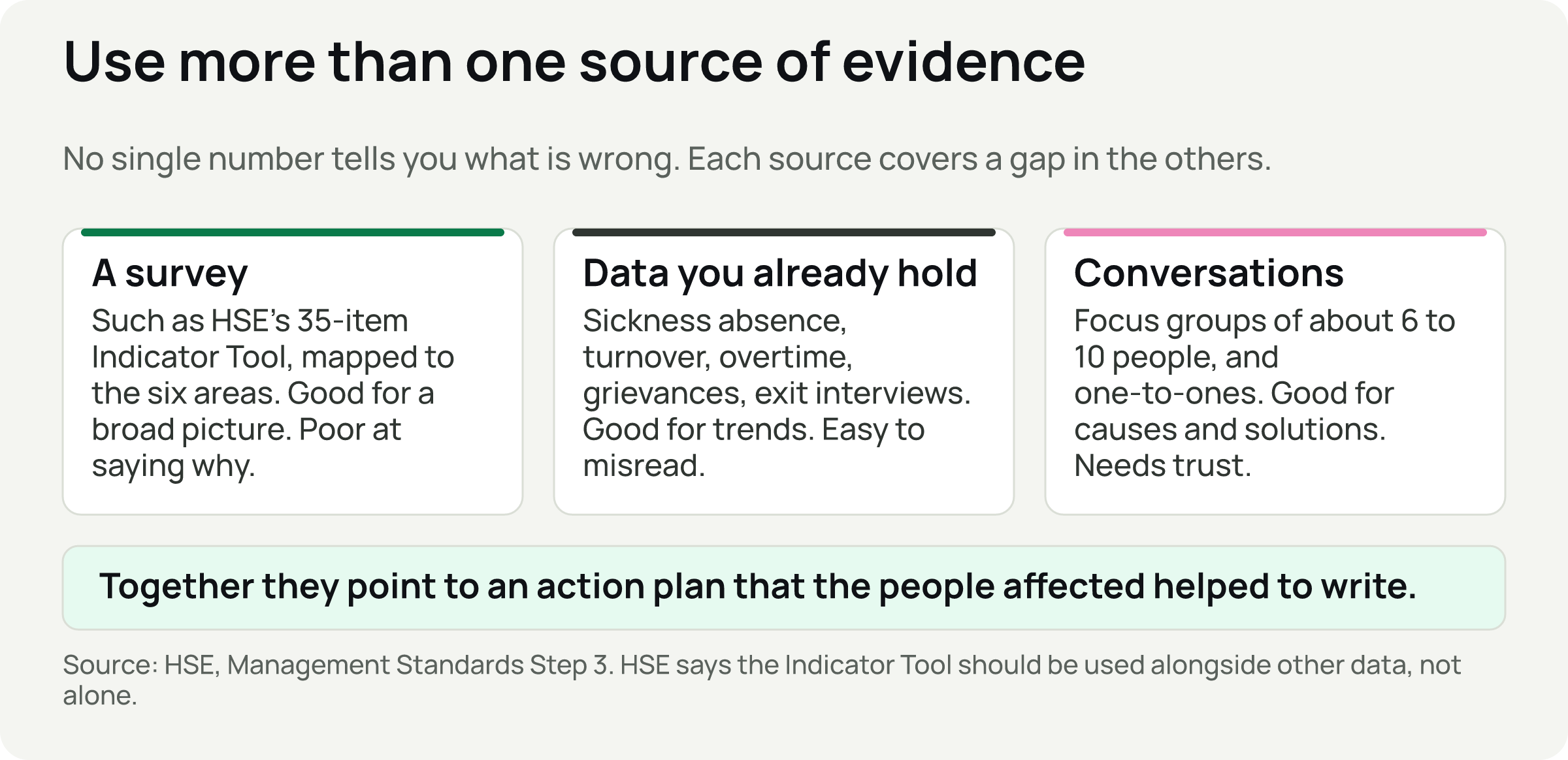
No single number will tell you what is wrong. HSE's Indicator Tool is a 35-item questionnaire mapped to the six areas, and HSE says it should be used alongside other data, not alone. [3] It asks people to reflect on their work over the last six months, using a 1 to 5 scale. [5]
A 2025 review found that the questions within each area give consistent results (alpha above 0.70) and are linked to burnout and distress in cross-sectional studies. It also notes that the UK norms may be outdated and that the tool does not capture role-specific demands. [6]
Pair the survey with data you already hold, and with conversations. HSE lists higher turnover, more sickness absence, more arguments, and more complaints as signs that stress may be a problem in a team. [7]
How do you run the conversations?
HSE says data gives only a broad picture: "If you want to know what is affecting employees, you have to ask them." Focus groups of about six to ten people work best, with employees and their representatives taking part. Structure the discussion around the six areas. Each group produces a preliminary action plan, and these are merged into one in Step 4. Share the outcomes with participants soon afterwards. [3]
HSE also has a free Stress Talking Toolkit with structured prompts for managers, but warns that it should not be used in isolation. [4]
How do you choose actions?
HSE classifies interventions by type: primary, which addresses the source and is usually the most cost-effective; secondary, which helps employees cope but not the cause; and tertiary, which supports employees made ill by work and their return to work. It also classifies them by level, which can be organisation-wide, team or group, or individual, and by timescale, from quick wins to long-term actions. For medium and long-term actions, plan how employees will be kept informed. [3]
| Problem found | Primary action (source) | Secondary or tertiary support |
|---|---|---|
| Workload exceeds capacity in one team | Review staffing and priorities; stop or defer low-value work. | Manager check-ins; EAP access. |
| Unclear roles after a reorganisation | Written role descriptions; a single decision-maker per area. | Coaching for those affected. |
| Change was poorly communicated | A communication plan with dates, a Q&A route, and a named contact. | Drop-in sessions. |
| Friction and conflict in a team | Clear behaviour standards and a route to resolve conflict early. | Mediation. |
What should the record look like?
HSE says the record can be brief, noting the significant risks and the decisions made. In Great Britain, if you have five or more workers you are required by law to write the risk assessment down, and HSE provides a template and example assessments for a small bakery, a financial services firm, and a college. [1] A useful record answers six questions for each risk.
- What is the risk, and in which of the six areas?
- Who is affected, and how do we know?
- What are we already doing?
- What further action will we take, and is it primary, secondary, or tertiary?
- Who owns it, and by when?
- When will we review it, and how will we tell whether it worked?
What mistakes should you avoid?
Avoid these common mistakes:
- Running a survey and not acting on it, or not reporting back.
- Treating a high score for one team as that team's fault.
- Relying only on secondary actions such as wellbeing apps or resilience training. [3]
- Using results to judge individuals, or collecting data that could identify someone.
- Making it a one-off. HSE's approach includes reviewing and making it routine. [4]
What if you are a small employer?
You can start with conversation. With fewer than five workers you do not have to write the assessment down in Great Britain, although doing so helps with later review. [1] A short team discussion around the six areas, a record of what you agreed, and a date to review may be proportionate. Check the rules where you operate.
Where can you find the tools?
We review HSE's Indicator Tool and Talking Toolkit, and explain how LuriaLab's individual questionnaires differ from workplace risk tools. The individual questionnaires on this site describe a person's answers about themselves, and are not substitutes for an organisational assessment.
Common questions
Is this a legal requirement?
In Great Britain, HSE states that employers have a legal duty to protect workers from stress at work by doing a risk assessment and acting on it. [1] Other countries have different laws. Take local advice.
How often should we repeat it?
HSE says to review the assessment if circumstances change, and its Working Minds step "make it routine" means checking in regularly and keeping risks under review. [1][4]
Can we use a burnout questionnaire instead?
Individual burnout questionnaires measure how a person answers. They do not tell you which working conditions to change, and they raise confidentiality issues. HSE's tool maps to work design. A work-design survey plus conversation is a better fit for risk assessment.
Keep reading
Sources and further reading
These links open external research and health-information websites.
- HSE: Work-related stress and how to manage it
Employers' legal duty, the written record requirement for five or more workers, and what to do. - HSE: Management Standards, step overview
The sequence: before you start, steps 1 to 5, and what to do next. - HSE: Management Standards Step 3, evaluate the risks
Focus groups, the Indicator Tool, the Analysis Tool, and types of intervention. - HSE: Working Minds, World Mental Health Day 2026
The five steps and the Stress Talking Toolkit. - HSE: Management Standards Indicator Tool (questionnaire)
The 35 items, response scales, and the six-month instruction. - Houdmont (2025): Questionnaire review: Management Standards Indicator Tool. Occupational Medicine
Narrative review of structure, reliability, validity, and limitations. - HSE: Signs of stress
Signs of stress in individuals and in teams or organisations. - HSE: What are the Management Standards?
The six areas of work design, with HSE's descriptions.
Educational guidance, not clinical, legal, or HR advice. If you need a person, skip the rest of the steps and talk to one.