
Get help
When to get help for work stress, and who can give it
You do not need a crisis, a diagnosis, or a score to ask for help. Here is who can help with which part of the problem, and how to start the conversation.
Ask for help when stress at work is hard to cope with, when what you are trying yourself is not working, or when it is affecting your sleep, health, or relationships. [1] You do not need a diagnosis or a crisis. Different people help with different parts: your manager or HR for workload and conditions, a GP for symptoms and referral, a therapist or counsellor for coping and mood, and emergency services if you may harm yourself. [1][2][3]
How do you know it is time to ask for help?
There is no fixed score or number of bad days. The NHS says to see a GP if you are struggling to cope with stress, if the things you are trying yourself are not helping, or if you would prefer a referral. [1] The US National Institute of Mental Health adds that you should seek professional help when symptoms interfere with everyday life, cause you to avoid activities, or seem always present. [4]
In practice, these are common reasons to act sooner rather than later. You do not need all of them.
- Your sleep has been poor for weeks, or you wake early and cannot get back to sleep.
- You dread work from the moment you wake, or feel nothing about it.
- You are getting ill more often, or have headaches, stomach problems, or muscle tension that will not settle. [1]
- You are drinking, smoking, or using other things more to get through the day. [1]
- You have pulled away from friends or things you enjoy.
- Your work is slipping in ways that are not like you.
- Low mood or loss of interest has lasted most of the day, every day, for more than two weeks. [5]
Who can help with what?
Different routes do different jobs. Looking for one person to fix everything is a common reason people feel stuck.
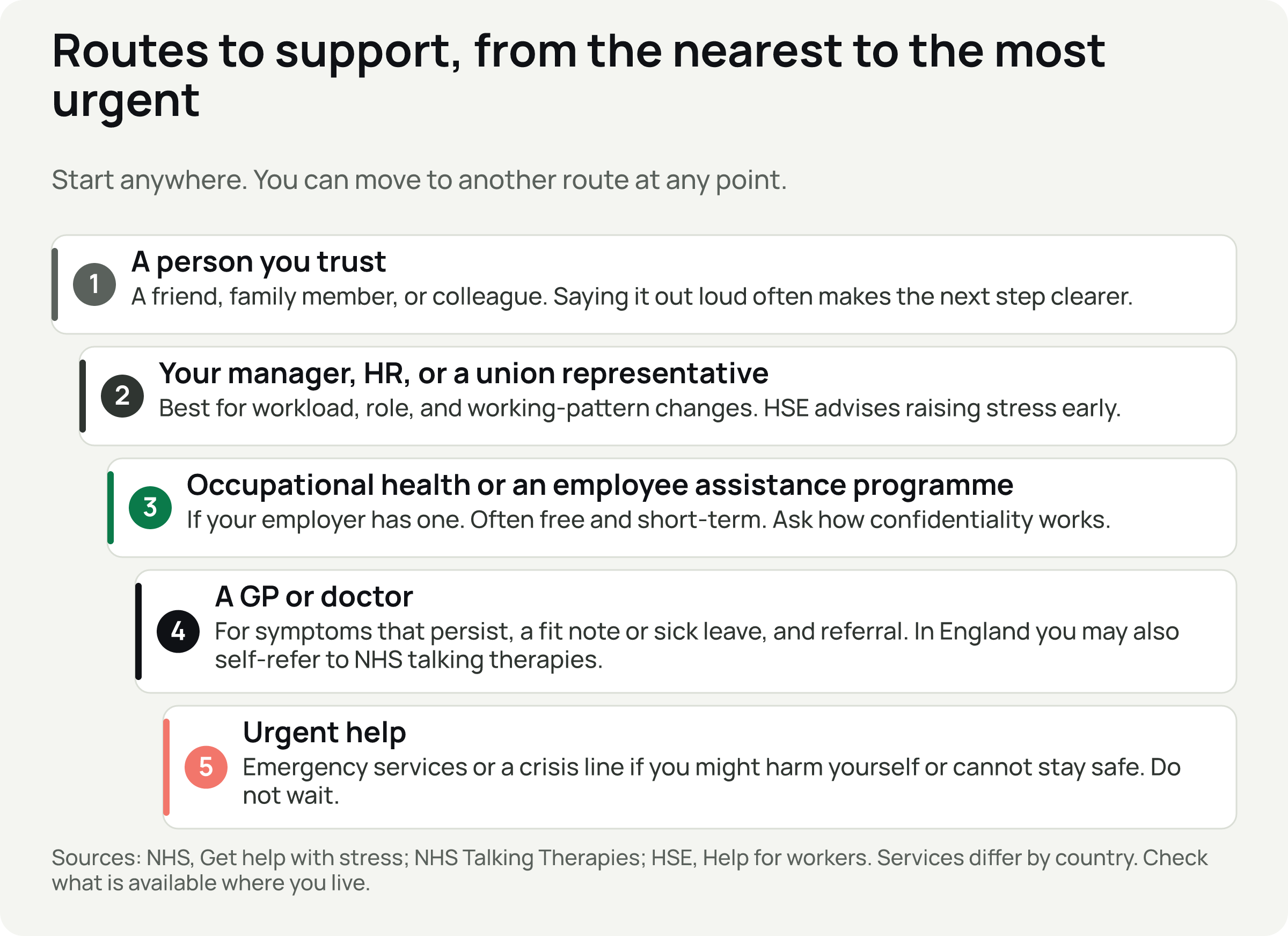
| Who | Good for | Worth knowing |
|---|---|---|
| Your manager | Workload, deadlines, role clarity, working pattern. | HSE advises raising stress early, and being specific about the cause. [3] |
| HR, a union or worker representative | Policies, adjustments, a difficult manager, bullying. | HSE lists these as routes if your line manager is the source of pressure. [3] |
| Occupational health or an employee assistance programme (EAP) | A quick first step, confidential counselling, advice. | Acas notes an employer may offer counselling or mental health support through an EAP. [6] Check what it covers and how confidentiality works. |
| A GP or doctor | Symptoms, health checks, other causes, time off work, referral. | In England, adults can self-refer to NHS talking therapies for anxiety and depression, or 16 and over in some areas. [2] |
| A therapist or counsellor | Coping, mood, anxiety, patterns that keep repeating. | The NHS advises checking a private therapist is registered with a professional body accredited by the Professional Standards Authority. [2] |
| Emergency services or a crisis line | Thoughts of harming yourself, or feeling unsafe. | NHS 111 for urgent help that is not an emergency, 999 for immediate danger, Samaritans on 116 123 in the UK. [1] 988 in the United States. [4] |
How do you start the conversation?
A good first message states a fact, an effect, and a request. You do not need to explain everything or to name a condition.
At work, be specific about what is causing the pressure, so the right help can be found. [3] With a doctor, describe how long it has lasted and what it is affecting.
What might happen when you ask?
Nobody can promise what the response will be, and the first response is not always helpful. Some managers act quickly, some are unsure what to do, and some need a second conversation. If the first person does not help, try another route. HSE says your employer has a legal duty to assess the risks to your health from stress at work, and to share the results with you. [3] That duty is set out for employers in Great Britain.
With a GP, expect questions about your symptoms, sleep, mood, and what has changed. They may suggest self-help, talking therapy, or other steps. [1][2] In England, if you are 18 or over (16 in some areas), you can also refer yourself for NHS talking therapies. [1] Guided self-help may be offered first. [2]
When is it an emergency?
If you are in immediate danger or have seriously harmed yourself, the NHS says to call 999 or go to A&E, not to drive yourself, and to bring any medicines you take. [1] If it is urgent but not an emergency, call NHS 111 or ask for an urgent GP appointment. [1] In the United States, call or text 988. [4] Elsewhere, findahelpline.com lists services by country and language.
If someone comes to you for help
Thank them, listen, and ask what would help. Do not diagnose, and do not promise confidentiality you cannot keep. If you manage them, look at their workload and support too. HSE lists signs of stress in individuals, such as taking more time off, arriving late, mood swings, and losing motivation, and signs in teams, such as more arguments, higher turnover, and more sickness absence. [3]
Common questions
Do I need a diagnosis to ask for help at work?
No. HSE advises talking to someone early, such as your manager, and pointing to the cause of the pressure so the right help can be found. [3] You can describe what is happening and what it affects without naming a condition.
Should I tell my employer I am struggling?
That is your choice. Talking early gives your manager the chance to help and stop things getting worse. [3] If you prefer to start elsewhere, you can begin with a GP, a union representative, or an employee assistance programme.
Are employee assistance programmes really confidential?
Many describe themselves as confidential. The US Office of Personnel Management says information about EAP discussions cannot be disclosed without your permission, with exceptions set by federal regulation. [7] Rules and practice differ by country and provider, so ask yours how it works before you start.
Is stress a reason to see a doctor, or only anxiety and depression?
Stress itself is a reason to see a GP if you are struggling to cope or it is affecting your health. [1] You do not have to reach a particular threshold.
Can I refer myself for therapy?
In England, adults can refer themselves to NHS talking therapies for anxiety and depression, or 16 and over in some areas, if registered with a GP. [2] Other countries work differently. A GP or EAP can explain your options.
Keep reading
Sources and further reading
These links open external research and health-information websites.
- NHS: Get help with stress
Symptoms, when to see a GP, urgent help routes in the UK, and self-referral to NHS talking therapies. - NHS: NHS talking therapies
Who can refer themselves, age requirements, guided self-help, and checking private therapists' registration. - HSE: Help for workers on stress at work
Who to talk to, employers' legal duty to assess stress risks, and what workers can do. - NIMH: I'm so stressed out! Fact sheet
When to seek professional help, and crisis resources in the United States. - NHS: Symptoms of clinical depression
The advice to see a GP if symptoms last most of the day, every day, for more than 2 weeks. - Acas: Getting emotional support
Employer-provided counselling through an employee assistance programme, and other routes. Acas is a UK body. - US Office of Personnel Management: Frequently asked questions
The federal definition of an EAP as voluntary, free, and confidential, with confidentiality of discussions. US federal employees only; shown as an example.
This article is educational. It is not a diagnosis or a treatment plan. If stress is affecting sleep, eating, or safety, talk to a GP, an occupational health service, or a local mental health service.