
Understand
Burnout or depression? How they overlap and how to tell them apart
They share exhaustion, poor sleep, and low motivation. Here is where they overlap, why researchers disagree, and what to do when you cannot tell which it is.
Burnout and depression overlap a great deal, and researchers disagree about how separate they are. Burnout, as the WHO defines it, is an occupational phenomenon tied to work. Depression is a condition that affects mood and interest across life. [1][2] You do not have to decide which one you have before asking for help. If low mood or loss of interest lasts most of the day, every day, for more than two weeks, the NHS advises seeing a GP. [3]
Is it burnout or depression?
Sometimes it is one, sometimes the other, and sometimes both. The WHO describes burn-out as a syndrome resulting from chronic workplace stress that has not been successfully managed, and states that it is not classified as a medical condition. It applies the term to the work context only. [1] Depression is a clinical condition that the NHS describes through persistent low mood, loss of interest, and effects on sleep, energy, and daily life. [3]
Maslach and Leiter, two of the leading burnout researchers, describe burnout as job-related and situation-specific, and depression as general and not tied to one context. They also note a close link: a longitudinal study they discuss found that burnout can lead on to depression. [2] Other researchers go further. A review by Bianchi, Schonfeld, and Laurent covered 92 studies and concluded that the distinction between the two is conceptually fragile. [5]
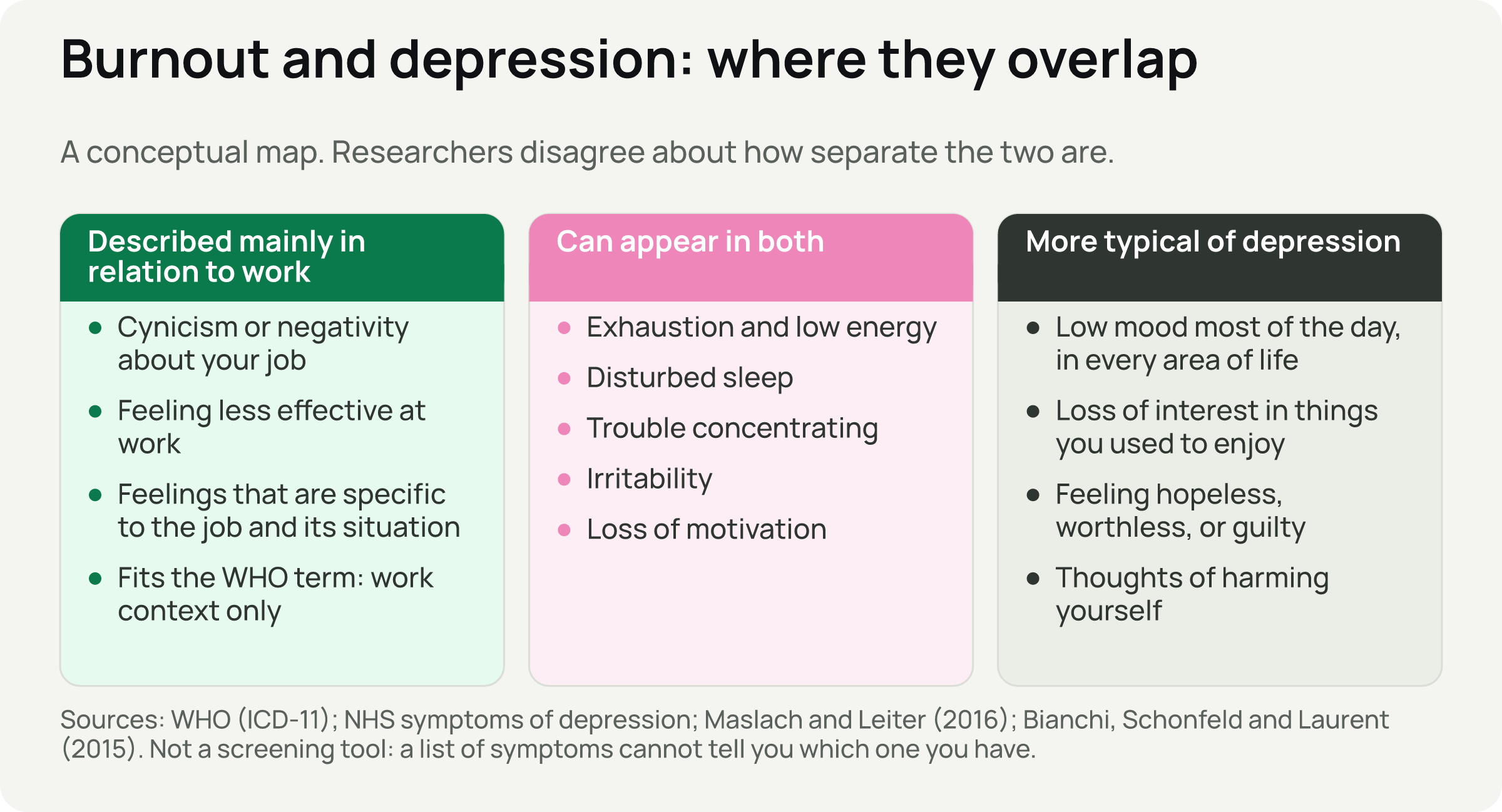
What this means for you: the line is blurry even for experts, so the useful question is not "which label fits?" but "how bad is it, how long has it lasted, and where does it show up?"
What do burnout and depression have in common?
Both can bring exhaustion and low energy. The NHS lists lack of energy, disturbed sleep, irritability, loss of motivation, and difficulty making decisions among the signs of depression, and it lists difficulty concentrating, feeling overwhelmed, and changes in sleep among the signs of stress. [3][4] Because the symptoms overlap, you cannot reliably sort them yourself by ticking items from a list.
That overlap is also why a questionnaire cannot settle the matter. Even Maslach and Leiter point out that some research arguing the two are indistinguishable relied on measures that overlap heavily in how they ask about fatigue. [2]
How are they different?
These are tendencies, not rules. Treat the table as a set of prompts for a conversation with a professional.
| Question | More often with burnout | More often with depression |
|---|---|---|
| Where does it show up? | Mainly in relation to work: dread, cynicism, feeling ineffective in the job. [1][2] | Across life: low mood most of the day, loss of interest in things you used to enjoy. [3] |
| How does the mood feel? | Detached, irritated, or resigned about work. [1] | Persistent sadness or hopelessness, tearfulness, guilt, low self-esteem. [3] |
| What happens away from work? | Burnout is described as specific to the job situation, so what changes at work matters a great deal. [2] | The low mood and loss of interest usually go with you. [3] |
| What is the main fix? | Changing the conditions of work, with support for you. [2] | Decided with a doctor. Talking therapies are one option, and in England adults can often refer themselves. [6] |
What questions help you work it out?
Instead of trying to name the condition, collect facts that make a conversation with a doctor or counsellor easier. Write answers down if that helps. These are prompts, not a scored test.
- How long has this lasted? The NHS says to see a GP if symptoms are present for most of the day, every day, for more than two weeks. [3]
- Does it ease on holiday or at weekends, or does it come with you?
- Are you still enjoying things outside work, such as friends, hobbies, or food?
- What has changed at work in the last year: workload, team, manager, role, reward?
- How are your sleep, appetite, and concentration compared with your normal?
- Have you had any thoughts of harming yourself, or that life is not worth living?
Who should you see first?
For most people the first stop is a GP or doctor. They can look at your symptoms, your sleep, your general health, and your work together, and consider other causes. In England, adults can also refer themselves to NHS talking therapies for anxiety and depression without seeing a GP. [6] If your employer has occupational health or an employee assistance programme, that can be a faster first step.
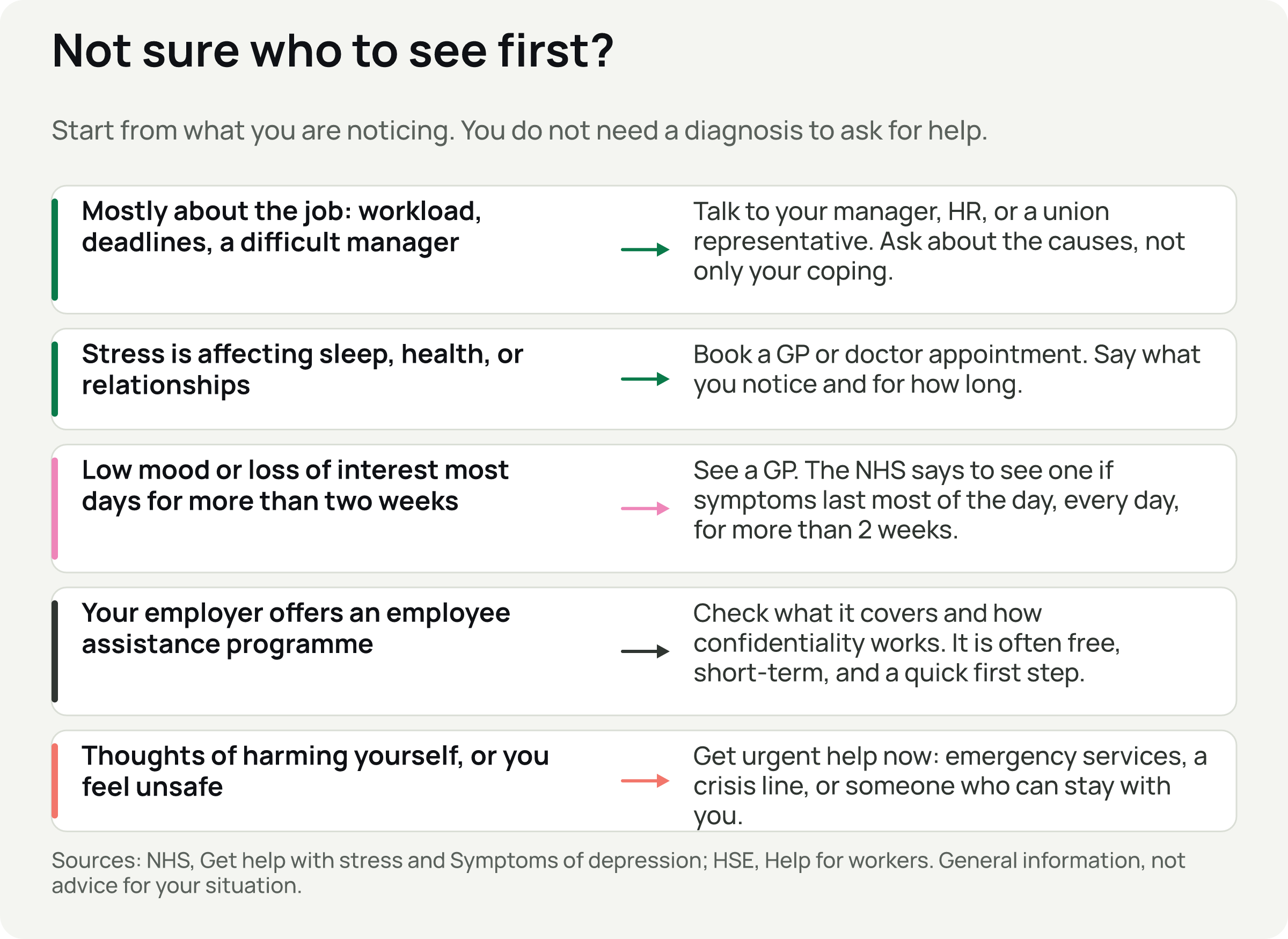
If the cause is clearly the job, such as an unmanageable workload, you will usually need both: support for you, and a conversation at work about what has to change. HSE advises talking to your manager early, or to HR, a union representative, or a counselling service if the manager is the source of pressure. [7]
When do you need help urgently?
Thoughts of harming yourself need urgent attention, whether the cause is burnout, depression, or something else. In the UK, the NHS says to call 999 or go to A&E for immediate danger, or call NHS 111 for urgent help that is not an emergency. Samaritans are on 116 123. [4] In the United States, you can call or text 988. [8] Elsewhere, findahelpline.com lists services by country.
If you manage someone who seems to be struggling
You are not there to work out whether it is burnout or depression, and you should not guess. Ask what is going on, listen, look at the workload and support around them, and point them to the support that exists. HSE lists withdrawal, loss of motivation, more time off, and mood swings among the signs of stress at work. [7] Our guide on supporting a colleague who may be burned out has wording you can adapt.
Common questions
Is burnout just depression with a different name?
Researchers disagree. A 2015 review of 92 studies argued that the distinction is conceptually fragile. [5] Others argue they are not the same illness and that burnout is tied to the job. [2] In practice, the label matters less than what you are experiencing and how long it has lasted.
Can burnout lead to depression?
It can be linked. Maslach and Leiter describe a longitudinal study in which burnout fully mediated the path from workplace strain to depression. [2] That is one study among many, and it does not mean burnout always leads to depression, but it is a reason to take persistent symptoms seriously.
Can I have burnout and depression at the same time?
Yes, it is possible to have both. If you think that may be the case, tell a doctor about the work side and the mood side together. [2]
Will a burnout test tell me which one I have?
No. A questionnaire records your answers. It cannot tell burnout from depression, and the symptom overlap is part of why. The Oldenburg Burnout Inventory and the DASS-21 are explained on this site, with their limits.
Should I tell my employer it is depression?
That is your decision, and you do not have to share a diagnosis to ask for changes. HSE says talking early about the pressure and its cause helps the right help be found. [7] You can describe the work factors and the effects on you without naming a condition.
Keep reading
Sources and further reading
These links open external research and health-information websites.
- World Health Organization: Burn-out an "occupational phenomenon" (2019)
The ICD-11 definition, and the statements that it is not classified as a medical condition and refers to the work context only. - Maslach and Leiter (2016): Understanding the burnout experience. World Psychiatry, 15(2), 103-111
Discusses how burnout and depression relate, including the longitudinal link and criticism of measures that overlap on fatigue. - NHS: Symptoms of clinical depression
Psychological, physical, and social symptoms, and the advice to see a GP if they last most of the day, every day, for more than 2 weeks. - NHS: Get help with stress
Symptoms of stress, and urgent help routes in the UK, including NHS 111, 999, and Samaritans. - Bianchi, Schonfeld, and Laurent (2015): Burnout-depression overlap: A review. Clinical Psychology Review, 36, 28-41
A review of 92 studies concluding the distinction is conceptually fragile. Abstract-level details checked through repository copies; full text not opened. - NHS: NHS talking therapies
Who can refer themselves for talking therapies for anxiety and depression in England, and age requirements. - HSE: Help for workers on stress at work
Who to talk to at work, and the signs of stress HSE lists for individuals. - NIMH: I'm so stressed out! Fact sheet
Crisis resources in the United States, including the 988 Suicide & Crisis Lifeline.
This article is educational. It is not a diagnosis or a treatment plan. If stress is affecting sleep, eating, or safety, talk to a GP, an occupational health service, or a local mental health service.