
DASS-21 (Depression Anxiety Stress Scales): a free mood and stress questionnaire explained
The DASS-21 is a 21-statement questionnaire with three scales, depression, anxiety, and stress, each with seven statements about how much each applied to you over the past week. [1][2] Each scale gets its own score, and the scores are doubled before they are compared with severity labels. [3][5] Its developers state that it is not a diagnostic instrument. [3]
What are the Depression Anxiety Stress Scales?
The DASS was developed by Sydney and Peter Lovibond in 1995 as a 42-item measure of three negative emotional states. The DASS-21 is its short form, with seven items per scale. [2][6] You rate each statement from 0 to 3, depending on how much it applied to you over the past week. [4]
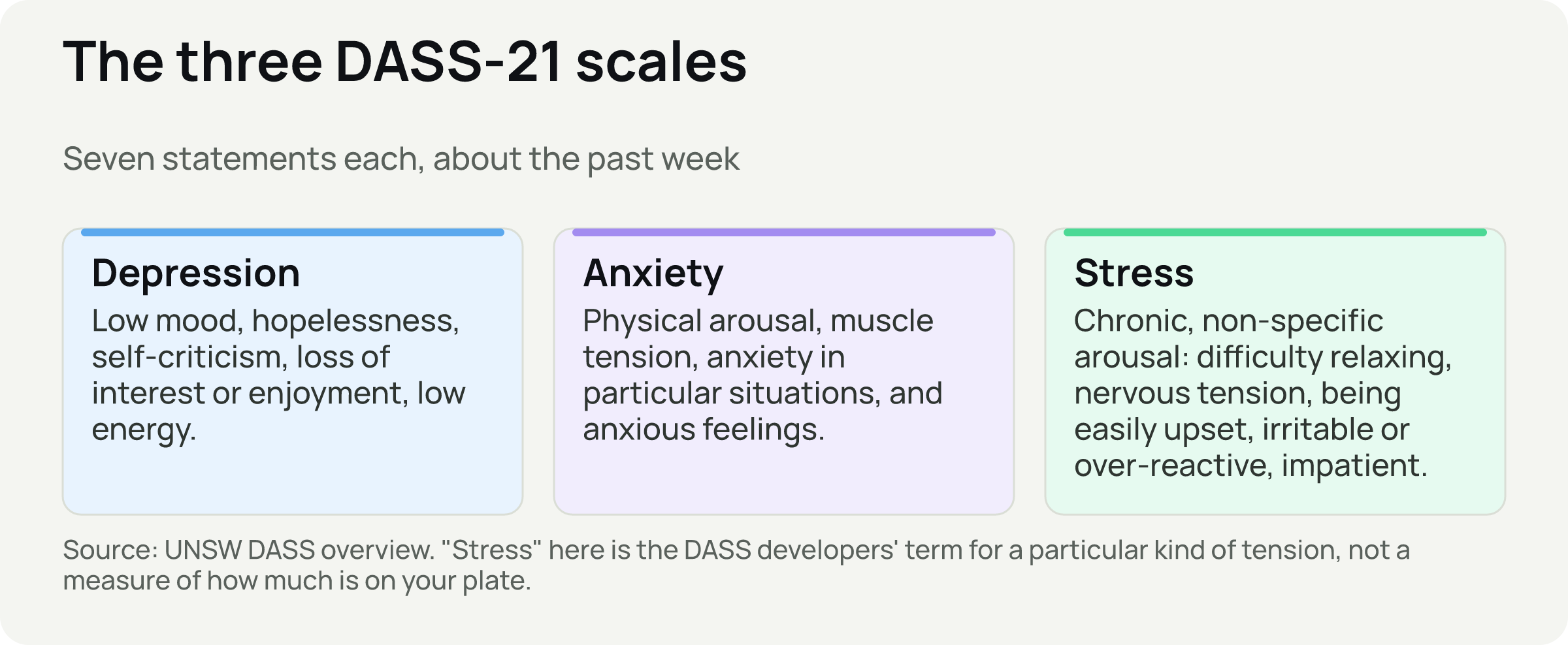
The three scales cover:
- Depression: low mood, hopelessness, self-criticism, loss of interest or enjoyment, and low energy.
- Anxiety: physical arousal, muscle tension, anxiety in particular situations, and anxious feelings.
- Stress: chronic, non-specific arousal, such as difficulty relaxing, nervous tension, being easily upset, irritability, and impatience. [2]
Can I use the DASS-21 for stress at work?
You can use the DASS-21 for stress at work, with care. The developers say that "occupational stress" is a broad term that probably involves all three DASS syndromes, so all three scales are usually relevant to assessing stress in that wider sense. [3] That fits what many people find: stress at work shows up as tension, worry, and sometimes low mood together.
But it does not ask about work, and it covers only the past week, so one week at a deadline can look worse than the month. It cannot tell you whether work is the cause. For burnout at work, the OLBI fits better. For how far the problem is reaching into life, the WSAS.
What can I find in these DASS-21 explainers?
If you already have a result, start with scoring or understanding results. If you are deciding whether to take it, start with what it measures.
Where do I take the DASS-21 online?
JobStressCheck explains questionnaires and does not host them. The link opens LuriaLab in a new tab. LuriaLab lists the DASS-21 for ages 17 and over, at about 3 minutes, and says it shows separate scores and severity bands for each scale. [1] Check its privacy policy first.
Do I need a score before I ask for support?
No. The NHS says to see a GP if you are struggling to cope with stress or what you are trying yourself is not helping. [7]
Common questions
How long does the DASS-21 take, and is it free?
LuriaLab lists it at about 3 minutes and free, for ages 17 and over. [1]
What is the difference between the DASS-21 and the DASS-42?
The DASS-21 is the short form, with seven items per scale. The developers say the full DASS gives somewhat more reliable scores and takes about twice as long. [3]
Sources and further reading
These links open external research and health-information websites.
- LuriaLab: DASS-21 test page
Twenty-one items, seven per subscale, past week, 0 to 3 scale, scoring statement, age 17+, and disclaimers. Read on 24 October 2026. - UNSW Psychology Foundation: Overview of the DASS
What the three scales cover, the 4-point rating, the past-week time frame, and the dimensional model. Read on 24 October 2026. - UNSW Psychology Foundation: DASS frequently asked questions
DASS-21 versus the full DASS, multiplying by 2, what the severity labels mean, that the DASS is not diagnostic, occupational stress, and age. Read on 24 October 2026. - DASS-21 response form (P. F. Lovibond, UNSW)
The 21 statements, the 0 to 3 labels, and the past-week instruction. - University of Bristol: DASS-21 scoring and interpretation
The sum-and-double instruction, the severity table, and the statement that the DASS is not a clinical instrument and cannot diagnose. - Henry and Crawford (2005): The short-form version of the Depression Anxiety Stress Scales (DASS-21): construct validity and normative data in a large non-clinical sample. British Journal of Clinical Psychology, 44, 227-239
A UK general-population sample of 1,794 adults. Full text read. - NHS: Get help with stress
Signs of stress, when to see a GP, urgent help routes in the UK, and self-referral to NHS talking therapies.
This page is educational. A questionnaire score cannot establish a diagnosis or explain the cause of your symptoms. If you are struggling, speak with a doctor or mental health professional, whatever your score. Read when to get help for work stress or find a helpline in your country.