
Understand
What is burnout? Signs, causes, and how it differs from stress
How the WHO defines burnout, the three signs to look for, how it differs from a stressful week, and what at work tends to cause it.
Burnout is the World Health Organization's term for a syndrome that results from chronic workplace stress that has not been successfully managed. It has three parts: exhaustion, mental distance from your job, and feeling less effective at work. [1] It is classed as an occupational phenomenon, not a medical condition, but it is real, and research links it closely to how work is organised, not only to how well you cope. [1][2]
How does the WHO define burnout?
The WHO's International Classification of Diseases (ICD-11) describes burn-out as "a syndrome conceptualized as resulting from chronic workplace stress that has not been successfully managed." It lists three dimensions: feelings of energy depletion or exhaustion; increased mental distance from your job, or negative or cynical feelings about it; and reduced professional efficacy. [1]
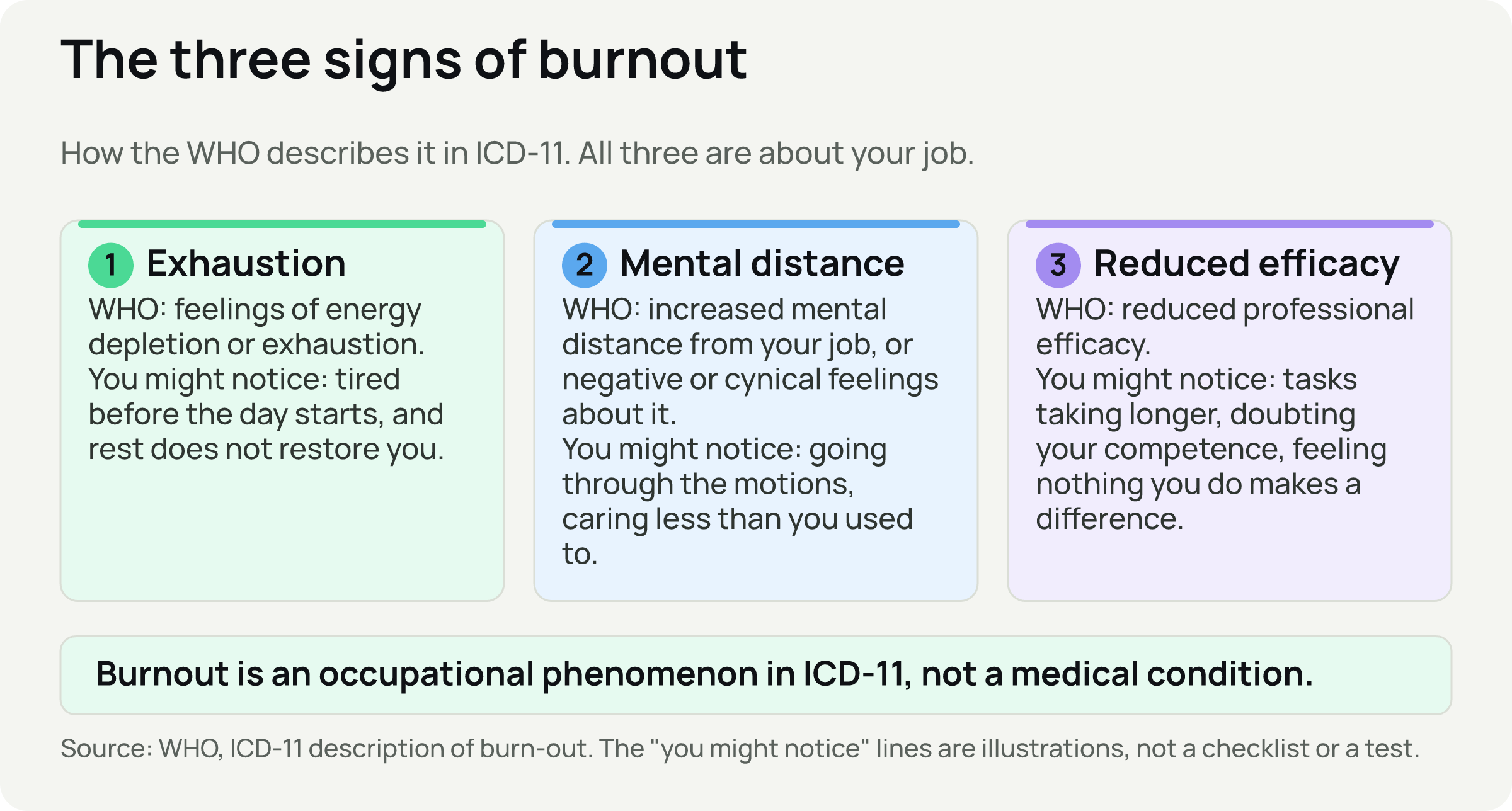
Two details matter. First, burnout is classified as an occupational phenomenon, and the WHO states it is not classified as a medical condition. It sits in the ICD chapter on factors influencing health status or contact with health services. [1] Second, the WHO says the term should not be used to describe experiences in other areas of life. [1]
None of that makes burnout less real, and it does not mean you cannot get support. It means the label describes the relationship between a person and their work. Because exhaustion also appears in depression, anxiety, and physical illness, it is worth speaking to a doctor if you are unsure what is behind it. [2][3]
What does burnout look like day to day?
The researchers Christina Maslach and Michael Leiter describe the same three parts: overwhelming exhaustion, a detached or negative attitude to the job, and a sense of ineffectiveness and lack of accomplishment. [2] Not everyone has all three, and the mix can change over time. These examples are prompts for reflection, not a checklist.
| Part of burnout | What you might notice at work | What you might notice outside work |
|---|---|---|
| Exhaustion | Starting the day already drained. Needing a long time to recover from a normal task. | Needing the whole weekend to recover. Nothing left for friends, family, or hobbies. |
| Mental distance | Going through the motions. Irritation with colleagues or customers. Caring less than you used to. | Dreading Monday. Talking about work in a negative way. |
| Reduced efficacy | Tasks taking longer. Doubting your competence. Feeling nothing you do makes a difference. | Carrying a sense of failure home with you. |
Is it stress or burnout?
Stress is the body's and mind's response to pressure. It can show up as tension, headaches, worry, trouble concentrating, or feeling overwhelmed. [3] The US National Institute of Mental Health notes that stress generally goes away once the situation is resolved. [4] Burnout, in the WHO's words, results from workplace stress that has not been successfully managed over time. [1]
In practice the two overlap, and you do not need to settle the label before acting. The comparison below is a rule of thumb, not a test.

What causes burnout?
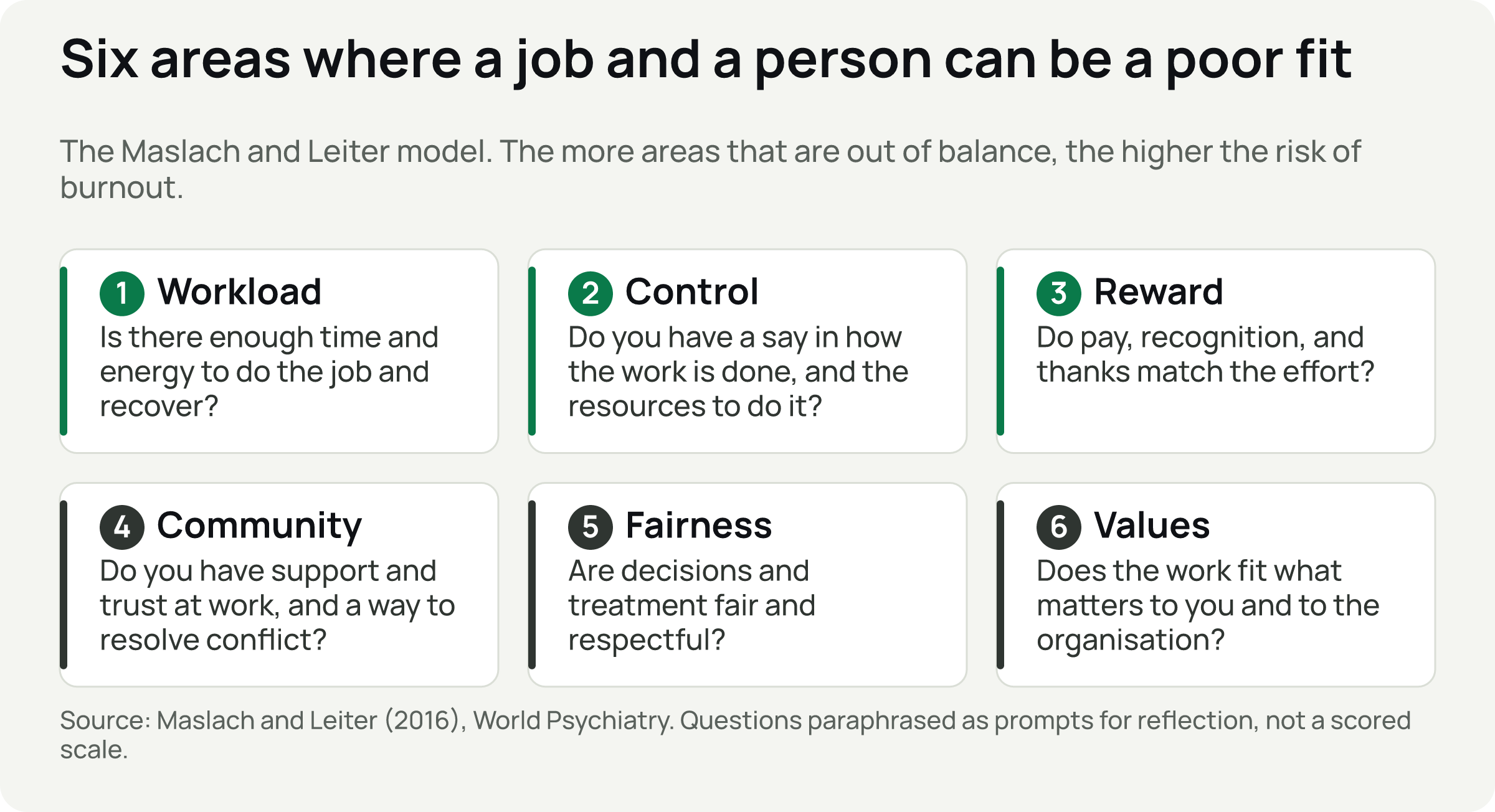
Burnout research points at the job as much as the person. Maslach and Leiter describe six areas of working life where a poor fit between a person and their job is linked to burnout. [2] In plain terms, they are:
- Workload: chronic overload with no time to recover.
- Control: a lack of influence over decisions or the resources you need.
- Reward: too little financial, institutional, or social recognition.
- Community: poor relationships, low support, or unresolved conflict.
- Fairness: perceived unfairness in decisions or treatment.
- Values: a gap between your values and the organisation's. [2]
A second influential model, the job demands-resources model, separates the demands of a job, such as workload and time pressure, from the resources that help you meet them, such as support, feedback, and a say in how the work is done. In the original study of 374 workers, demands were linked mainly to exhaustion and missing resources mainly to disengagement. [5]
Maslach and Leiter cite extensive evidence that organisational factors drive burnout, and argue it should be seen partly as a feature of workgroups rather than only an individual problem. [2] Our article on what causes stress at work goes through the main areas one by one.
How common is work-related stress?
There is no single agreed count of burnout, because there is no agreed way to measure it. The figures below are for the wider problem of work-related stress, depression, and anxiety. They are not burnout counts, and the Great Britain figures come from a self-reported survey. [6][7]
What helps if this sounds familiar?
Maslach and Leiter list both individual and organisational approaches. Individual ones include changing work patterns, building coping skills, seeking social support, and relaxation and fitness. Organisational ones include moderating workload, improving civility, increasing recognition, and job crafting. They also note that few of these have been rigorously evaluated. [2] So treat the steps below as sensible starting points, not proven cures.
- Name the pattern. Which of the three parts, exhaustion, distance, or reduced efficacy, is loudest right now?
- Check the six areas. Which one is furthest out of balance? That is usually where a change will matter most.
- Make one small change this week, such as a real lunch break or a fixed finishing time. Our guide on switching off after work has a ten-minute routine.
- Have one conversation. Workload problems need a conversation about priorities, not more willpower. Our guide on talking to your manager has scripts.
- If sleep, mood, or health are slipping, speak to a GP or doctor. You do not need to wait for a crisis.
If you manage people or run an organisation
Because the research points at workload, control, reward, community, fairness, and values, the most effective responses often sit with the employer. The WHO's guidelines on mental health at work recommend organisational interventions that assess and reduce workplace risks, and training for managers to recognise distress and manage job stressors. [8]
Common questions
Is burnout a mental illness?
No. In ICD-11 burn-out is an occupational phenomenon and is not classified as a medical condition. [1] It can still affect health and daily life, and it can overlap with conditions that do need treatment, such as depression. If you are struggling, speak to a doctor. [2]
Can you get burnout from a job you love?
Yes, it is possible. In the research models, burnout follows from the conditions of work, such as workload, control, and support, not from how much you like the work. [2][5] Enjoying the content of a job does not remove the effect of an unsustainable load.
How long does burnout last?
There is no reliable timeline. How long it lasts depends on the person and on whether the conditions that caused it change. Be wary of any source that promises a fixed recovery time. [2]
Can an online test diagnose burnout?
No. Questionnaires such as the Oldenburg Burnout Inventory describe how you answered. They cannot diagnose burnout, depression, or any other condition, and there are no agreed diagnostic cut-offs for the OLBI. Read the explainer before you take one.
What is the difference between burnout and just being tired?
Tiredness usually responds to sleep and rest. Burnout, as the WHO describes it, also involves mental distance from your job and feeling less effective, not only exhaustion. [1] If tiredness lasts and rest does not help, tell a doctor, because there are many possible causes. [3]
Keep reading
Sources and further reading
These links open external research and health-information websites.
- World Health Organization: Burn-out an "occupational phenomenon" (2019)
The ICD-11 definition, the three dimensions, and the statement that it is not classified as a medical condition. - Maslach and Leiter (2016): Understanding the burnout experience. World Psychiatry, 15(2), 103-111
Review of the research: three dimensions, six areas of worklife, individual and organisational interventions, and how burnout differs from depression. - NHS: Get help with stress
Common physical, mental, and behavioural signs of stress, and when to see a GP. - NIMH: I'm so stressed out! Fact sheet
Stress as a response to an external cause that generally goes away once the situation is resolved, and when to seek professional help. - Demerouti, Bakker, Nachreiner, and Schaufeli (2001): The job demands-resources model of burnout. Journal of Applied Psychology, 86(3), 499-512
Original study of 374 workers. Abstract-level details checked through publisher and repository listings; full text not opened. - HSE: Key figures for Great Britain 2024 to 2025
The 964,000 estimate of workers with work-related stress, depression or anxiety. - HSE: Working days lost in Great Britain
22.1 million days lost to stress, depression or anxiety in 2024/25. Labour Force Survey estimates based on self-reported ill health. - WHO: Mental health at work (fact sheet)
Global working days lost, risk factors for mental health at work, and recommendations for organisations. Page dated 15 September 2026 when checked.
This article is educational. It is not a diagnosis or a treatment plan. If stress is affecting sleep, eating, or safety, talk to a GP, an occupational health service, or a local mental health service.