
Understand
What causes stress at work? Six areas to check
Work stress is rarely about one thing. Six areas of work design explain most of it, and checking them tells you what to change, not only how to cope.
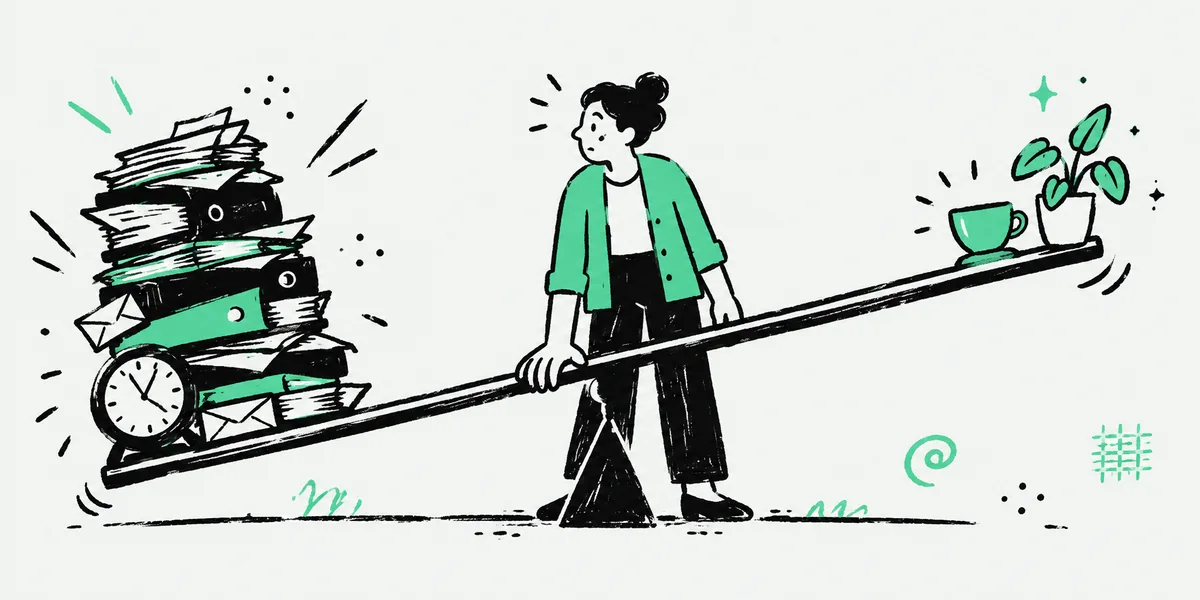
Work-related stress is usually caused by how work is designed and managed, not by a weakness in the person doing it. The UK Health and Safety Executive groups the causes into six areas: demands, control, support, relationships, role, and change. [1] The WHO lists the same kinds of risk: heavy workloads, little control, poor support, unclear roles, long hours, and conflict between home and work. [2] Checking each area tells you what to ask for, not just how to cope.
What are the main causes of stress at work?
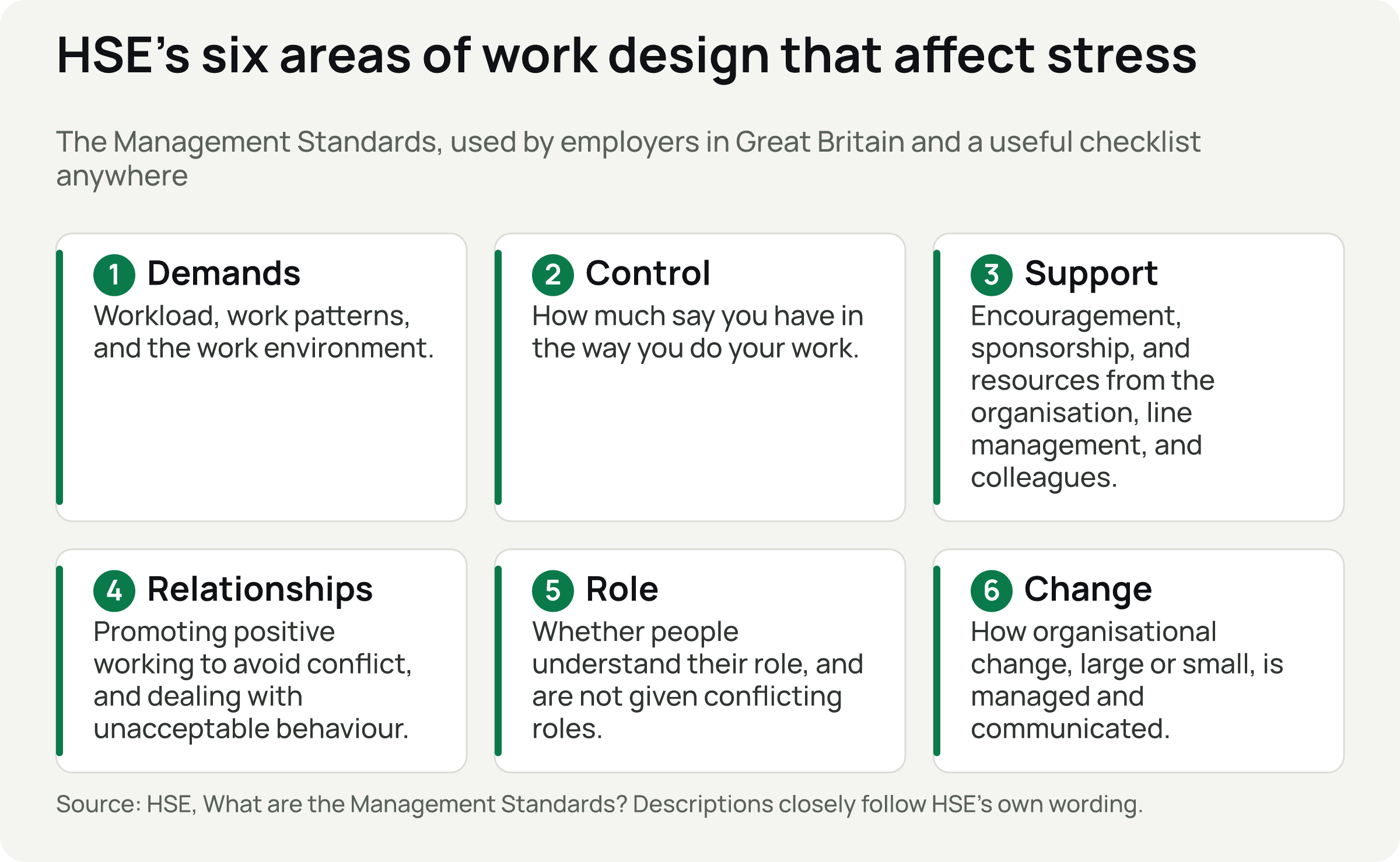
HSE's Management Standards describe six areas of work design that affect stress. [1]
- Demands: workload, work patterns, and the work environment.
- Control: how much say you have in how you do your work.
- Support: the encouragement and resources from your organisation, manager, and colleagues.
- Relationships: positive working, and dealing with unacceptable behaviour.
- Role: whether you understand your role and are not given conflicting ones.
- Change: how organisational change, large or small, is managed and communicated.
The WHO's list of risks to mental health at work covers the same ground, and adds some specifics: underusing your skills or lacking the skills a job needs, understaffing, long or inflexible hours, unsafe conditions, harassment and bullying, discrimination, job insecurity, low pay, and conflict between home and work demands. [2]
Which everyday problems belong to which area?
Most of what people describe as "just how my job is" lands in one of the six areas. Use the table to name the problem more precisely, because a precise problem is easier to raise with a manager.
| What you might say | HSE area | What to ask for |
|---|---|---|
| "There is more work than hours." | Demands | A conversation about priorities, deadlines, or staffing. [1] |
| "I am told what to do and not allowed to decide how." | Control | A say in how and when you do tasks. [1] |
| "Nobody has my back when it gets difficult." | Support | Regular one-to-ones, clear routes for help, feedback. [1] |
| "There is constant friction in the team." | Relationships | Action on conflict and unacceptable behaviour. [1] |
| "I do not know what I am accountable for, or two bosses disagree." | Role | A written description of your role and who decides what. [1] |
| "Everything changed and nobody explained why." | Change | Clear, early communication about changes and what they mean for you. [1] |
Why do demands and resources matter differently?
The job demands-resources model separates two things. Demands are the parts of a job that cost effort, such as workload and time pressure. Resources are the parts that help you cope or grow, such as support, feedback, and autonomy. In the original study of 374 workers in human services, industry, and transport, demands were linked mainly to exhaustion and missing resources mainly to disengagement. [3]
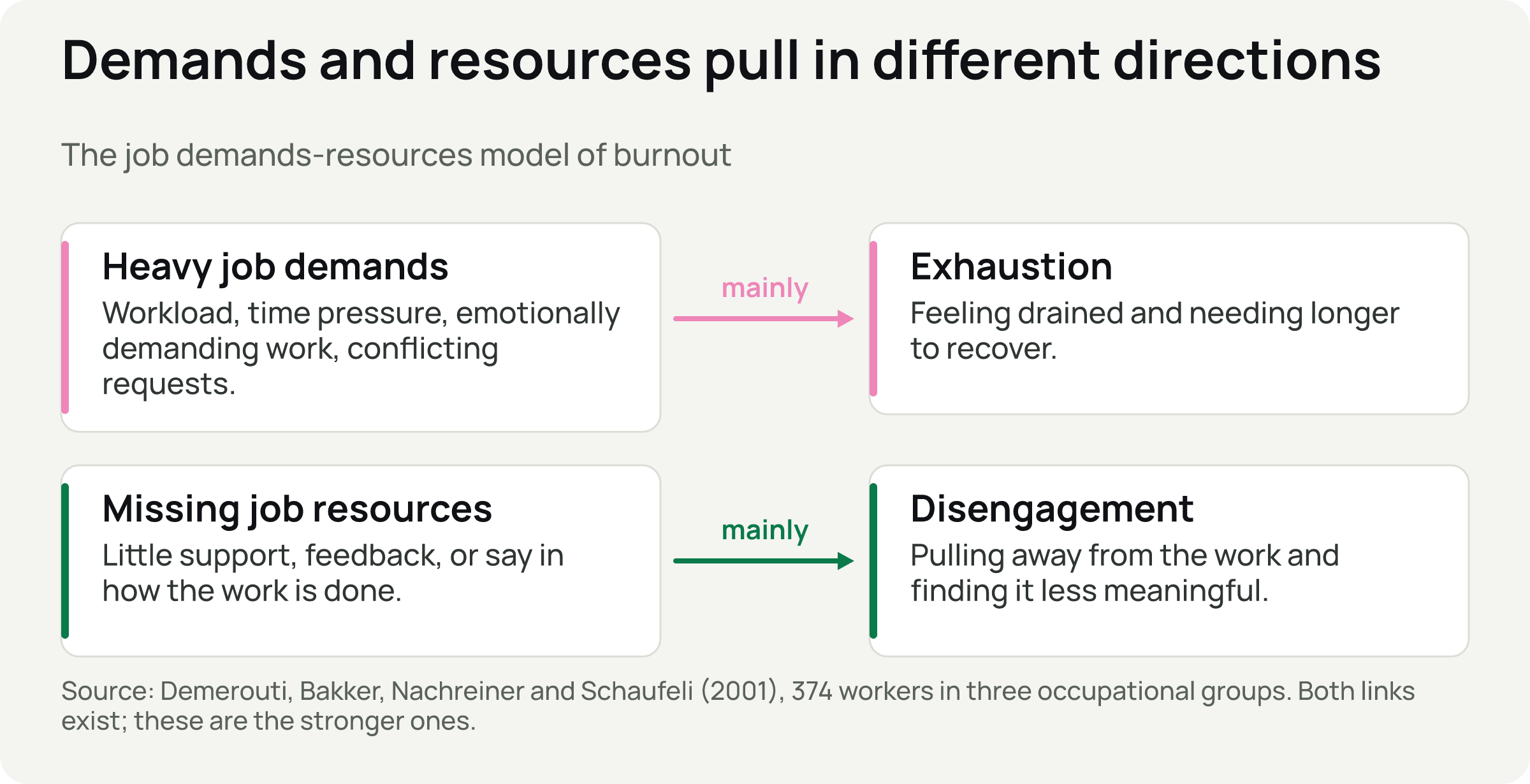
This explains a common experience: a job can be demanding yet fine when you have support and a say in how you work, and the same job can feel unbearable when you do not. It also suggests where to look. If you are exhausted, look at demands. If you feel detached, look at what is missing.
What do long working hours do?
Hours are part of demands, and they matter for physical health too. A WHO and International Labour Organization analysis of more than 2,300 surveys from 154 countries, plus two systematic reviews, found that working 55 or more hours a week was linked to about a 35% higher risk of stroke and a 17% higher risk of dying from ischaemic heart disease, compared with working 35 to 40 hours. [4]
The WHO and ILO recommended that governments set maximum working hours, and that employers and worker associations agree a maximum through collective bargaining. For employees, they suggested sharing work so that nobody's weekly hours climb to 55 or more. [4] These are group-level findings, not a prediction for any one person.
Is it your job, or is it you?
It is rarely only the job or only you. Stress at work often sits on top of stress elsewhere, and the WHO lists conflict between home and work demands as a risk factor in its own right. [2] But if you only look inward, you risk treating a design problem as a personal failing. Research on burnout argues that organisational factors are strongly involved, and that most interventions have focused on the individual. [6]
This ten-minute check gives you an honest picture. For each area, ask whether it is mostly fine, sometimes a problem, or mostly a problem.
- Demands: Can I usually finish what is expected in normal hours, with breaks?
- Control: Do I have a say in how I do my work and in my own pace?
- Support: If work gets difficult, do my manager and colleagues help?
- Relationships: Do I get treated with respect, without bullying or constant friction?
- Role: Am I clear what is expected of me and where my job fits?
- Change: When things change, am I told what is happening and why?
What should employers do about it?
In Great Britain, HSE states that employers have a legal duty to protect workers from stress at work by doing a risk assessment and acting on it. With five or more workers, the assessment must be written down. [5] Other countries have different rules, but the same approach, finding the causes in the work and acting on them, is widely used.
HSE's approach for employers is to talk to workers about the six areas, identify the causes, record the actions, and review them regularly. [7]
Common questions
What is the most common cause of work stress?
HSE names demands, which includes workload, as the first of its six areas. [1] But no single cause dominates for everyone. The WHO lists many risk factors that often combine, such as heavy workloads, little control, and poor support. [2] The more areas that are a problem, the harder work tends to be.
Is work stress my fault if I cannot cope?
No. HSE and the WHO both focus on how work is designed and managed. [1][2] Coping skills can help, but they work better when the causes are also dealt with.
Can stress at work make me ill?
Long-term stress can affect health. The NHS lists headaches, muscle tension, stomach problems, and chest pain among its effects, and long working hours are linked to a higher risk of stroke and heart disease. [4][8] If you are worried about symptoms, see a doctor.
What if the cause is my manager?
HSE suggests checking company policies and, if the manager is the source of pressure, speaking to a union or worker representative, HR, a counselling service, a first aider trained in mental health, or your GP. [9]
Keep reading
Sources and further reading
These links open external research and health-information websites.
- HSE: What are the Management Standards?
The six areas of work design: demands, control, support, relationships, role, and change, with HSE's descriptions. - WHO: Mental health at work (fact sheet)
Risk factors for mental health at work. Page dated 15 September 2026 when checked. - Demerouti, Bakker, Nachreiner, and Schaufeli (2001): The job demands-resources model of burnout. Journal of Applied Psychology, 86(3), 499-512
Original study of 374 workers. Abstract-level details checked through publisher and repository listings; full text not opened. - WHO and ILO (2021): Long working hours increasing deaths from heart disease and stroke
Findings on working 55 or more hours a week, based on systematic reviews and surveys from 154 countries. - HSE: Work-related stress and how to manage it
Employers' legal duty to assess the risk of stress, and the six areas. - Maslach and Leiter (2016): Understanding the burnout experience. World Psychiatry, 15(2), 103-111
Organisational factors in burnout, and the focus of interventions on individuals. - HSE: Working Minds, World Mental Health Day 2026
HSE's five steps for employers: reach out, recognise, respond, reflect, make it routine. - NHS: Get help with stress
Physical, mental, and behavioural signs of stress. - HSE: Help for workers on stress at work
Who to talk to, including when your manager is the source of pressure.
This article is educational. It is not a diagnosis or a treatment plan. If stress is affecting sleep, eating, or safety, talk to a GP, an occupational health service, or a local mental health service.