
Review · HSE Stress Indicator Tool
HSE Stress Indicator Tool and Talking Toolkit review: free ways to find what is causing work stress
A free 35-question survey from the UK's Health and Safety Executive that looks at the workplace, not the person. What it measures, how to use it, and where it falls short.

The HSE Management Standards Indicator Tool is a 35-item questionnaire from the UK's Health and Safety Executive that asks workers about their working conditions, mapped to six areas: demands, control, support, relationships, role, and change. [1][2] Unlike a burnout questionnaire, it measures the workplace, not the person, and HSE says it should be used alongside other data, not alone. [1] A 2025 review reports good internal consistency and links to burnout and distress, and warns that its norms may be outdated and that it misses role-specific demands. [3] It is a strong free starting point for employers, not a complete assessment.
The tool at a glance
Facts below come from HSE's pages and the questionnaire itself.
| Question | Answer |
|---|---|
| Who made it? | The Health and Safety Executive (HSE), Great Britain's workplace health and safety regulator. [1] |
| What does it measure? | Working conditions in six areas of work design. HSE describes it as a 35-item questionnaire mapping to demands, control, support, role, relationships, and change. [1] |
| How long is the recall period? | The instructions ask for responses that reflect your work in the last six months. [2] |
| Response scales | Items 1 to 22 use Never, Seldom, Sometimes, Often, Always. Items 23 to 35 use Strongly disagree to Strongly agree. Scored 1 to 5, with some reverse-scored. [2] |
| What do you use to analyse it? | HSE's Analysis Tool, an Excel workbook. Use numeric scores, not answer labels, and at least 10 records. [1] |
| Cost | The questionnaire is a free download on HSE's website. [2] |
What does it ask?
The questions describe the job, not feelings. Examples include "I am clear what is expected of me at work," "I can decide when to take a break," "I have unachievable deadlines," "I am given supportive feedback on the work I do," and "When changes are made at work, I am clear how they will work out in practice." [2]
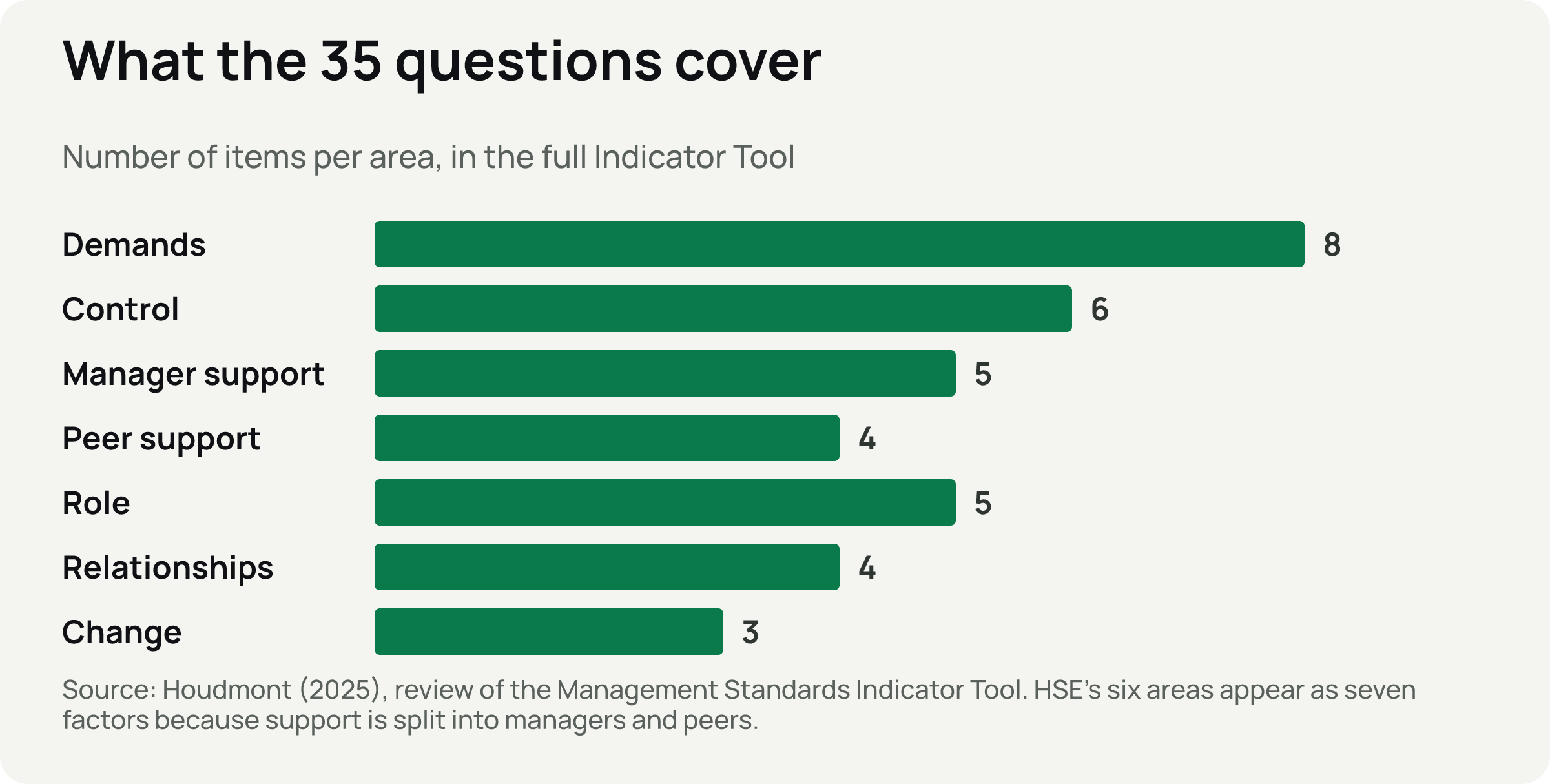
Across the 35 items, the 2025 review reports seven factors, because support is split into managerial support and peer support: demands (8 items), control (6), managerial support (5), peer support (4), role (5), relationships (4), and change (3). [3] Items are scored so that higher scores indicate a better work environment, and each factor gets a mean from 1 to 5. [3]
How do you use it well?
HSE puts the tool in Step 3 of its Management Standards approach. It says data gives only a broad picture, so "if you want to know what is affecting employees, you have to ask them." [1] It recommends:
- Focus groups of about 6 to 10 people, with employees and their representatives taking part.
- A preliminary action plan from each group.
- Merging the group plans into one organisational plan.
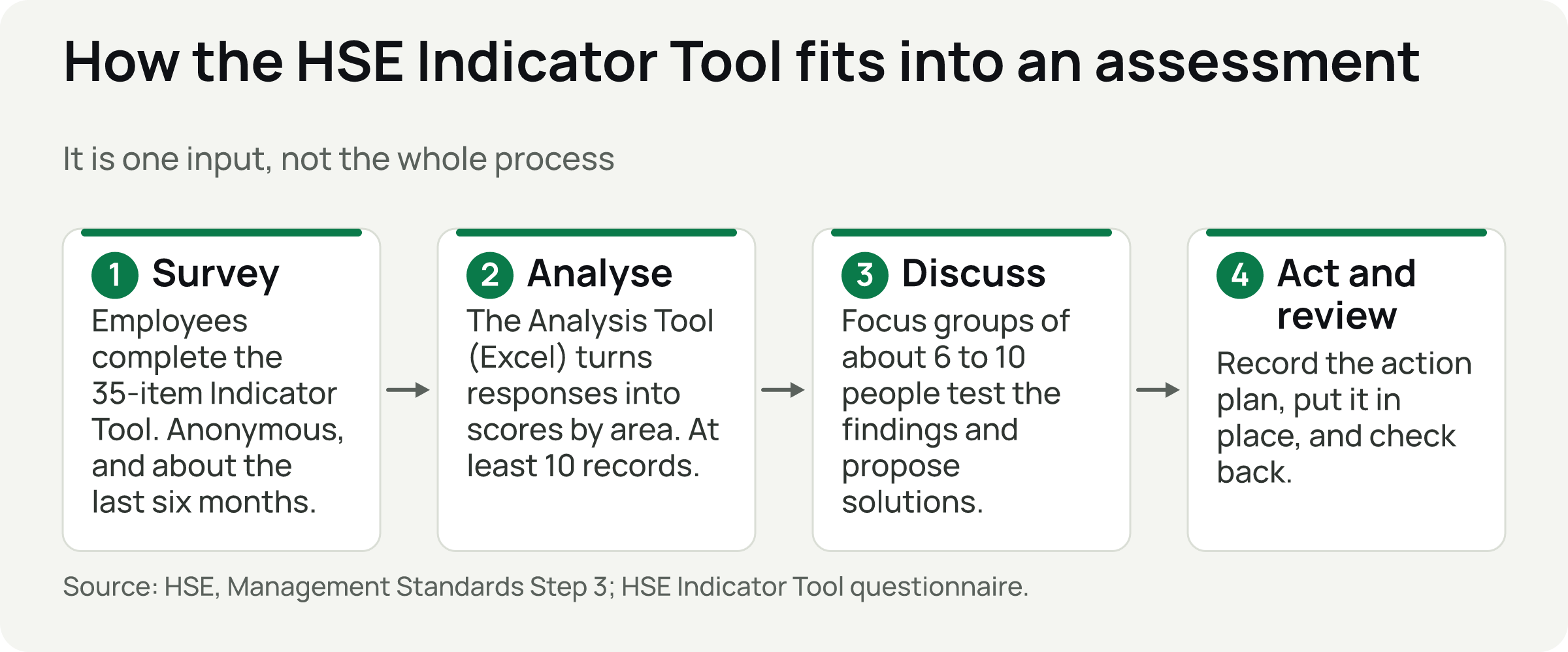
The Indicator Tool should be used alongside other data, not alone. [1]
What is the Stress Talking Toolkit?
HSE's Working Minds approach starts by reaching out: starting conversations with your team using the Stress Talking Toolkit. HSE says the toolkit provides structured questions and prompts to help managers talk with workers, and that it "should not be used in isolation," because risks identified through the conversations should still be managed. [4] We did not examine the toolkit itself, so this review does not assess its content.
What does the research say about its quality?
A 2025 narrative review in Occupational Medicine reports that Cronbach's alpha is consistently above 0.70 for each area across studies, and that the short and full versions show similar relationships with emotional exhaustion and psychological distress. Most research is cross-sectional, linking the areas to burnout, wellbeing, and distress, and a smaller set links them to outcomes such as performance and turnover intentions. [3] A 25-item short version was created by removing ten items with low factor loadings. [3]
Those are the strengths: a clear structure tied to HSE's six areas, reasonable reliability, and a link to burnout and distress, at no cost.
What are the limits?
The same review sets out limits. The tool measures generic psychosocial factors and is insensitive to context-specific work characteristics. The UK normative data from 2012 may not reflect current working conditions. [3]
The tool is about two decades old and does not capture changes from technology, the pandemic, or remote working. One example of an extended hybrid-working tool comes from the University of Hull. [3] The review recommends comparing with contemporary data where available or tracking your own change over time, and using caution with the 2012 norms. [3]
- It does not tell you why a score is low. That needs conversation. [1]
- It is a group tool. Results for small groups can identify people, so combine small teams and report at group level. [1]
- It will not capture issues specific to your sector, role, or way of working without extra questions. [3]
- A survey that is not followed by action can lower trust.
Is it useful for individual workers?
Not as a score for an individual. It is designed to be answered by a workforce and analysed as a group. But reading the 35 questions is a good way to check your own working conditions against what HSE considers important, such as clarity of role, say over how you work, and support when work is hard. [2]
If several describe your situation, these are a natural next step.
Who is it for?
It suits employers, HR teams, and safety representatives who want to find the work causes of stress and are ready to act on what they learn. HSE's legal duty applies in Great Britain; elsewhere, the logic still applies, but check local rules. [5] It is not a screening tool for individuals, and it is not a replacement for conversation.
Common questions
Is the HSE Indicator Tool free?
The questionnaire is available as a free download on HSE's website. [2] HSE also provides an Excel Analysis Tool for processing responses. [1]
Can I use it outside the UK?
Nothing stops you using the questions, but the legal context and the benchmarking are British. The 2025 review says the UK norms date from 2012 and may be outdated. [3] Use it to track your own change over time.
How many people do I need?
HSE says its Analysis Tool needs at least 10 records. [1] Small teams risk identifying people, so combine groups.
Is it a burnout test?
No. It measures conditions of work. The 2025 review links its areas to emotional exhaustion and psychological distress in research, but the tool does not measure burnout in individuals. [3]
Keep reading
Sources and further reading
These links open external research and health-information websites.
- HSE: Management Standards Step 3, evaluate the risks
The Indicator Tool, Analysis Tool, focus groups, and types of intervention. - HSE: Management Standards Indicator Tool (questionnaire)
The 35 items, response scales, and the six-month instruction. Downloaded from hse.gov.uk. - Houdmont (2025): Questionnaire review: Management Standards Indicator Tool. Occupational Medicine
Narrative review of structure, reliability, validity, and limitations. - HSE: Working Minds, World Mental Health Day 2026
The five steps and the Stress Talking Toolkit. - HSE: Work-related stress and how to manage it
Employers' legal duty in Great Britain to assess the risk of stress.
Educational review, not medical advice. Prices, features, and policies change, so check the provider's own pages before you pay or enter personal information.