
Guide · Audit
How to audit your workload in one week
Five days, five minutes a day. A simple log that shows where your time really goes, and what to ask for when it does not add up.

To audit your workload, log what you actually do for five working days, in blocks of time. Give each block one of four types (planned work, meetings, interruptions, or admin and email), and flag any time outside your contracted hours. At the end, look for where the pattern does not fit your contracted hours. A specific record gives you something concrete to bring to your manager, which HSE's guidance on raising work stress early points towards. [1][2] This method is a practical suggestion, not a validated instrument.
Why audit your workload?
HSE's first area of work design is demands, which covers workload, work patterns, and the work environment. [1] Demands are hard to discuss when all you have is a feeling. A log turns "I am drowning" into "I have 48 hours of work in a 37.5 hour week, and the extra comes from sales requests". HSE advises pointing to the cause of the pressure so the right help can be found. [2]
A log also helps you. It can show that some of the load is yours to change, such as meetings you accept by default, and that some of it is not.
What do you need before you start?
The printable log above, a notebook, a spreadsheet, or a notes app is enough. Sort every block of time into one of four types, decide them in advance, and stick to them. Do not record confidential details or names of customers or colleagues. Note types of work, not content, and check what your employer's policies say about personal records at work.
Then add one flag. Mark any block you worked outside your contracted or paid hours. The flag is not a fifth type: an evening email is still "Admin and email", with a flag, so every block is counted once.
| Type | What goes in it | Examples |
|---|---|---|
| Planned work | Tasks you planned or were assigned and chose to do. | Writing the report, preparing the presentation. |
| Meetings | Scheduled calls and meetings, including preparation. | Team meeting, one-to-one, client call. |
| Interruptions and urgent requests | Anything that arrived and had to be handled now. | Urgent email, a colleague asking for help, a system fault. |
| Admin and email | Routine messages and administrative tasks. | Expenses, timesheets, inbox clearing, evening email. |
How do you run the audit?
Do it over five consecutive working days, and choose a normal week, not a holiday or a crunch. A note at the end of each day takes about five minutes.
- At the start of the day, write the three things you plan to do.
- At the end of each day, split the day into rough blocks of 30 to 60 minutes. Note what you did and give each block one of the four types.
- Flag any block that fell outside your contracted or paid hours. The block keeps its type.
- Add up each type for the day, and write the day's total hours.
- After five days, add up each type across the week, and add up the hours you flagged as outside your contracted hours.
- Write three sentences: what surprised you, what most disrupted your planned work, and what you would change first.
What does a finished week look like?
The invented week below uses the same four types and a contracted day of 7.5 hours. Look at the shape before the numbers: planned work keeps losing to meetings and urgent requests, and every day runs past the dashed line.
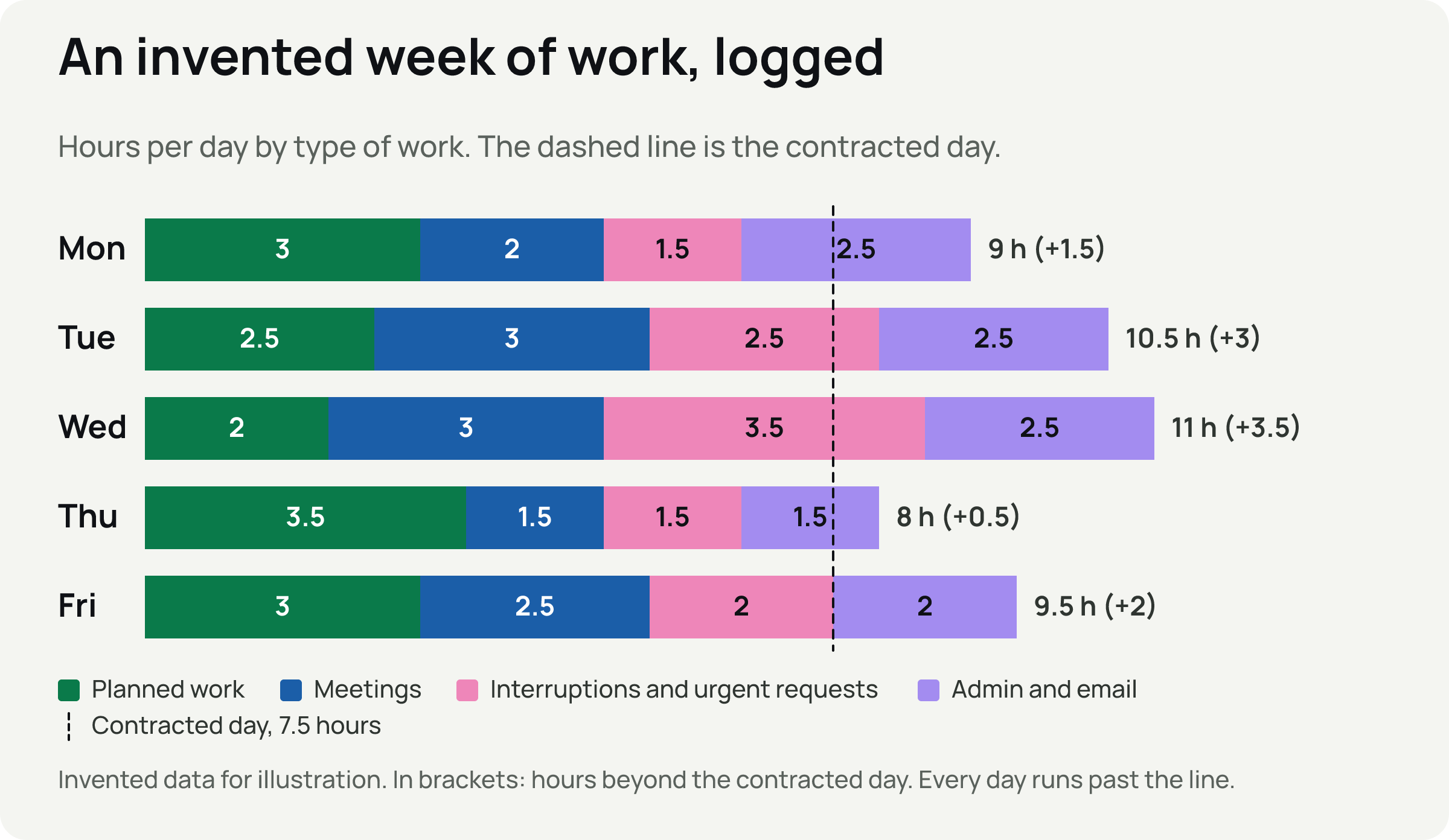
The table gives the same figures. The contracted week is 37.5 hours, so 48 logged hours is 10.5 hours over, and those are the flagged hours.
| Day | Planned | Meetings | Interruptions | Admin | Total | Outside hours |
|---|---|---|---|---|---|---|
| Mon | 3 | 2 | 1.5 | 2.5 | 9 | 1.5 |
| Tue | 2.5 | 3 | 2.5 | 2.5 | 10.5 | 3 |
| Wed | 2 | 3 | 3.5 | 2.5 | 11 | 3.5 |
| Thu | 3.5 | 1.5 | 1.5 | 1.5 | 8 | 0.5 |
| Fri | 3 | 2.5 | 2 | 2 | 9.5 | 2 |
| Week | 14 | 12 | 11 | 11 | 48 | 10.5 |
How do you read the pattern?
Ask your own log five questions.
- Is my total regularly above my contracted hours? By how much, and on which days?
- How much of my day is planned work, and how much is reaction?
- Which day was the worst, and what was different about it?
- Which meetings or requests could be shorter, rarer, or someone else's?
- What did I not get to that matters?
How do you turn the log into a request?
Pick one finding and one ask. HSE's guidance describes talking to your manager early, and giving them the chance to help. [2] A log shows them the facts, and your ask shows them what a good outcome looks like.
Three patterns show up often, and each supports a different request.
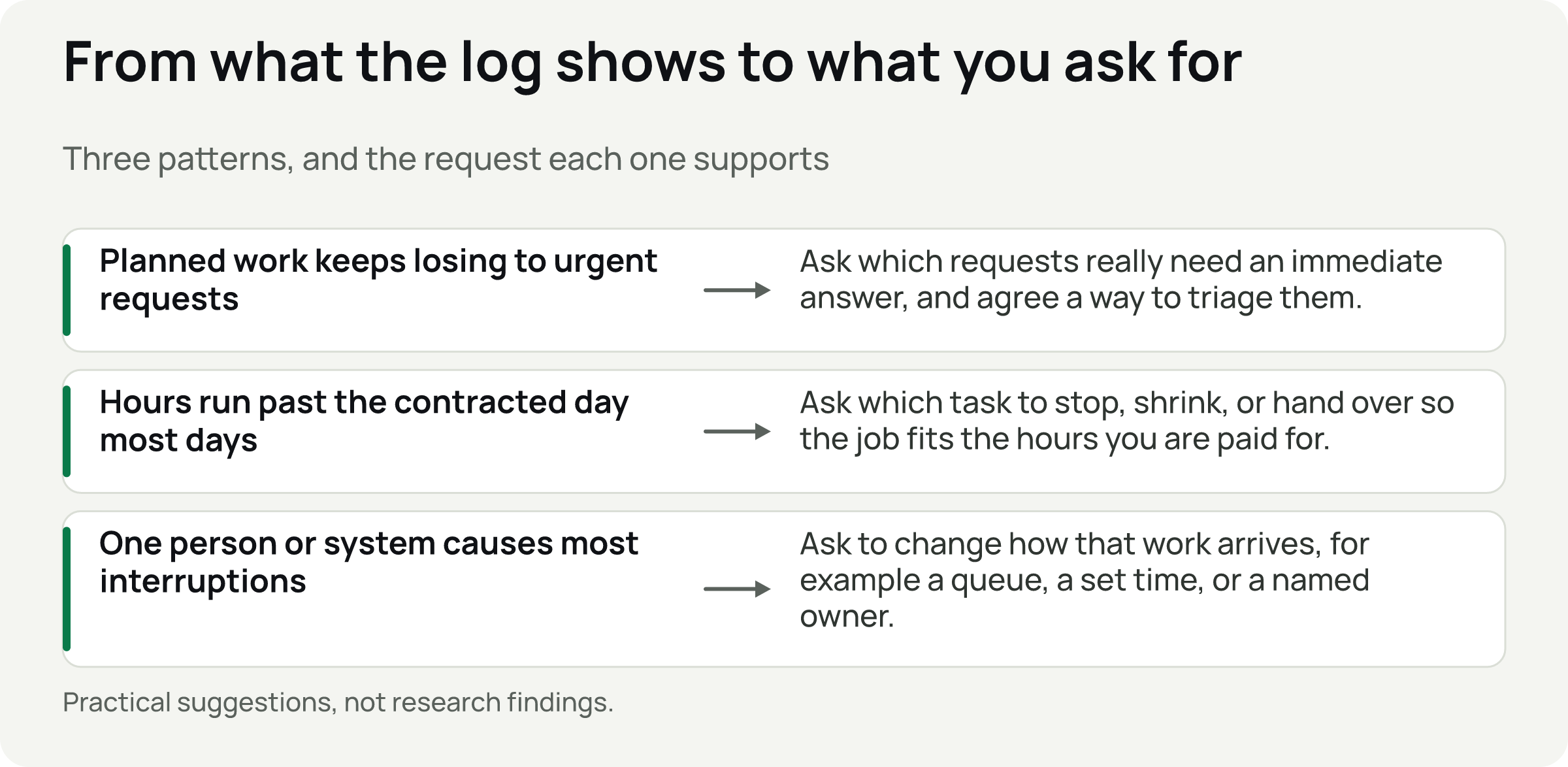
| If the log shows | You could ask |
|---|---|
| Planned work keeps losing to urgent requests. | Which requests really need an immediate answer, and how can we triage them? |
| Hours run past the contracted day most days. | Which task can I stop, shrink, or hand over so the job fits the hours I am paid for? |
| One person or system causes most interruptions. | Can that work arrive differently, for example through a queue, at a set time, or with a named owner? |
What if the log shows very long hours?
Consistently long hours are a health issue, not only a performance one. A WHO and ILO analysis found that working 55 or more hours a week was associated with a higher risk of stroke and of dying from ischaemic heart disease, compared with 35 to 40 hours. [3] That is a group-level finding, not a prediction for you, but it is a reason to take a log that shows 50 or 55 hours seriously and to raise it.
If you manage a team
The same method works at team level, with the team's consent. Ask people to log one typical week, anonymously if needed, and look at what sits on top of planned work. HSE suggests asking employees directly what is affecting them, in focus groups of about six to ten people. [4]
Common questions
Do I have to log every minute?
No. Blocks of 30 to 60 minutes are enough to show the shape of the week. Precision matters less than honesty.
What if my week is not typical?
If it is a crunch week, say so, and repeat the audit in a quieter week. The comparison itself is useful: it shows what changes when pressure rises.
Is it fine to share my log with my manager?
You choose what to share. Many people share a summary, such as the totals and three sentences, rather than the raw log. Remove anything confidential.
What if I am self-employed?
The log still works. Add a type for unpaid time, such as chasing invoices, and compare what you earn per hour of total work, not only billable work.
Keep reading
Sources and further reading
These links open external research and health-information websites.
- HSE: What are the Management Standards?
The six areas of work design; demands include workload, work patterns, and the work environment. - HSE: Help for workers on stress at work
Talking to someone early, and pointing to the cause of the pressure. - WHO and ILO (2021): Long working hours increasing deaths from heart disease and stroke
Findings on working 55 or more hours a week compared with 35 to 40. - HSE: Management Standards Step 3, evaluate the risks
Focus groups of about six to ten people, and asking employees what is affecting them.
Educational guidance, not clinical, legal, or HR advice. If you need a person, skip the rest of the steps and talk to one.