
Guide · Conversation
How to talk to your manager about workload, with scripts you can use
A six-step plan, three asks a manager can say yes to, and scripts for the awkward moments. Built to fit into a lunch break.

To raise a workload problem, bring a short list of your tasks, name one specific problem, and ask your manager to make a choice: re-prioritise, move a deadline, or add capacity or remove a task. HSE advises talking to your manager early, because it gives them the chance to help before things get worse. [1] Treat it as a request for a decision about priorities, not a complaint about you or them.
What is this conversation for?
It is for getting a decision about what matters most, not for sympathy and not for proving how hard you work. HSE says that if you are feeling stress at work it is important to talk to someone, for example your manager, and that talking early gives them the chance to help and stop the situation getting worse. [1]
Workload sits in the first of HSE's six areas of work design, called demands, which includes workload, work patterns, and the work environment. Control, the second, is how much say you have in how you work. [2] Both are things a manager can often change, which is why a clear request works better than "I am stressed".
What are the steps?
Allow about an hour of preparation across a few days, and 20 to 30 minutes for the conversation itself.
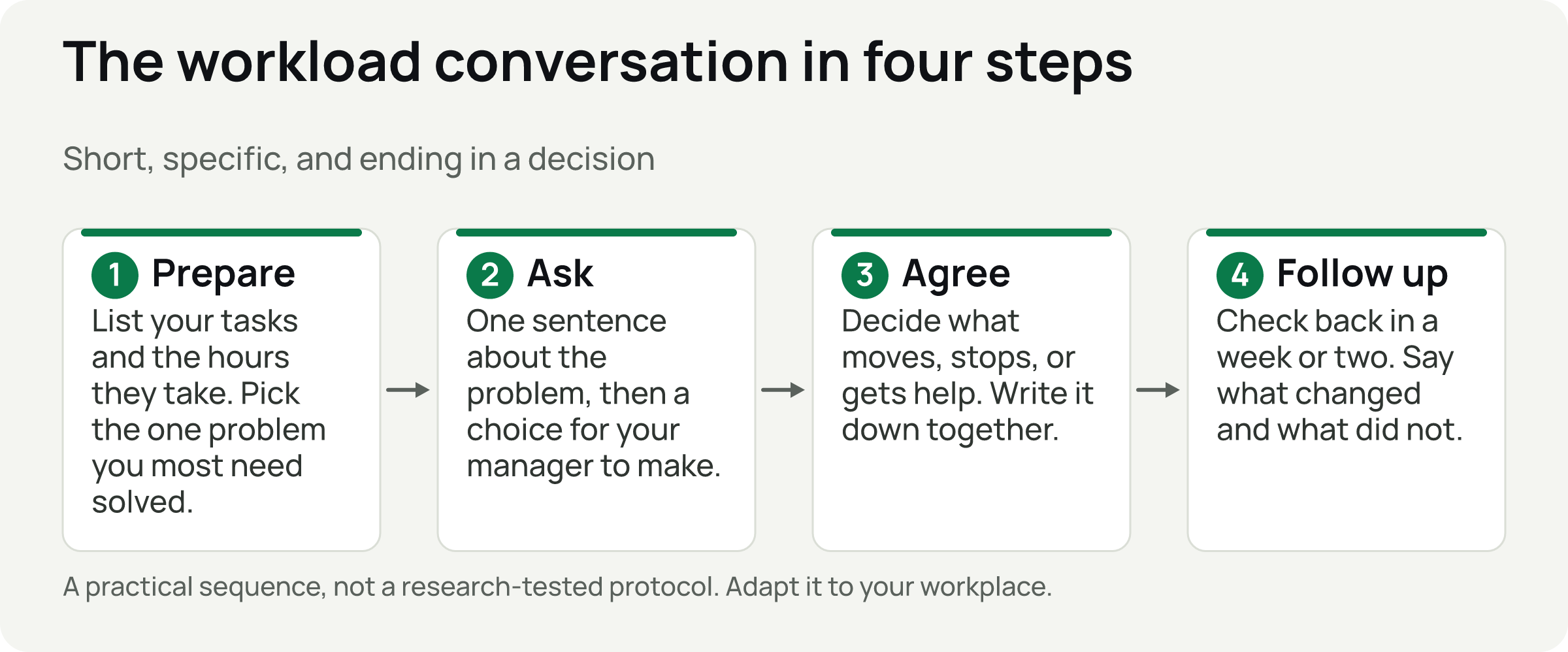
- Collect evidence for one week. Note your tasks, the hours they take, and any time worked beyond your contract. Our workload audit guide shows how.
- Name the problem in one sentence. For example: "I have four projects due in the next two weeks and enough time for two."
- Choose your ask. Pick one from the next section. Do not ask for everything at once.
- Book the time. Send a short message asking for 30 minutes on workload. Do not raise it in passing or at the end of a meeting.
- Have the conversation. Open with the problem, show the list, make the ask, then listen. Ask what trade-offs they see.
- Agree and write it down. Send a two-line summary the same day: what was agreed, what moves, and when you will check in again.
What can you ask for?
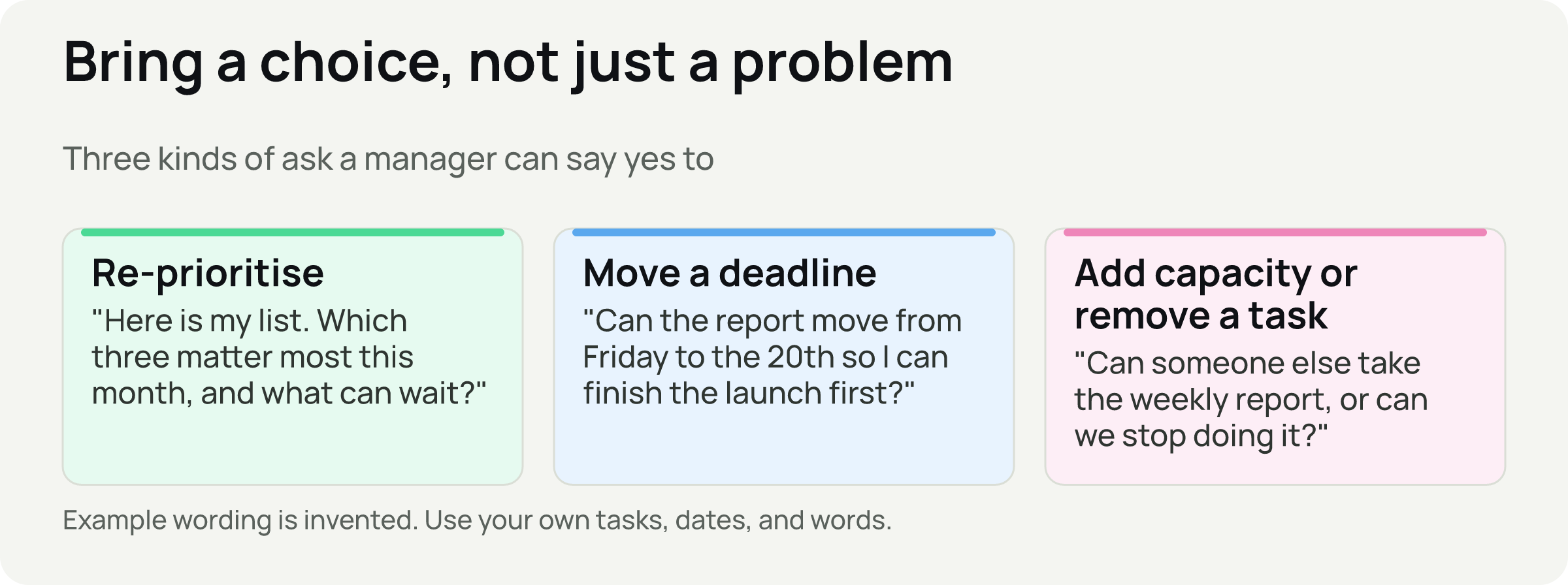
A manager can usually say yes to a specific choice more easily than to a general problem. Bring one of these, and be ready to offer a second.
What can you say?
Use these as a starting point and put them in your own words. Short sentences work best when you are nervous.
A worked example
Here is an invented list for a marketing coordinator, Dana. The hours are a week's estimate. Dana is contracted for 37.5 hours and has been working about 48.
| Task | Hours a week | Status | Dana's ask |
|---|---|---|---|
| Weekly campaign report | 6 | Fixed deadline Friday | Keep |
| Product launch emails | 14 | Deadline in 10 days | Keep, top priority |
| Social media scheduling | 8 | Daily | Keep, reduce to three days a week |
| Ad hoc requests from sales | 9 | Unpredictable | Agree a queue and a response time |
| Monthly newsletter | 7 | Deadline in 3 weeks | Move deadline to after launch |
| Meetings | 4 | Fixed | Review which are needed |
What if nothing changes?
A first conversation does not always work. Give the agreement a fair chance, and follow up. If it still does not move, HSE suggests that where a line manager is the source of pressure, you can check company policies and speak to a trade union or worker representative, HR, a worker assistance or counselling service, a first aider trained in mental health support, or your GP. [1]
In Great Britain, employers have a legal duty to protect workers from stress at work by doing a risk assessment and acting on it. HSE says your employer must share the results with you. [1][3] Elsewhere, rules differ. If you are not sure of your rights, speak to a union, an employment adviser, or your HR team.
Look after yourself while you wait. The NHS suggests talking to someone about how you feel, planning ahead for stressful days, and focusing your energy on things you can change. If you are struggling to cope, see a GP. [5]
If you are the manager hearing this
Thank them, ask to see the list, and decide something. The WHO lists heavy workloads, fast pace, understaffing, and little control as risk factors for mental health at work. [4] Ask what can stop or move before you ask what can be done faster. Write down what you agree and keep the follow-up date.
Common questions
What if I am afraid of looking weak or not coping?
HSE notes that stress is common and not a weakness, and that stigma makes many people reluctant to speak up. [1] Framing the conversation as a decision about priorities, with a list, shows that you are managing your work, not failing at it.
Should I put my concerns in writing?
A short written summary of what you agreed is a good habit, and it is easier to refer to later. You do not need to write a formal complaint to start. If a problem continues, a written record helps if you later involve HR or a union.
Can I refuse extra work?
That depends on your contract, your role, and the law where you work, and this guide cannot say. Asking "which of my current tasks should move so I can take this on?" is often more effective than a flat no. For your rights, ask a union, HR, or an employment adviser.
What if my manager is the problem?
HSE suggests checking your company's policies and speaking to a union or worker representative, HR, a counselling service, or your GP. [1]
Keep reading
Sources and further reading
These links open external research and health-information websites.
- HSE: Help for workers on stress at work
Talking to someone early, who to talk to if your manager is the source of pressure, and employers' duty to assess risks. - HSE: What are the Management Standards?
The six areas of work design, including demands and control. - HSE: Work-related stress and how to manage it
Employers' legal duty in Great Britain to assess the risk of stress and act on it. - WHO: Mental health at work (fact sheet)
Risk factors including heavy workloads, fast pace, understaffing, and little control. Page dated 15 September 2026 when checked. - NHS: Get help with stress
Self-help suggestions and when to see a GP.
Educational guidance, not clinical, legal, or HR advice. If you need a person, skip the rest of the steps and talk to one.