
Guide · Routine
How to switch off after work: a ten-minute shutdown routine
A ten-minute routine to close the working day, a plan for when work thoughts come back, and what research says about mentally switching off.
To switch off after work, end the day with a short, repeatable routine: review what you finished, write down every loose task, choose tomorrow's top three, close your tools, and say the day is done. Research on "psychological detachment" finds that people who mentally disconnect from work in their free time report higher life satisfaction and fewer symptoms of strain, without losing engagement at work. [1] The routine is a practical suggestion; it has not been tested as a package.
Why is it hard to stop thinking about work?
Researchers call mentally disconnecting from work in your free time "psychological detachment". Sonnentag's 2012 review reports that people who detach more are more satisfied with their lives and have fewer symptoms of psychological strain, and that their engagement at work does not suffer. It also finds that detaching is harder when you have high job stressors, a strong involvement in your job, or a tendency to negative emotions. [1]
A later review of recovery from job stress describes the same pattern: job stressors, especially workload, are associated with lower detachment, and low detachment is linked to higher strain and poorer wellbeing, including burnout. [3] So if you cannot switch off, it is not a character flaw. It is often a sign of load.
Does switching off actually protect you?
Evidence from one longitudinal study suggests it can. Sonnentag, Binnewies, and Mojza followed 309 employees in human services over 12 months. High job demands predicted emotional exhaustion, physical complaints, and lower work engagement over time. Detachment from work in off-job time predicted lower emotional exhaustion, and it buffered the link between high demands and a rise in physical complaints. [2]
That does not show that any particular routine works, or that detaching erases a bad workload. It shows that the evening matters, which is a reason to protect it.
What is the ten-minute shutdown routine?
Do it at the same time each day, in the same order, and keep it short enough that you will actually do it. It works best when it ends in a physical action, like closing a laptop.
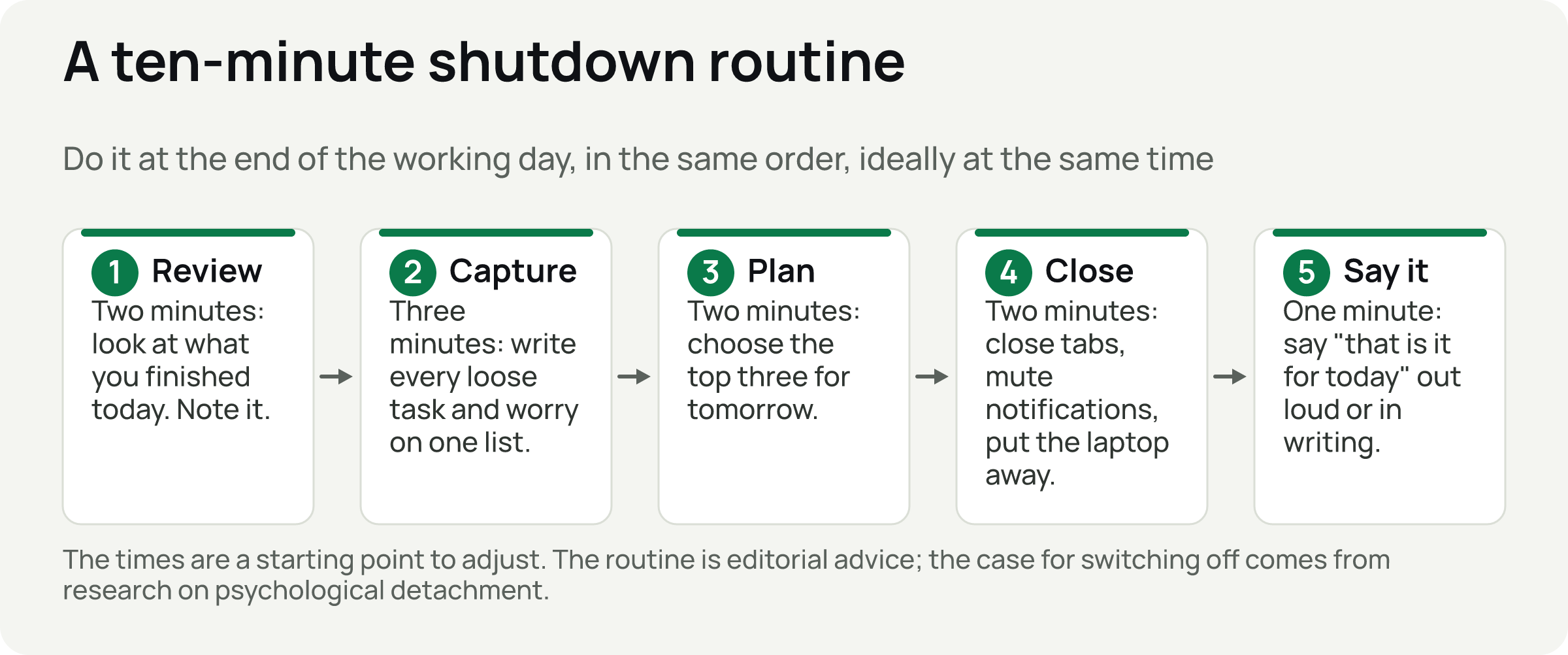
- Review (2 minutes). Look at what you finished today and note it. Your brain keeps the unfinished list, and it forgets the done one.
- Capture (3 minutes). Write every loose task, worry, and idea onto one list, in any order. Do not solve them. Writing them down tells your mind they will not be lost.
- Plan (2 minutes). Choose the top three things for tomorrow, and put them first on the list. You now have a first move for the morning.
- Close (2 minutes). Close tabs, mute work notifications, and put the laptop or work phone out of sight.
- Say it (1 minute). Say "that is it for today" out loud, or write it. A clear marker helps the day end in your head as well as on the clock.
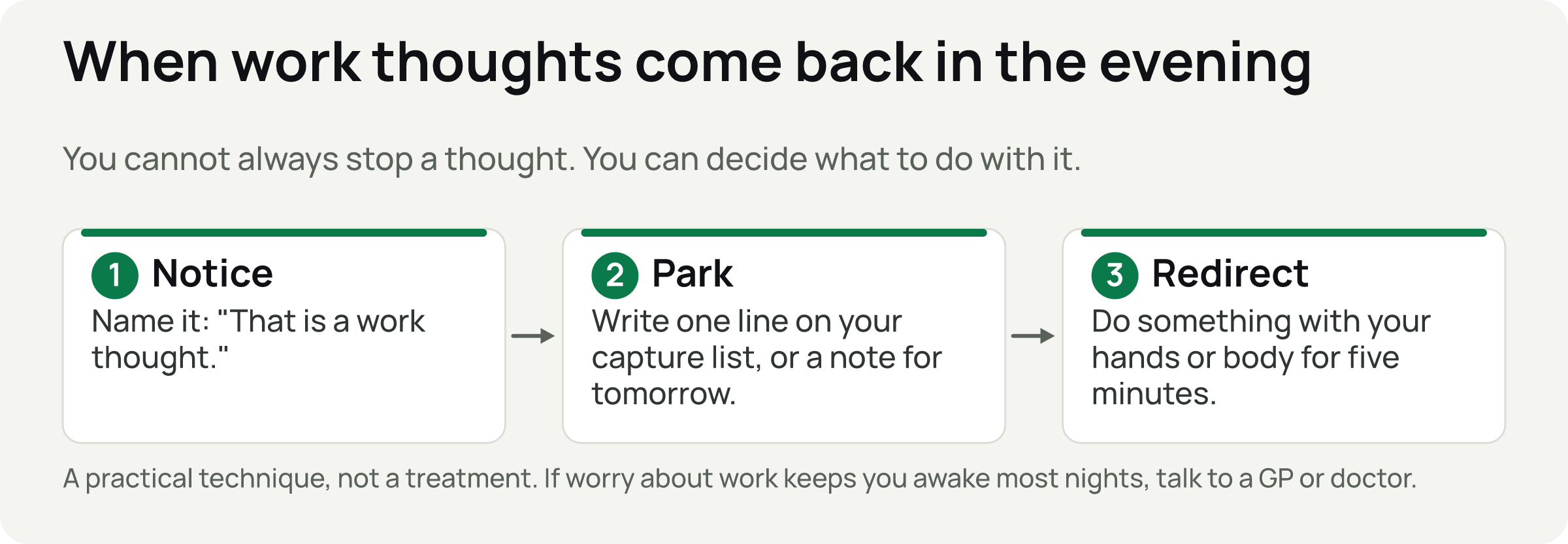
What if work thoughts come back anyway?
They will, especially in the first weeks. The aim is not to stop the thought but to change what you do with it. Notice it, park it, then move your attention with your body or hands.
What if you work from home, or are always on call?
When work and home share a space, make the end of the day physical. Close the laptop and put it in a drawer, or walk around the block as a "commute home". Use a separate user profile or turn off work notifications on your personal phone.
If your job really does require availability outside hours, agree the rules. Ask which situations need an immediate response, who is on call, and what counts as an emergency. Our guide on talking to your manager about workload has scripts for this kind of request.
What should you do with the evening?
Choose something that takes your attention without effort. The NHS suggests setting aside time for yourself and for physical activity, and talking to a friend or family member. [4] The NIMH suggests regular exercise and meals, limiting excess caffeine, and keeping a consistent sleep routine. [5] None of these is a cure. They protect the conditions your recovery needs.
- Move your body: a walk, a stretch, or a short workout.
- Eat something at a regular time.
- Contact one person who is not a colleague.
- Do one thing for no reason other than enjoying it.
- Choose a screen-free half hour before bed if you can.
If you manage a team
The research ties detachment to job stressors such as workload. [3] If you want your team to be able to switch off, reduce the load that blocks it, and be clear about out-of-hours expectations. Sending messages at night and not expecting a reply the same night is a start, but only if people believe it.
Common questions
How long does it take to switch off properly?
There is no reliable timeline. Try the routine consistently for two weeks and see whether the evenings feel different. If they do not, look at workload and sleep, and talk to someone. [3][4]
Is it bad to check email in the evening?
Research on detachment describes mentally disconnecting from work during off-hours. [1] Checking messages keeps work in reach, which tends to work against this. If you must check, set a fixed time and a limit.
What if I cannot stop worrying about work even with the routine?
Persistent worry can be a sign that you need more than a routine. The NHS suggests seeing a GP if you are struggling to cope or what you are trying yourself is not helping. [4]
Do I need to be fully disconnected from my phone?
Not necessarily. The aim is to avoid keeping work thoughts and tasks in play during your free time. Muting work notifications and using separate apps or profiles is often enough.
Keep reading
Sources and further reading
These links open external research and health-information websites.
- Sonnentag (2012): Psychological detachment from work during leisure time. Current Directions in Psychological Science, 21(2), 114-118
Review of research on detachment, wellbeing, and what makes detaching harder. Abstract checked through a university repository; full text not opened. - Sonnentag, Binnewies, and Mojza (2010): Staying well and engaged when demands are high. Journal of Applied Psychology, 95(5), 965-976
A 12-month study of 309 human service employees. Abstract-level details checked through a university repository; full text not opened. - Sonnentag and Fritz (2015): Recovery from job stress: The stressor-detachment model. Journal of Organizational Behavior, 36(S1), S72-S103
Review of detachment, job stressors, and strain. Abstract checked through repository and CDC record; full text not opened. - NHS: Get help with stress
Self-help suggestions, and when to see a GP. - NIMH: I'm so stressed out! Fact sheet
Coping tips including exercise, regular meals, a consistent sleep routine, and limiting caffeine.
Educational guidance, not clinical, legal, or HR advice. If you need a person, skip the rest of the steps and talk to one.