
Review · LuriaLab
LuriaLab review: free burnout and stress questionnaires, results, and privacy
What the free questionnaires cover, what a result can and cannot tell you, how the privacy policy reads, and what we could not confirm.

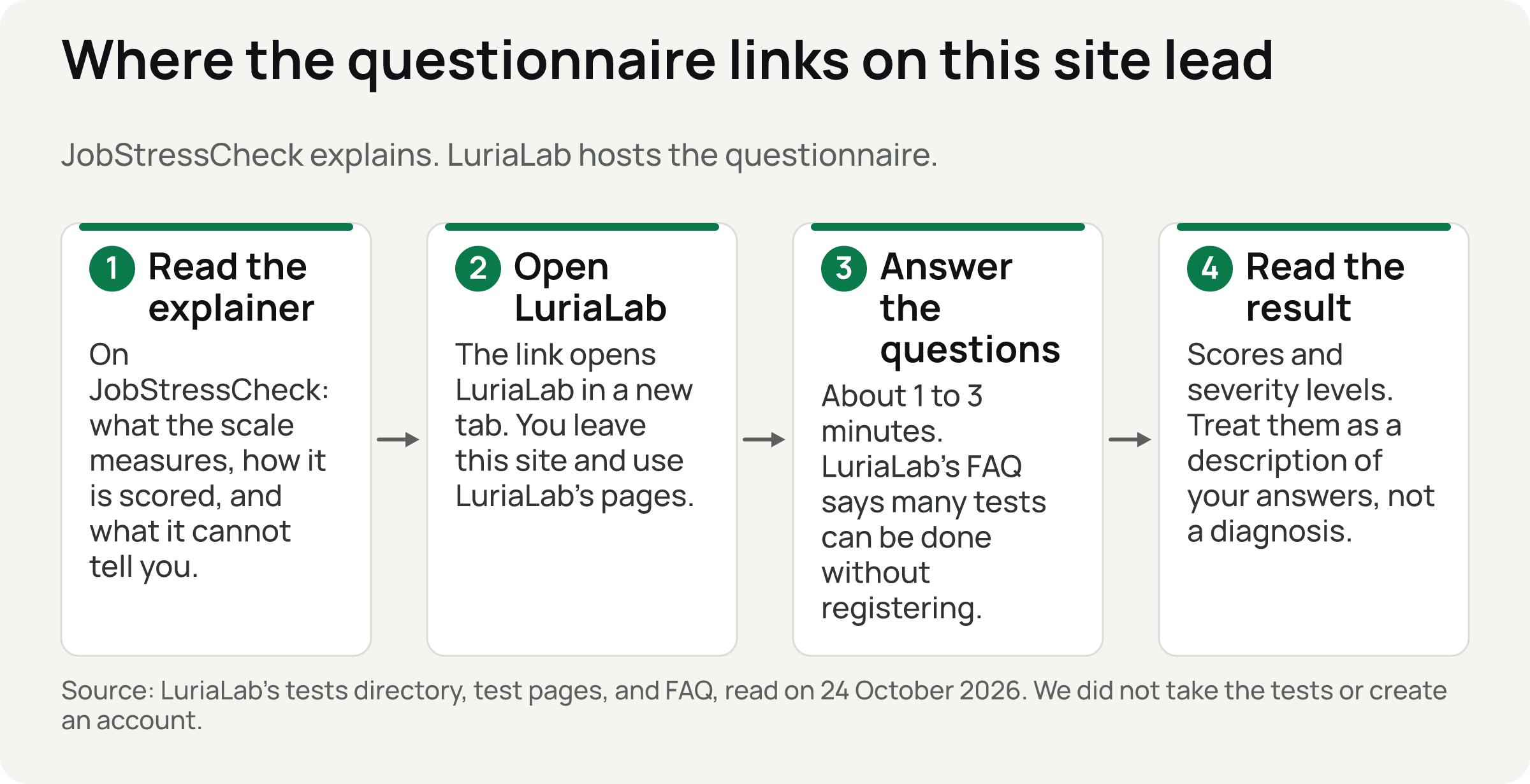
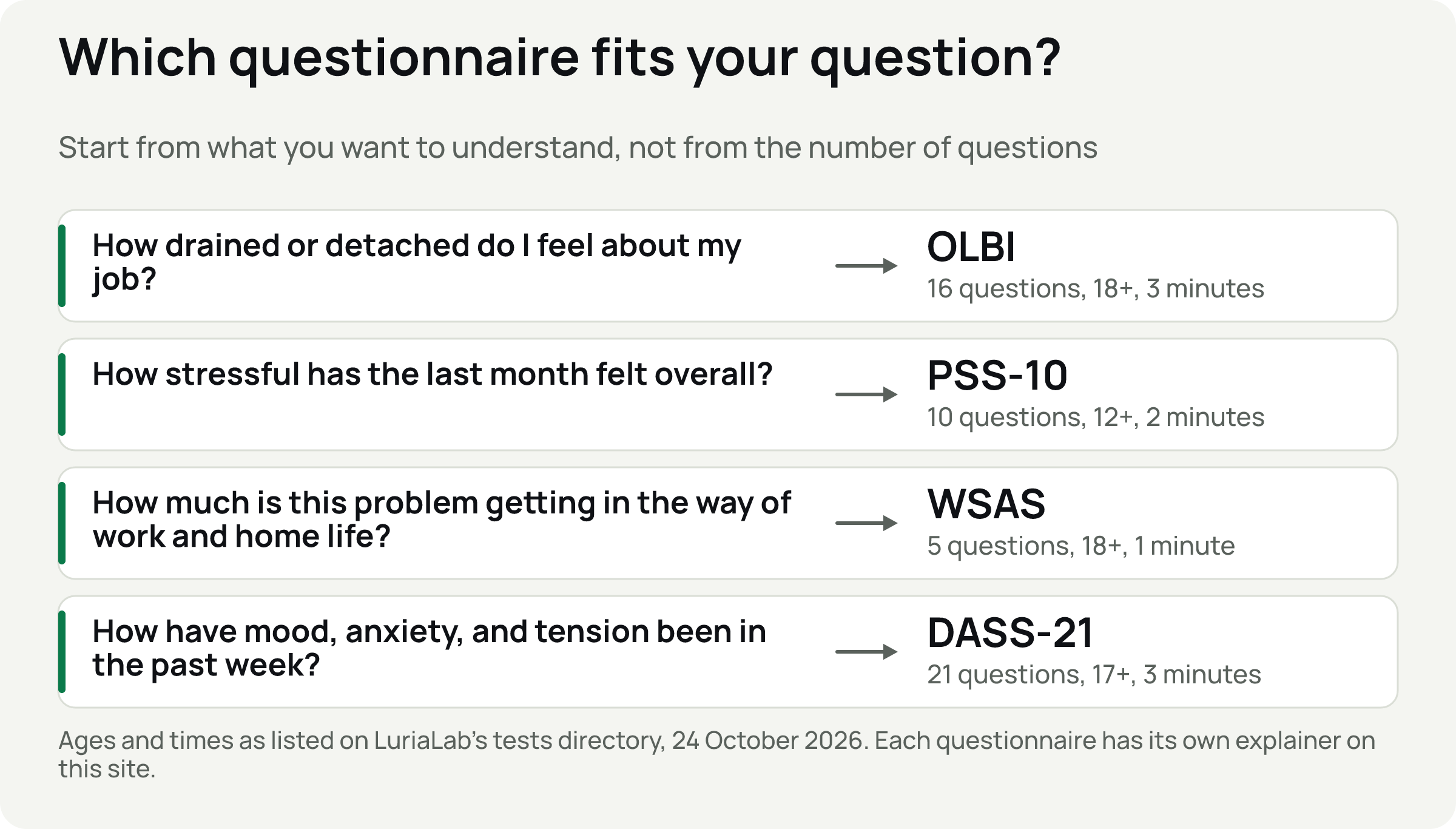
LuriaLab is a free online library of 72 psychological screening questionnaires in 18 languages. [1] Four are relevant to work stress: the Oldenburg Burnout Inventory, the Perceived Stress Scale, the Work and Social Adjustment Scale, and the DASS-21. [1] They give instant scores, and LuriaLab says plainly that they are educational screening tools, not medical diagnoses. [2][3] Useful for a quick look, with caveats about privacy details we could not confirm, and about what a score can mean.
LuriaLab at a glance
Facts below come from LuriaLab's own public pages on 24 October 2026. They are what the company says, not independent findings.
| Question | What the public pages say |
|---|---|
| What is it? | An online psychological assessment platform with 72 free screenings listed in its tests directory. [1][4] |
| Cost | "Many tests are available for free." Some advanced features, detailed reports, or professional tools may require payment, with costs shown before use. [4] |
| Account | Optional. An account lets you save results and track progress. Many assessments can be completed anonymously. [4] |
| Languages | 18 listed on the tests directory. The FAQ says 17, so the number appears to have changed. [1][4] |
| Time and ages | OLBI: about 3 minutes, 18+. PSS-10: about 2 minutes, 12+. WSAS: about 1 minute, 18+. DASS-21: about 3 minutes, 17+. [1][6] |
| Who is behind it | Not named. Site pages are "maintained by the LuriaLab editorial team." [7] |
Which LuriaLab tests relate to job stress and burnout?
Four of the 72 are most relevant. They measure different things, so the one you choose should match your question. Each has a full explainer on this site, covering what it measures, how it is scored, and its limits.
What do you get when you finish a test?
LuriaLab says results are scored instantly. [4][8] What you see depends on the test:
- OLBI: scoring for the exhaustion and disengagement subscales. LuriaLab says higher scores suggest greater burnout-related strain. [2]
- DASS-21: each subscale is summed and multiplied by 2, and the report shows separate scores and severity bands. [3]
- PSS-10: a total from 0 to 40 and three reference bands, 0 to 13, 14 to 26, and 27 to 40, which LuriaLab describes as not official clinical cut-offs. [9]
That last point deserves care. The developer of the PSS states there are no diagnostic score cut-offs. A reference band is a convenience, not a finding about you. Our explainer on each scale says what its scores can and cannot mean.
What about privacy?
Here is what LuriaLab says about your data, and where it says it.
| Where | What it says |
|---|---|
| Homepage | "Test without an account. Your data is never sold or shared." [8] |
| FAQ | Personal data is never sold or shared with third parties, and you can delete your data on request. [4][5] |
| Privacy policy, what it collects (last updated 7 March 2025) | It may collect personal information such as name, email address, and demographic details, plus test responses and usage data such as IP address and browser type. [5] |
| Privacy policy, how it handles data | Responses are stored securely and not shared with third parties without explicit consent, and retained only as long as necessary or as the law requires. It says it complies with international data protection rules including GDPR for EU users. [5] |
Some things we could not confirm from public pages. The policy does not name a legal entity or say where the operator is based; the only contact given is an email address. [5] The policy says LuriaLab "does not knowingly collect data from individuals under the age of 16," yet the PSS-10 listing is for ages 12 and over, and the DASS-21 for 17 and over. [5][1][9] It names no analytics provider, and says it may use cookies. [5]
- Read the privacy policy before entering personal information.
- If you want to stay anonymous, avoid creating an account and avoid entering your name or email.
- If you are under 16, ask a trusted adult before you use the site, given the policy wording above.
- Do not share a result with your employer unless you have chosen to.
Is there anything for HR and employers?
LuriaLab's homepage describes a corporate offering: employee wellbeing assessments, automatic scoring, team and leadership assessments, anonymous feedback tools, and organisational reports. Its FAQ says bulk assessments and anonymised group reporting are available, and that organisations can integrate it into wellness programmes. It lists no corporate prices. [8][4] It also says it is not a healthcare provider and does not provide HIPAA-covered clinical services, which matters if you are weighing what health data an employer should handle. [2]
The individual questionnaires on this site measure how a person answers about themselves. They are not an assessment of risks in the workplace. For that, see our guide on running a work stress risk assessment.
Strengths and limits
What works for the reader: the tests are free and short, they are well-known scales rather than invented quizzes, the pages cite the original research, and the disclaimers are clear. [2][3][9]
What to bear in mind: we did not take the tests or create an account, so this review does not describe the experience of using them. LuriaLab does not publish who runs it or who reviews its content. [7] The count of languages and the age statements differ between pages. Research on a questionnaire does not validate every online adaptation of it. Treat the result as one prompt for a conversation, not as an answer.
Who is it for?
It suits adults who want a quick, free, well-known questionnaire to describe how they have felt, and who will read the limits first. It is not suitable as a diagnosis, as proof for an employer, or as a replacement for talking to a doctor. If you are struggling, a result does not change what to do: speak to someone. [2]
Common questions
Is LuriaLab free?
Many tests are, and every test listed in its directory was marked free when we checked. Some advanced features, detailed reports, or professional tools may require payment, with costs shown before use. [1][4]
Do I need an account to take a test?
LuriaLab says an account is optional, and that many assessments can be completed anonymously. [4] The account lets you save and compare results.
Keep reading
Sources and further reading
These links open external research and health-information websites.
- LuriaLab: Free mental health screenings (tests directory)
72 tests, 18 languages, all marked free, with age ranges and times for the four tests discussed. Read on 24 October 2026. - LuriaLab: Oldenburg Burnout Inventory (OLBI) test page
Subscales, scoring statement, disclaimers, and citation. - LuriaLab: DASS-21 test page
Past-week time frame, scoring, severity bands, and disclaimers. - LuriaLab: Frequently asked questions
Cost, optional accounts, anonymity, data statements, and the organisations offering. - LuriaLab: Privacy policy (last updated 07.03.2025)
Data collected, storage, retention, minors, deletion, and the absence of a named operator. - LuriaLab: Work and Social Adjustment Scale (WSAS) test page
Five areas of functioning, 18+, and disclaimers. - LuriaLab: About
Site pages are maintained by the LuriaLab editorial team; no individuals or organisation named. - LuriaLab: Homepage
Instant scoring, anonymous testing claim, and the corporate offering. - LuriaLab: Perceived Stress Scale (PSS-10) test page
Total from 0 to 40, reverse-scored items, the three reference bands, and age 12+. - WHO: Burn-out an "occupational phenomenon" (2019)
ICD-11: burn-out is not classified as a medical condition.
Educational review, not medical advice. Prices, features, and policies change, so check the provider's own pages before you pay or enter personal information.