
Review · Employee assistance programmes
Employee assistance programmes explained: what they cover, confidentiality, and what to ask
A free, short-term support service some employers provide. What it covers, how to check confidentiality, what research says, and questions for employees and HR.

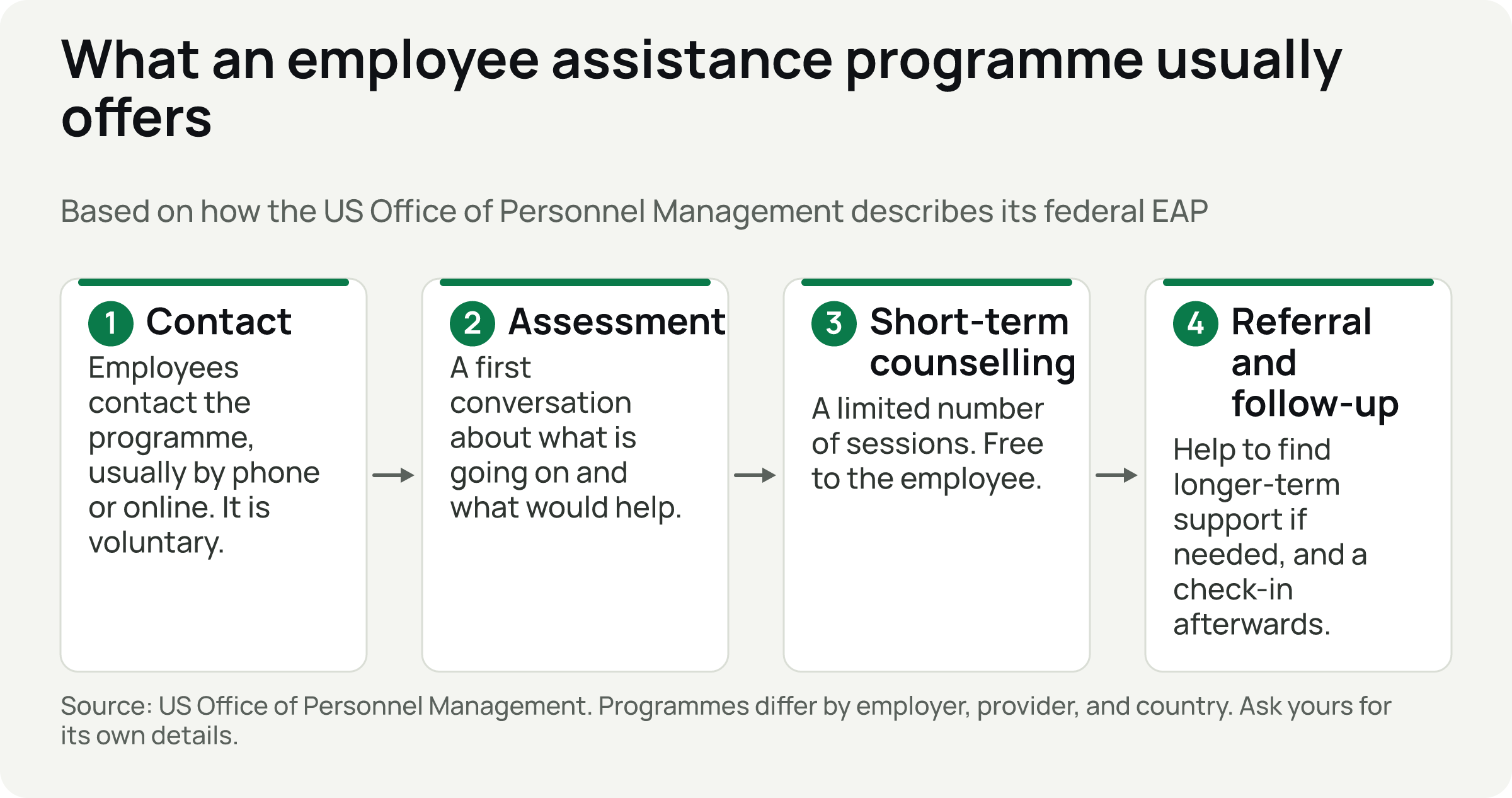
An employee assistance programme (EAP) is a voluntary, work-based service that the US Office of Personnel Management describes as offering free and confidential assessments, short-term counselling, referrals, and follow-up for personal and work-related problems. [1] Many employers outside the US offer a similar service under the same name. [3] A review of workplace counselling found it generally effective in easing psychological problems and as having a significant impact on sickness absence, but it called for more high-quality research. [4] An EAP is a useful first step, and cannot replace changing the work.
What is an employee assistance programme?
The US Office of Personnel Management (OPM) describes an EAP as "a voluntary, work-based program that offers free and confidential assessments, short-term counseling, referrals, and follow-up services to employees who have personal and/or work-related problems." [1] Its description of federal EAPs adds services such as 24-hour access to a licensed clinician or counsellor, financial and legal help, dependent care, workplace conflict resolution, substance use referrals, and crisis intervention. [2]
Outside the US, Acas, the UK workplace advice body, says an employer might offer counselling or mental health support through an EAP. [3] Services and wording vary, so treat the OPM description as an example of the typical model, not a rule for every programme.
When is an EAP a good first step?
It can be a good first step when you want to talk to someone soon, you are not sure where to start, or you would like a referral. NHS guidance notes that therapy is sometimes available for free through your employer. [7] It may also suit you if you want to avoid your GP waiting list, or want help with a work problem that is not clinical, such as a conflict.
- You are struggling and want to speak to a trained person this week.
- You want help thinking through a decision, a conflict, or a change at work.
- You want a referral to longer-term support.
- You are not sure whether what you feel needs treatment.
How confidential is an EAP?
OPM describes federal EAP services as confidential. [1][2] That is one employer's framework, and the details are not the same everywhere. Providers are separate companies, practice differs by country, and what an employer sees may differ from what you tell the counsellor. The honest answer is: ask.
- Who provides the service: an outside company or an in-house team?
- What will my employer be told, if anything? Is it only the number of people who used the service, with no names?
- In what situations would the counsellor have to break confidentiality, such as a risk to safety?
- Where is my data stored, and for how long?
- Can my family members use it too?
- Is there a limit on the number of sessions, and what happens after that?
- Is it available out of hours, in my language, by phone, video, or in person?
Does it work?
The evidence is mixed in quality. McLeod's 2010 systematic review of workplace counselling concluded that it is generally effective in alleviating psychological problems and has a significant impact on sickness absence, and it called for more high-quality research. [4] That review looked at counselling in the workplace in general, not at any one provider. The abstract does not report limitations in detail, and we did not read the full paper.
Another point worth keeping in mind is where an EAP sits in the bigger picture. The WHO lists individual interventions such as psychosocial support as one of six categories of recommendation for mental health at work, alongside organisational interventions and manager training. [6] HSE describes help for coping as secondary action, which does not remove the cause, and support for those made ill as tertiary. [5]
If you are choosing an EAP for your organisation
An EAP is a reasonable part of a response, but it is not an assessment of the causes. Ask providers what they can show, rather than what they say. These questions are suggestions drawn from the principles above.
- What does the provider report to us, and at what level of detail? Aggregate only, and with minimum group sizes to protect anonymity?
- How is confidentiality protected, and who audits it?
- How many sessions, and what are the referral routes after them?
- Who are the counsellors, and what registration or accreditation do they hold?
- How are people told about the service, and how will we make it easy to use without stigma?
- How will we use trends in what people raise to change the work? HSE puts the source of stress first. [5]
What are the alternatives?
In England, adults registered with a GP can refer themselves to NHS talking therapies for anxiety and depression, or 16 and over in some areas. [7] A GP can discuss your symptoms and options. Acas also lists counsellors provided by work, the NHS, or found privately, and mentions charities and support groups. [3] Elsewhere, ask your doctor or findahelpline.com.
Common questions
Does using the EAP go on my record?
It depends on the provider and your country. OPM describes federal EAP services as confidential. [1] For any other programme, ask what is recorded, who can see it, and how long it is kept.
Will my manager know I used it?
Ask your provider and your HR team. Many services say they do not tell your employer who uses them, but practice differs, and we cannot confirm it for your programme.
How many sessions do I get?
EAP counselling is described as short-term. [1] The number varies by programme, so check yours before you start. Ask what happens after the sessions end.
Is it free?
OPM describes federal EAP services as free. [1] Check this for your programme, and ask what happens if you need longer-term care outside it.
Keep reading
Sources and further reading
These links open external research and health-information websites.
- US Office of Personnel Management: Frequently asked questions
The federal definition of an EAP as voluntary, free, and confidential, with short-term counselling, referrals, and follow-up. US federal employees; used as an example. - US Office of Personnel Management: Employee Assistance Programs
Services offered by federal EAPs, including 24/7 access to licensed counsellors. - Acas: Getting emotional support
Employer-provided counselling through an EAP, and other routes. Acas is a UK body. - McLeod (2010): The effectiveness of workplace counselling: a systematic review. Counselling and Psychotherapy Research, 10(4), 238-248
Abstract read on a university repository record; full text not opened. - HSE: Management Standards Step 3, evaluate the risks
Primary, secondary, and tertiary interventions. - WHO: Mental health at work (fact sheet)
Recommendations for organisations, including individual interventions. Page dated 15 September 2026 when checked. - NHS: NHS talking therapies
Self-referral in England, age requirements, and the note that therapy is sometimes available free through your employer.
Educational review, not medical advice. Prices, features, and policies change, so check the provider's own pages before you pay or enter personal information.