
Work and Social Adjustment Scale (WSAS): a free impairment questionnaire explained
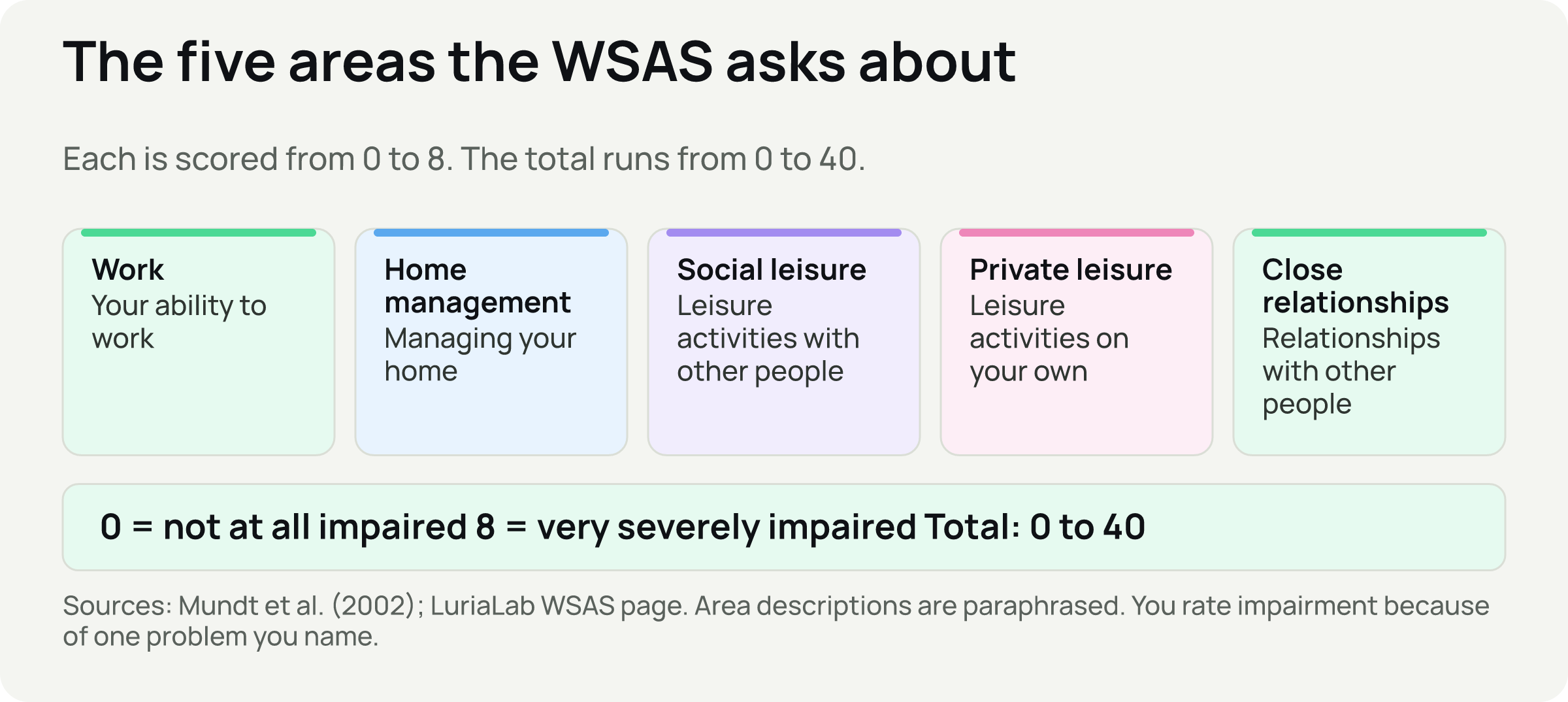
The Work and Social Adjustment Scale (WSAS) is a five-question scale about how much a problem you name is getting in the way of work, home management, social leisure, private leisure, and close relationships. Each area is scored from 0 to 8, giving a total from 0 to 40, and higher means more impairment. [2] It does not measure stress or burnout directly, and it is not a diagnosis.
What is the Work and Social Adjustment Scale?
It is a short self-report scale published by Jim Mundt, Isaac Marks, and colleagues in 2002 as a simple measure of impairment in functioning. [2] You keep one problem in mind, such as stress or low mood, and rate how much it affects your ability to work, manage your home, enjoy social and private leisure, and keep close relationships. [2][3]
LuriaLab describes functional impairment as the degree to which symptoms interfere with everyday roles, and says it is a description of impact, not a diagnosis. [4] That makes the WSAS different from symptom questionnaires: two people with the same symptoms can differ greatly in how far their lives are affected.
Can I use the WSAS if my problem is work stress?
Yes, because you decide what the "problem" is. If you name work stress or burnout, the five items show how far it reaches beyond work, for example into your home life and friendships. If the work item is your only high one, the problem may be concentrated in the job. If several are high, it has spread.
It does not ask what is causing the stress, and it does not measure how stressed you feel. For that, use the PSS-10 or the OLBI.
What can I find in these WSAS explainers?
If you have a result, start with scoring or understanding results. If you are deciding whether to take it, start with what it measures and who it is for.
Where do I take the WSAS online?
JobStressCheck explains questionnaires and does not host them. The link opens LuriaLab in a new tab. LuriaLab lists the WSAS for ages 18 and over, at about 1 minute. [1] Its page does not describe the response options or the scoring, so read this explainer first. Check its privacy policy too.
Do I need a score before asking for support?
No. A good question is whether your life is being affected, and you can answer it without a questionnaire. NIMH suggests seeking professional help when symptoms interfere with everyday life, cause you to avoid activities, or seem always present. [6]
Common questions
Sources and further reading
These links open external research and health-information websites.
- LuriaLab: Work and Social Adjustment Scale (WSAS) test page
Five areas of functioning, age 18+, about 1 minute, and disclaimers. Response options and scoring are not described on the page. Read on 24 October 2026. - Mundt, Marks, Shear, and Greist (2002): The Work and Social Adjustment Scale: a simple measure of impairment in functioning. British Journal of Psychiatry, 180(5), 461-464
The original paper: five items, 0 to 8, over 500 patients in two treatment studies (depression and obsessive-compulsive disorder), reliability, validity, and the tentative score bands. - NovoPsych: Work and Social Adjustment Scale
A commercial publisher's summary of items, scoring, alternative bands, percentile context, reliability figures, and populations. Read on 24 October 2026. - LuriaLab glossary: What is functional impairment?
Describes functional impairment as interference with everyday roles, and the WSAS as rating five areas. Gives no numeric thresholds. - NHS: Get help with stress
Signs of stress, when to see a GP, urgent help routes in the UK, and self-referral to NHS talking therapies. - NIMH: I'm so stressed out! Fact sheet
When to seek professional help when symptoms interfere with everyday life, and the 988 Suicide & Crisis Lifeline.
This page is educational. A questionnaire score cannot establish a diagnosis or explain the cause of your symptoms. If you are struggling, speak with a doctor or mental health professional, whatever your score. Read when to get help for work stress or find a helpline in your country.