
BAT scoring: averages from 1 to 5, norms, and traffic-light cut-offs
Add the item scores and divide by the number of items, so every score is an average from 1 to 5. [1] The manual gives two ways to read it: statistical norms (low, average, high, very high) and clinical cut-offs (green, orange, red). Both are for Flemish employees, and other countries are still being developed. [1]
How do you calculate a BAT score?
Add the scores for all 23 core items, divide by 23, and round to two decimals. For the short version, divide by 12. For a single scale, add its items and divide by its number of items. The 10 secondary items are scored the same way, divided by 10. [1]
Worked example
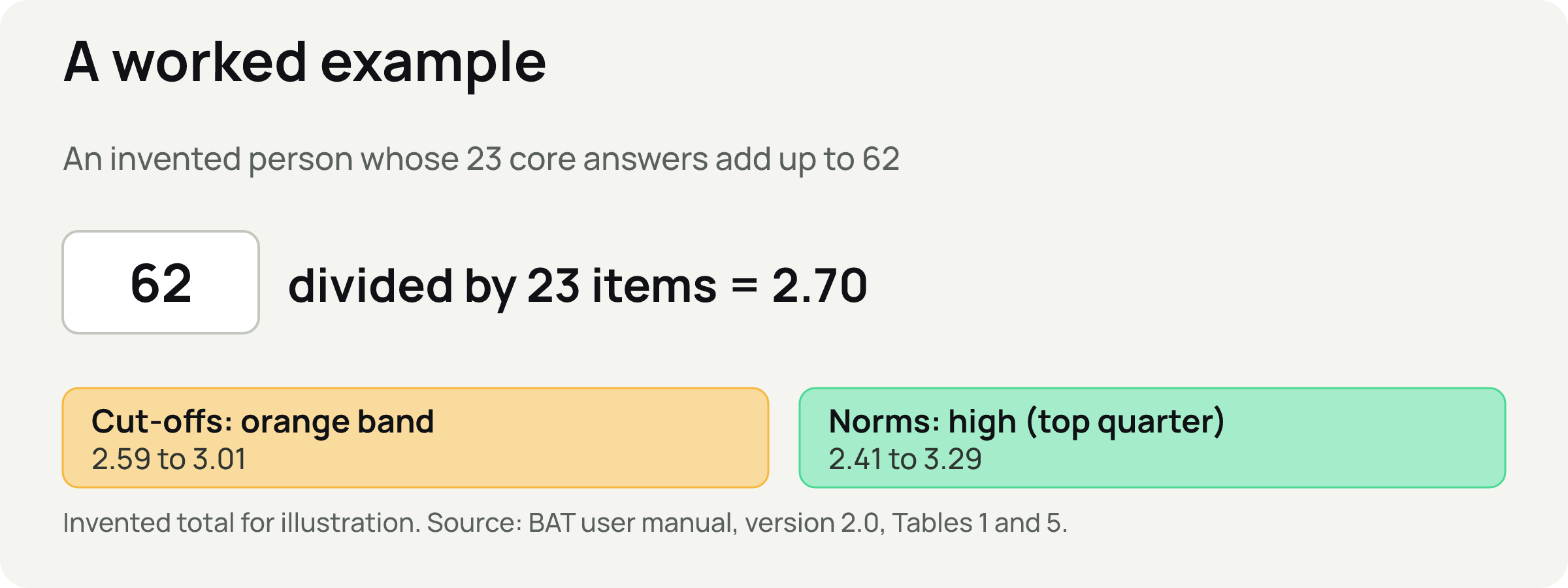
An invented person answers the 23 core items of the work-related version and the answers add up to 62.
What are the norms?
The manual says "low" means the score is among the lowest 25% of employees, "high" among the highest 25%, and "very high" among the top 5%. For the BAT-23 total, the Flemish ranges are low 1.00 to 1.60, average 1.61 to 2.40, high 2.41 to 3.29, and very high 3.30 to 5.00. Norms are also available for the Netherlands. [1] A norm shows how you compare with other workers. It does not say whether your score is a problem. [1]
What are the traffic-light cut-offs?
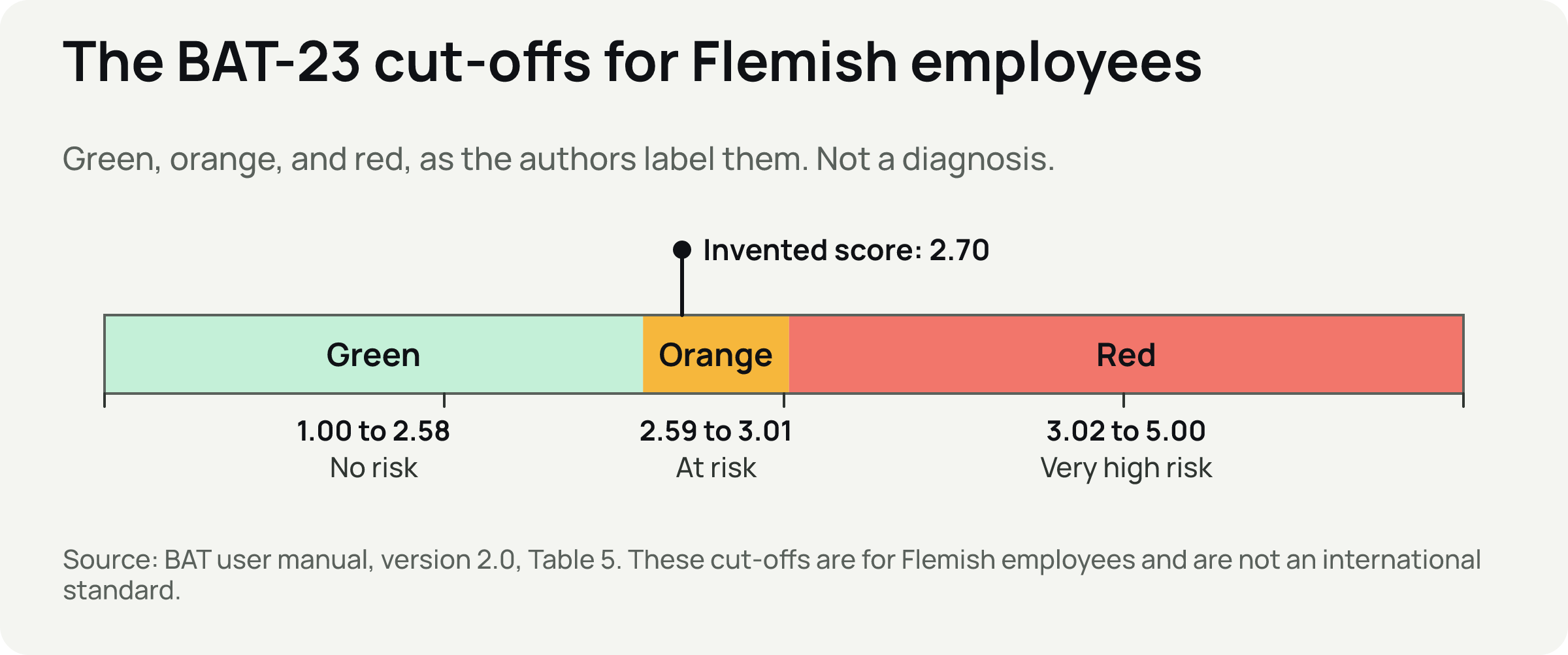
The cut-offs are based on the scores of patients who, according to trained professionals, have severe burnout complaints. The manual labels them green (no risk of burnout), orange (at risk of burnout), and red (very high risk of burnout). For the BAT-23 total in Flemish employees, green is 1.00 to 2.58, orange 2.59 to 3.01, and red 3.02 to 5.00. [1]
How far can I trust the cut-offs?
Only for the group they were made for. Clinical cut-offs are available for Flanders only, and the manual says statistical norms and cut-offs for other countries are being developed. [1] The development paper, published later in 2020, said clinically validated cut-off scores were not yet available, and proposed a method for finding them. [2] We could not reconcile the two, so treat the cut-offs as the authors' proposals for Flemish employees. For the short version, the manual says the red cut-offs are not sensitive enough, so it recommends using only the total score. [1]
Is the result a percentage or a probability?
No. It is an average from 1 to 5. It does not give the chance of having burnout.
Common questions
What is a high BAT score?
In the Flemish norms, 2.41 to 3.29 on the BAT-23 total is "high" and 3.30 and above is "very high". In the cut-offs, 3.02 and above is red. These come from Flemish employees and are not diagnoses. [1]
What is the highest possible BAT score?
The highest average is 5, because every item is scored from 1 to 5. [1]
Does the BAT have international norms?
Not yet. The manual gives norms for Flanders and the Netherlands, cut-offs for Flanders only, and says other countries are being developed. [1]
Sources and further reading
These links open external research and health-information websites.
- Schaufeli, De Witte, and Desart (2020): User manual, Burnout Assessment Tool (BAT), version 2.0. KU Leuven, Belgium (internal report). Copy read from the Australian and New Zealand Society of Occupational Medicine
The versions, the dimensions and item counts, the five-point scale, how to calculate and interpret scores, the Flemish norms and cut-offs, and the three principles of use. Read on 2 November 2026. - Schaufeli, Desart, and De Witte (2020): Burnout Assessment Tool (BAT): development, validity, and reliability. International Journal of Environmental Research and Public Health, 17(24), 9495
The development paper: 1,500 Flemish employees, the dimensions, reliability, limitations, and the statement that no clinically validated cut-offs were yet available. Read through Europe PMC; the last 2,097 of about 202,000 characters not read.
This page is educational. A questionnaire score cannot establish a diagnosis or explain the cause of your symptoms. If you are struggling, speak with a doctor or mental health professional, whatever your score. Read when to get help for work stress or find a helpline in your country.