
Burnout Assessment Tool (BAT): a newer burnout questionnaire explained
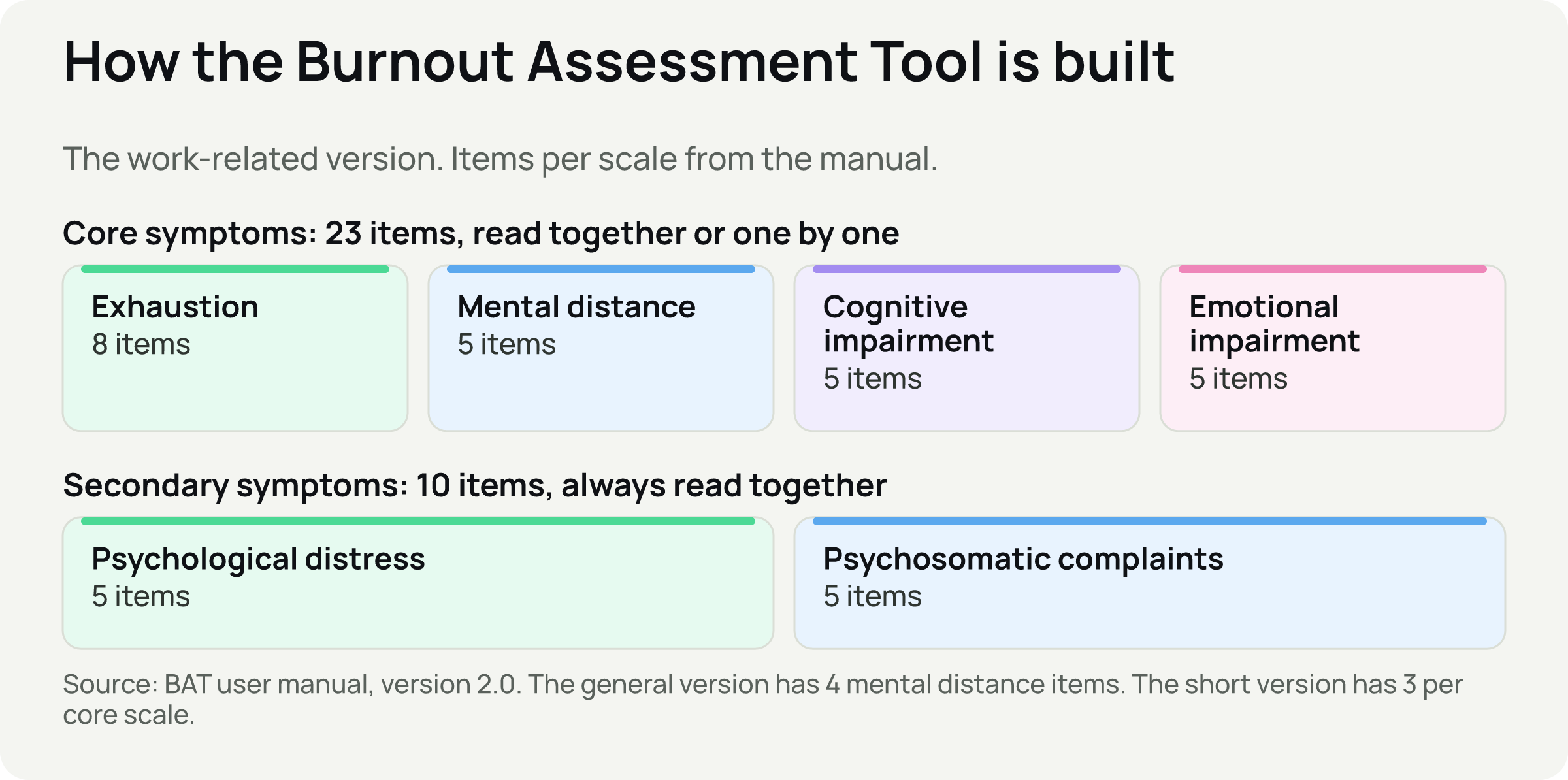
The Burnout Assessment Tool (BAT) is a burnout questionnaire developed at KU Leuven in Belgium. Its full work-related version has 23 core items about four symptoms: exhaustion, mental distance, cognitive impairment, and emotional impairment, plus 10 items on secondary symptoms. [2][3] Each item is answered from 1 ("never") to 5 ("always"), and scores are averages from 1 to 5. [2] The authors say it should not be used to diagnose burnout. [2]
What is the Burnout Assessment Tool?
It is a self-report questionnaire developed by Wilmar Schaufeli, Hans De Witte, and Steffie Desart at KU Leuven. [1][2] The development paper describes 33 items in total: 23 core items and 10 secondary items. [3] The full version takes about five minutes, and a short version takes less. [2]
The World Health Organization (WHO) describes burn-out in ICD-11 as an occupational phenomenon, not a medical condition, resulting from chronic workplace stress that has not been successfully managed. [4] The BAT measures symptoms that people report. It is not that definition, and a score does not say whether someone meets it.
Can I use the BAT if my problem is work stress?
Yes. The work-related version is written for people who work, and its items refer to your work situation. [2] It tells you how often you notice burnout symptoms, not what in your job is causing them. The manual says other questionnaires should be used for causes. [2] For stress as such, use the PSS-10.
What can I find in these BAT explainers?
If you have a result, start with scoring or understanding results. If you are deciding whether to take it, start with what it measures and who it is for.
Where do I get the BAT?
JobStressCheck explains questionnaires and does not host them. The official website has the manual and the language versions, and says the BAT is free to use. It does not host an online test. It points to two options from the Belgian government: one with the core components, and one with the extended version. [1] The manual notes that the BAT is available as a paper-and-pencil questionnaire, and that it can be built into an online platform. [2]
Do I need a score before asking for support?
No. The NHS suggests seeing a GP if you are struggling to cope with stress, or if what you are trying yourself is not helping. [5] You do not need a questionnaire result to do that.
Common questions
How long does the BAT take, and is it free?
The manual says about five minutes for the full version, and less for the short one. [2] The official site says it is free to use without asking the authors. [1]
What is a good BAT score?
A lower average means fewer reported burnout symptoms. The manual's bands are for Flemish employees and are not targets or diagnoses. [2]
Sources and further reading
These links open external research and health-information websites.
- Burnout Assessment Tool: official website (KU Leuven)
What the BAT is, that it is free and non-proprietary but must not be modified and the 2020 paper must be cited, where the manual and language versions are, and that the site hosts no online test. Read on 2 November 2026. - Schaufeli, De Witte, and Desart (2020): User manual, Burnout Assessment Tool (BAT), version 2.0. KU Leuven, Belgium (internal report). Copy read from the Australian and New Zealand Society of Occupational Medicine
The versions, the dimensions and item counts, the five-point scale, how to calculate and interpret scores, the Flemish norms and cut-offs, and the three principles of use. Read on 2 November 2026. - Schaufeli, Desart, and De Witte (2020): Burnout Assessment Tool (BAT): development, validity, and reliability. International Journal of Environmental Research and Public Health, 17(24), 9495
The development paper: 1,500 Flemish employees, the dimensions, reliability, limitations, and the statement that no clinically validated cut-offs were yet available. Read through Europe PMC; the last 2,097 of about 202,000 characters not read. - WHO: Burn-out an "occupational phenomenon" (2019)
The ICD-11 definition, the three dimensions, and the statement that it is not classified as a medical condition. - NHS: Get help with stress
Signs of stress, when to see a GP, urgent help routes in the UK, and self-referral to NHS talking therapies.
This page is educational. A questionnaire score cannot establish a diagnosis or explain the cause of your symptoms. If you are struggling, speak with a doctor or mental health professional, whatever your score. Read when to get help for work stress or find a helpline in your country.