
CBI scoring: converting answers to 0 to 100, and what a score is compared with
Each answer is converted to points: 100, 75, 50, 25, or 0. A scale score is the average of its answers, so it runs from 0 to 100, and higher means more burnout. [1] The document gives comparison figures from Danish samples and from human service workers, and uses 50 or more to describe a "high degree" of burnout in its own results. It gives no diagnostic cut-off. [1]
How do you calculate a CBI scale score?
Convert each answer to points: always (or to a very high degree) is 100, often (or to a high degree) is 75, sometimes (or somewhat) is 50, seldom (or to a low degree) is 25, and never or almost never (or to a very low degree) is 0. The scale score is the average of the points for the questions in that scale. [1] Reverse the one reversed question first.
The document sets non-responder rules. If fewer than three of the six personal questions, fewer than four of the seven work-related questions, or fewer than three of the six client questions are answered, that scale is not scored. [1]
Worked example
An invented person answers the six personal burnout questions.
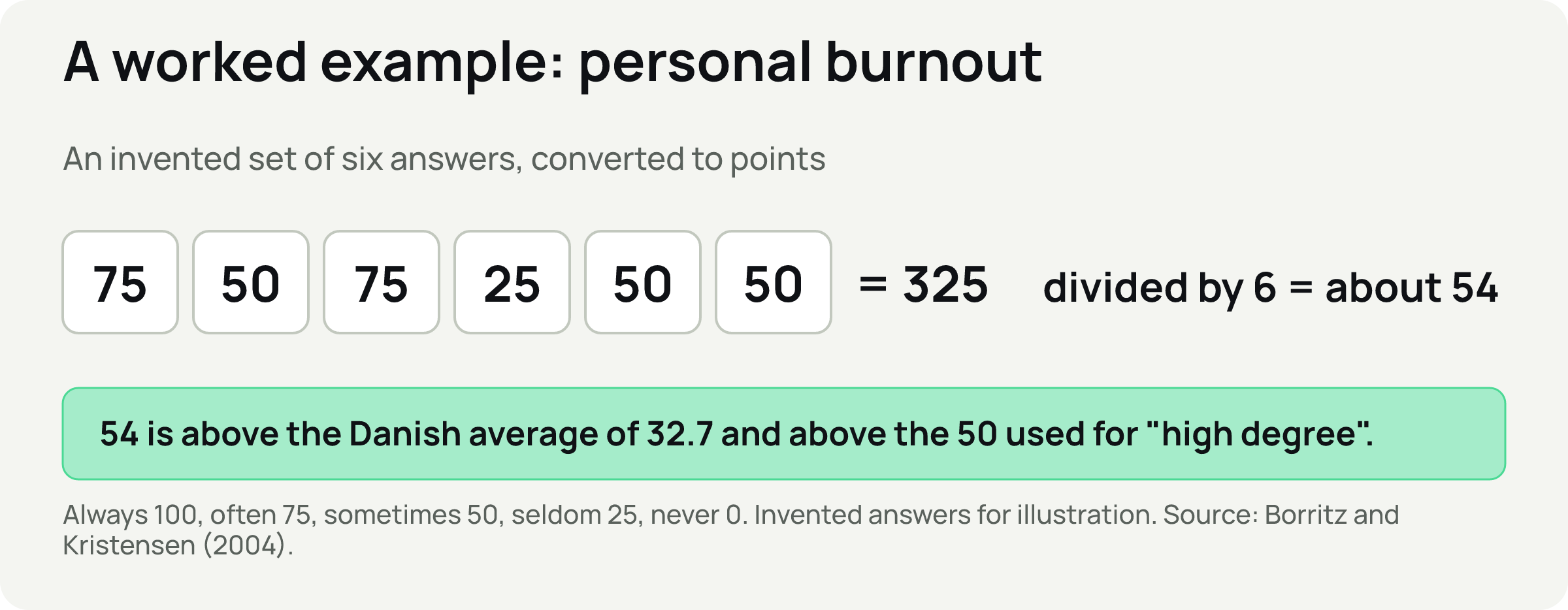
What is a score compared with?
The document gives figures for several groups. A representative sample of 1,498 Danes aged 20 to 59 had an average personal burnout score of 32.7. Among the employed, it was 31.7, and among those without employment, 36.6. [1] The PUMA study of 1,917 people in human service professions (83% women) had averages of 35.9 for personal, 33.0 for work-related, and 30.9 for client-related burnout. [1]
| Group | Personal | Work-related | Client-related |
|---|---|---|---|
| Representative Danish adults (N 1,498) | 32.7 | Not given | Not given |
| Employed Danish adults (N 1,186) | 31.7 | Not given | Not given |
| Danish adults without employment (N 312) | 36.6 | Not given | Not given |
| PUMA human service workers (N about 1,900) | 35.9 | 33.0 | 30.9 |
Is there a cut-off for burnout?
The document gives none for diagnosis. In its PUMA results it defines a "high degree" of burnout as 50 points or more, and reports that 22.2% of that group had it for personal burnout, 19.8% for work-related, and 15.9% for client-related burnout. [1] That is a description of one sample, not an official threshold, and it does not mean everyone above 50 has burnout. The Hong Kong Academy of Medicine's online version gives tiered result text but states no cut-off for "high" on its page. [2]
Is the result a percentage or a probability?
No. It is an average of points from 0 to 100, not a percentage of anything and not a chance of having burnout.
Common questions
What is a high CBI score?
The document uses 50 points or more to describe a "high degree" of burnout in its PUMA results. It is not a diagnostic cut-off. [1]
What is the highest possible CBI score?
Each scale runs from 0 to 100. Three scales give three separate scores, not one total. [1]
Can I add the three scales together?
The document scores each scale on its own and does not describe a combined score. [1]
Sources and further reading
These links open external research and health-information websites.
- Borritz and Kristensen (2004): Copenhagen Burnout Inventory. Normative data from a representative Danish population on personal burnout, and results from the PUMA study. National Institute of Occupational Health, Copenhagen (first edition, February 2004)
The inventory's own document, hosted by the Danish National Research Centre for the Working Environment: the three parts and their definitions, response categories, scoring, non-responder rules, Danish normative data, and PUMA results. Read on 2 November 2026. - Hong Kong Academy of Medicine: Copenhagen Burnout Inventory (online self-assessment)
An automated online version, made with the consent of the Danish centre. Three scales from 0 to 100, tiered result text, and a note that burnout is an occupational phenomenon in ICD-11. Read on 2 November 2026.
This page is educational. A questionnaire score cannot establish a diagnosis or explain the cause of your symptoms. If you are struggling, speak with a doctor or mental health professional, whatever your score. Read when to get help for work stress or find a helpline in your country.