
Copenhagen Burnout Inventory (CBI): a work-related burnout questionnaire explained
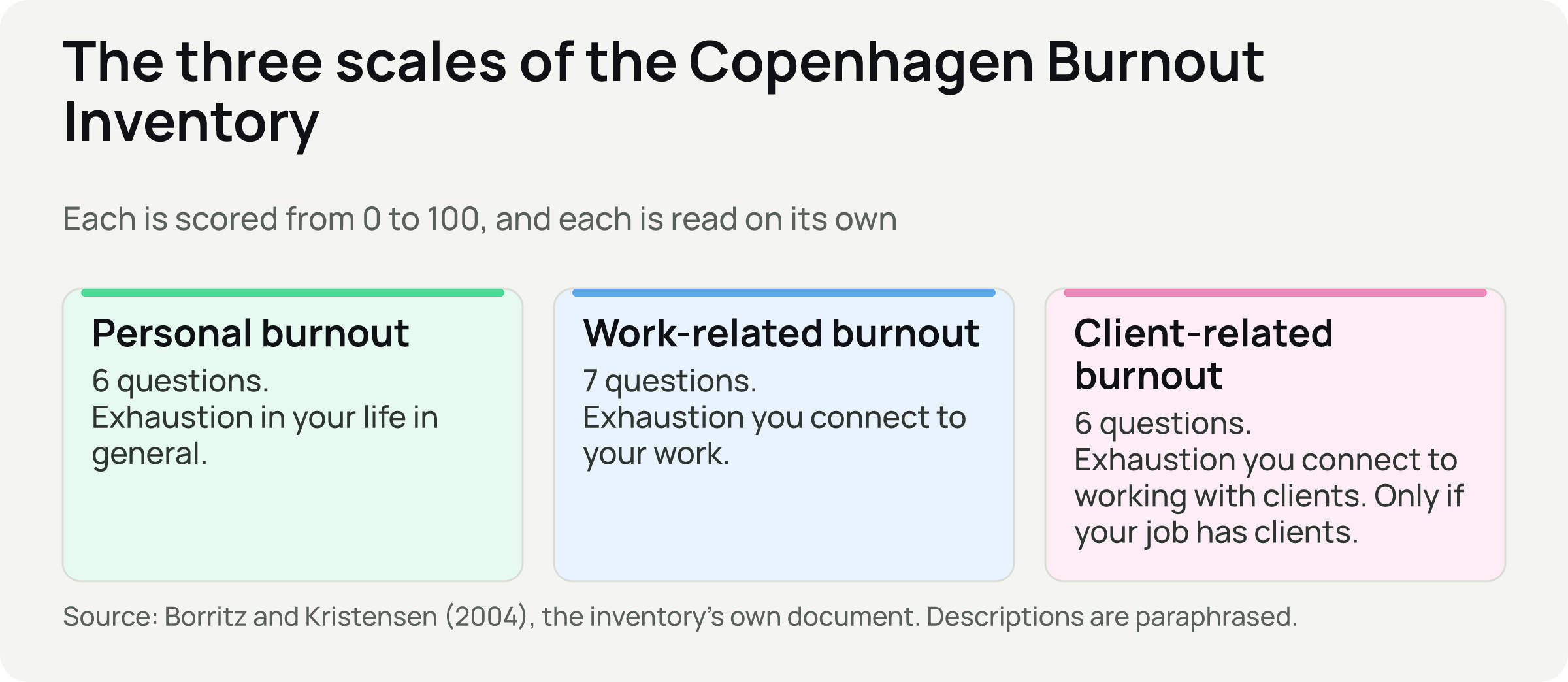
The Copenhagen Burnout Inventory (CBI) is a 19-question questionnaire with three separate scales: personal burnout (6 questions), work-related burnout (7), and client-related burnout (6). [1] Each answer is converted to a number from 0 to 100, and a scale score is the average of its answers. Higher means more burnout. [1] It is not a diagnosis.
What is the Copenhagen Burnout Inventory?
It is a burnout questionnaire written by researchers at the Danish National Institute of Occupational Health for the PUMA study, a project on burnout, motivation, and job satisfaction. [1] The first edition of its document is dated February 2004. [1] It describes burnout as a state of prolonged physical and psychological exhaustion, and asks about it in three settings: your life in general, your work, and your work with clients. [1]
The World Health Organization (WHO) describes burn-out in ICD-11 as an occupational phenomenon, not a medical condition, resulting from chronic workplace stress that has not been successfully managed. [4] The CBI is a measure of exhaustion linked to work. It is not that definition, and a score does not say whether someone meets it.
Can I use the CBI if my problem is work stress?
Yes, and this is where it is useful. The work-related scale asks about exhaustion that you connect to your work, and the personal scale asks about exhaustion in general. [1] Comparing the two shows whether the tiredness is mostly about the job or reaches into the rest of your life.
It does not ask what in your job is causing the exhaustion, and it does not measure stress as such. For stress, use the PSS-10. For another view of burnout at work, read about the OLBI, the Maslach Burnout Inventory, or the Burnout Assessment Tool.
What can I find in these CBI explainers?
If you have a result, start with scoring or understanding results. If you are deciding whether to take it, start with what it measures and who it is for.
Where do I take the CBI online?
JobStressCheck explains questionnaires and does not host them. The Hong Kong Academy of Medicine offers an automated online version, and says it was made with the consent of the Danish National Research Centre for the Working Environment. [2] It shows three scores from 0 to 100 and a short result text, and it describes itself as a way to notice warning signs. [2] The inventory's own document, with its questions and scoring, is on the Danish centre's website. [1] Check the privacy information of whichever page you use.
Do I need a score before asking for support?
No. The NHS suggests seeing a GP if you are struggling to cope with stress, or if what you are trying yourself is not helping. [5] NIMH suggests seeking professional help when symptoms interfere with everyday life, cause you to avoid activities, or seem always present. [6] Neither asks for a questionnaire result.
Common questions
How many questions are in the CBI?
There are 19: six on personal burnout, seven on work-related burnout, and six on client-related burnout. [1]
Sources and further reading
These links open external research and health-information websites.
- Borritz and Kristensen (2004): Copenhagen Burnout Inventory. Normative data from a representative Danish population on personal burnout, and results from the PUMA study. National Institute of Occupational Health, Copenhagen (first edition, February 2004)
The inventory's own document, hosted by the Danish National Research Centre for the Working Environment: the three parts and their definitions, response categories, scoring, non-responder rules, Danish normative data, and PUMA results. Read on 2 November 2026. - Hong Kong Academy of Medicine: Copenhagen Burnout Inventory (online self-assessment)
An automated online version, made with the consent of the Danish centre. Three scales from 0 to 100, tiered result text, and a note that burnout is an occupational phenomenon in ICD-11. Read on 2 November 2026. - Efremova et al. (2025): Burnout scales used in healthcare workers during the COVID-19 pandemic and their psychometric properties: a systematic review. Frontiers in Public Health
An open-access review that compares the MBI, CBI, and OLBI. First 100,000 of about 165,000 characters read through Europe PMC; the rest not read. - WHO: Burn-out an "occupational phenomenon" (2019)
The ICD-11 definition, the three dimensions, and the statement that it is not classified as a medical condition. - NHS: Get help with stress
Signs of stress, when to see a GP, urgent help routes in the UK, and self-referral to NHS talking therapies. - NIMH: I'm so stressed out! Fact sheet
When to seek professional help, and the 988 Suicide & Crisis Lifeline.
This page is educational. A questionnaire score cannot establish a diagnosis or explain the cause of your symptoms. If you are struggling, speak with a doctor or mental health professional, whatever your score. Read when to get help for work stress or find a helpline in your country.