
DASS-21 scoring: add, double, and read the severity labels
To score the DASS-21, add the seven item scores for each scale, then multiply each total by 2. [3][5] Compare each doubled score with its own table: depression, anxiety, and stress have different bands. The labels describe where a score falls in the population range. They are not diagnoses. [3]
How do you calculate DASS-21 scores?
Add the scores in each scale to get three totals. Then multiply each by 2, "because the DASS-21 is the short form of the scale," as the University of Bristol's scoring sheet puts it. [5] The developers say to remember to multiply by 2 when comparing DASS-21 scale scores with normative data and published studies. [3] LuriaLab says it does this and reports separate scores and severity bands. [1]
What are the severity labels?
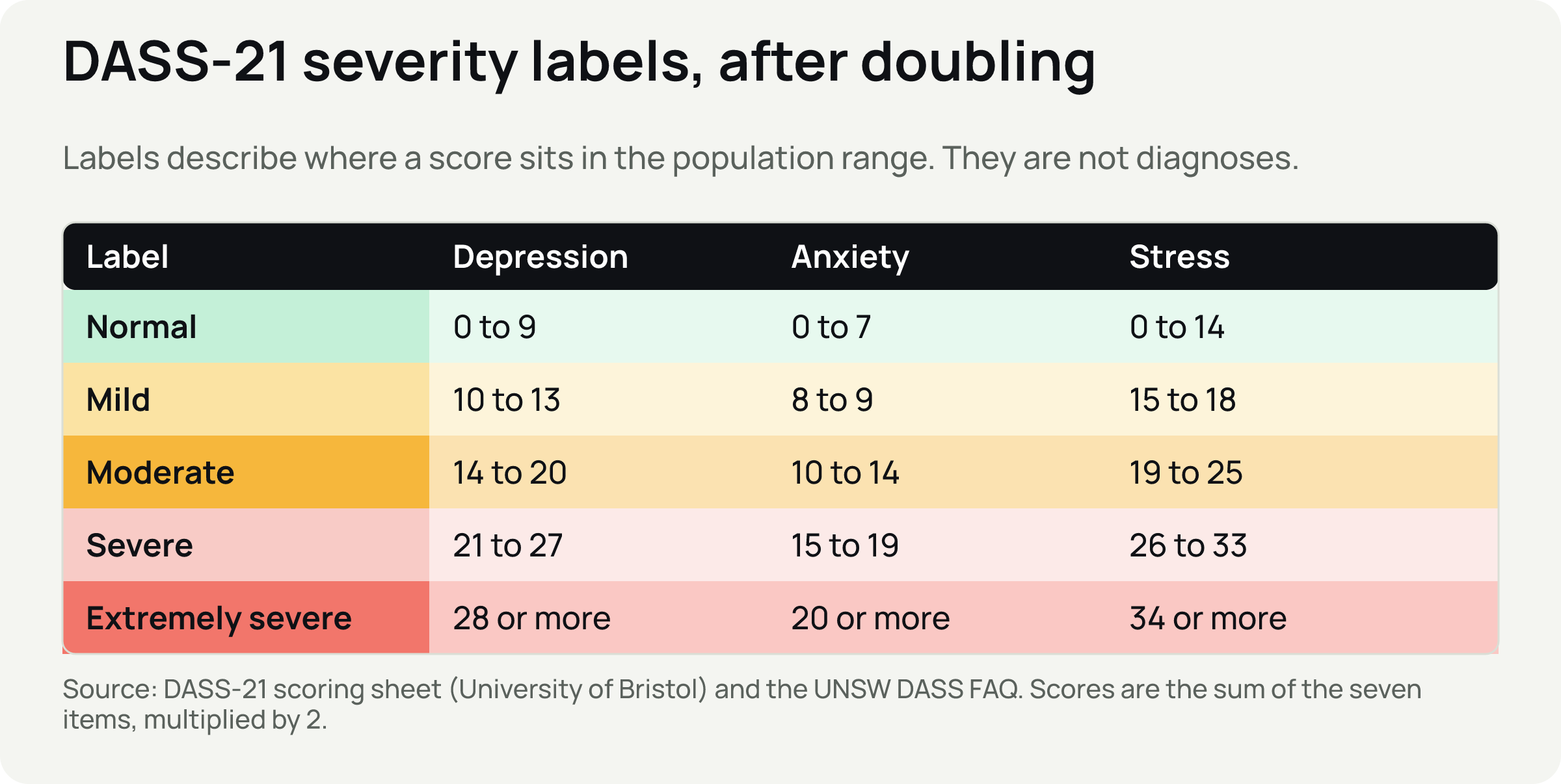
After doubling, a depression score of 0 to 9 is labelled normal, 10 to 13 mild, 14 to 20 moderate, 21 to 27 severe, and 28 or more extremely severe. The anxiety bands are 0 to 7, 8 to 9, 10 to 14, 15 to 19, and 20 or more. The stress bands are 0 to 14, 15 to 18, 19 to 25, 26 to 33, and 34 or more. [5]
What do the labels actually mean?
The developers say any single clinical cut-off is somewhat arbitrary because depression and anxiety lie on a continuum, and that the labels describe the full population range. "Mild" means a score is above the population mean but still well below the typical severity of help-seeking people. It does not mean a mild form of a disorder. [3]
They also say the mild, moderate, severe, and extremely severe labels appear only in the DASS manual, to avoid misinterpretation. [3] So a label you see on a website is a convenience taken from that manual, and it should be read with this caution in mind.
Should I add the three scores together?
No. Each scale has its own table, and the scales measure different things. Henry and Crawford found that each scale also taps a general dimension of psychological distress. [6] But the standard way to use the instrument is to read the three scores separately.
Why does my result look different from a simple sum?
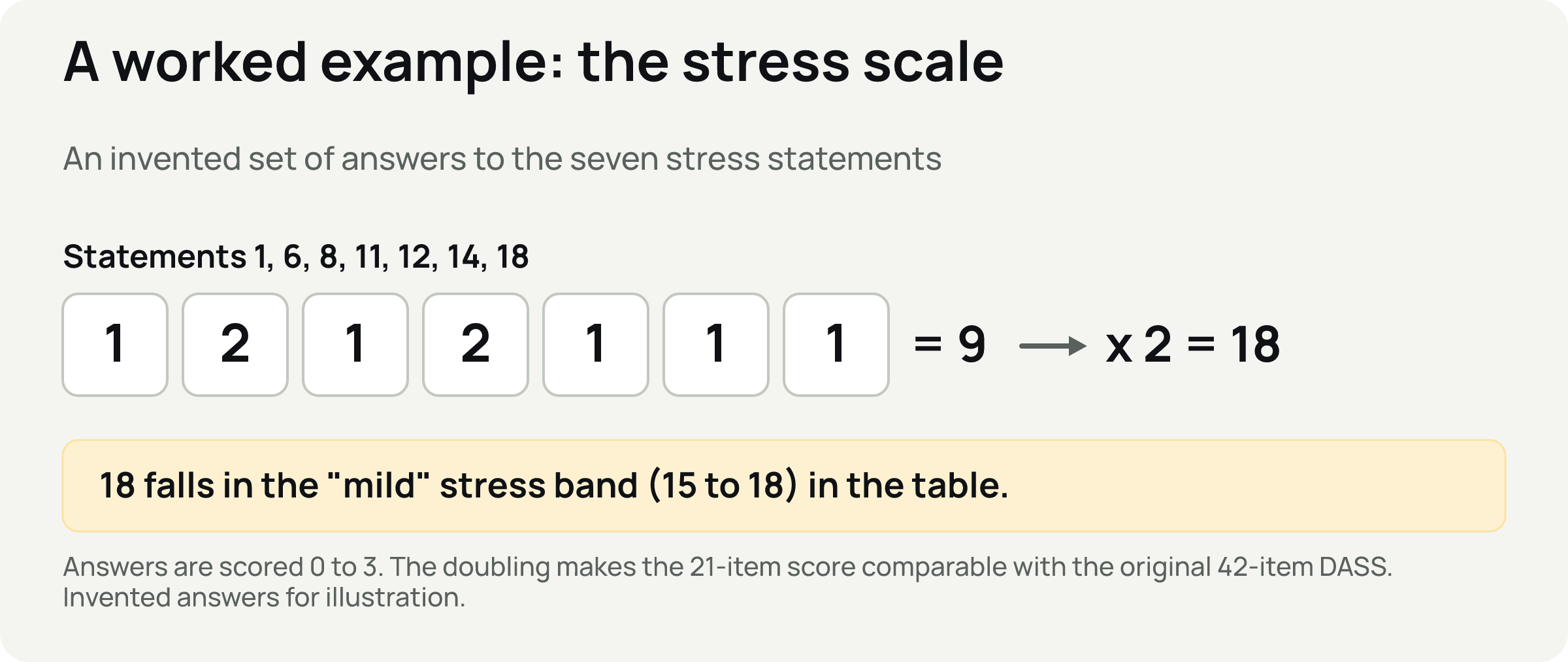
Your result differs from a simple sum because the DASS-21 doubles each scale total. A stress total of 9 from the seven items is reported as 18. If you compare a raw total with the table, you will under-read it.
Is the result a percentage or a probability?
No. It is a score on a scale. It does not give the chance of having a condition, and it does not predict what will happen.
Common questions
Why do you multiply DASS-21 scores by 2?
Because the DASS-21 is the short form of the 42-item scale, doubling makes scores comparable with the original and with the severity table. [3][5]
Sources and further reading
These links open external research and health-information websites.
- LuriaLab: DASS-21 test page
Twenty-one items, seven per subscale, past week, 0 to 3 scale, scoring statement, age 17+, and disclaimers. Read on 24 October 2026. - UNSW Psychology Foundation: Overview of the DASS
What the three scales cover, the 4-point rating, the past-week time frame, and the dimensional model. Read on 24 October 2026. - UNSW Psychology Foundation: DASS frequently asked questions
DASS-21 versus the full DASS, multiplying by 2, what the severity labels mean, that the DASS is not diagnostic, occupational stress, and age. Read on 24 October 2026. - DASS-21 response form (P. F. Lovibond, UNSW)
The 21 statements, the 0 to 3 labels, and the past-week instruction. - University of Bristol: DASS-21 scoring and interpretation
The sum-and-double instruction, the severity table, and the statement that the DASS is not a clinical instrument and cannot diagnose. - Henry and Crawford (2005): The short-form version of the Depression Anxiety Stress Scales (DASS-21): construct validity and normative data in a large non-clinical sample. British Journal of Clinical Psychology, 44, 227-239
A UK general-population sample of 1,794 adults. Full text read.
This page is educational. A questionnaire score cannot establish a diagnosis or explain the cause of your symptoms. If you are struggling, speak with a doctor or mental health professional, whatever your score. Read when to get help for work stress or find a helpline in your country.