
PSS-10 questions, answer choices, and reverse-scored items
The PSS-10 has ten questions, each answered on a five-point scale from never to very often, scored 0 to 4. Answer about the last month and follow the wording. Four positively worded items are reversed during scoring. [1]
What are the PSS-10 answer choices?
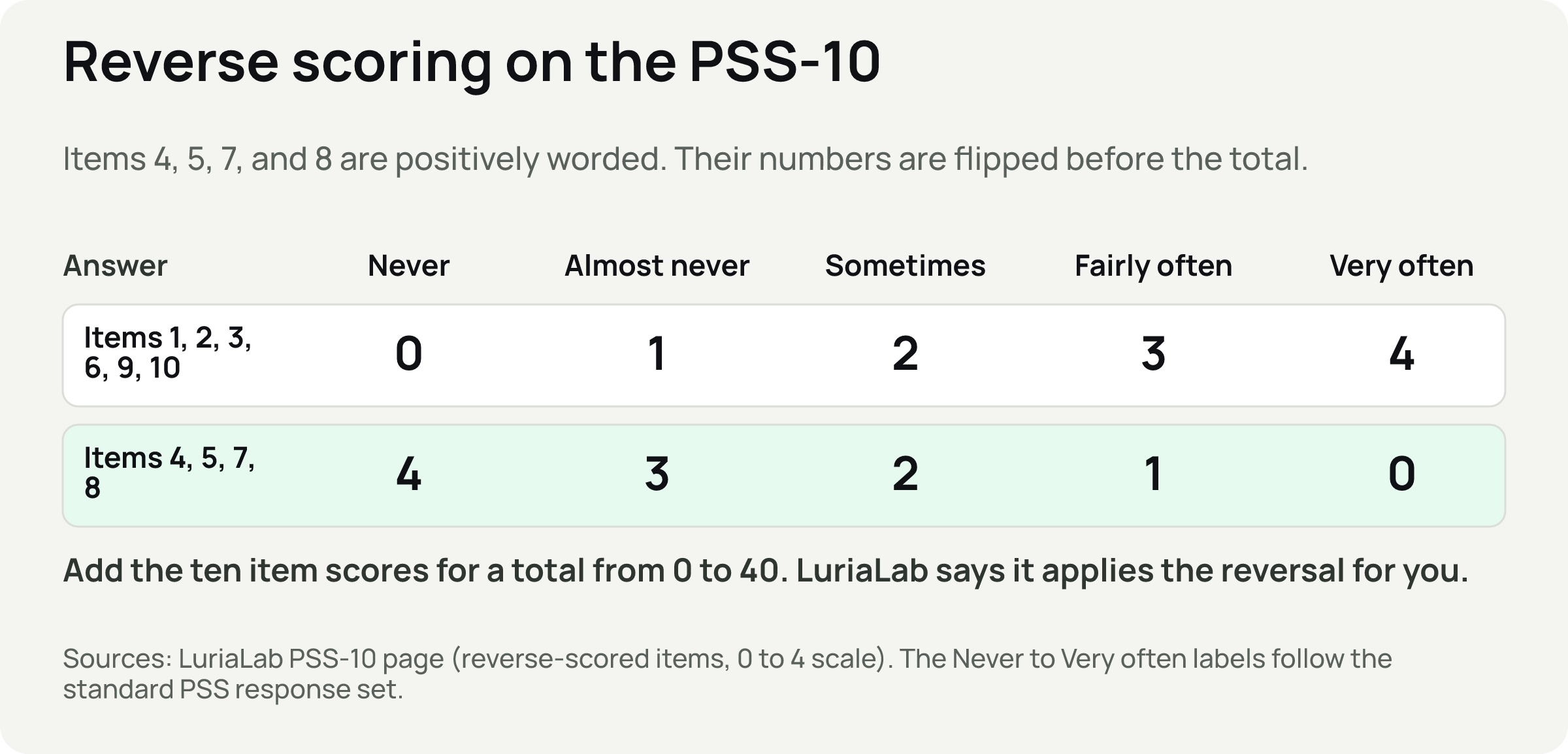
Each item is rated on a frequency scale from "never" to "very often," scored 0 to 4. [1] The middle labels follow the standard PSS response set. The codes are used as they are for most items, and reversed for four.
What do the questions cover?
The questions are general rather than about specific events. [5] Six are worded negatively, about feeling stressed, unable to cope, or out of control. Four are worded positively, about feeling able to cope or in control, and those are the reversed items. [1][4] The exact wording belongs to the instrument's authors, and you will see it on LuriaLab.
Which time period should I answer about?
The last month, as a whole. [1] Do not answer for only the worst week. The developers say they have not collected psychometric data for other time periods, and suspect longer retrospective periods reduce accuracy. They consider shorter intervals, such as daily, unproblematic. [2] If you want to check a different period, treat the result as informal.
Should I reverse my answers while taking the test?
No. Answer each question honestly as written. The reversal happens when the total is calculated. [1] Answering the positive items "backwards" yourself would give a wrong total.
What about the 14-item and 4-item versions, and translations?
The developers list 14-item, 10-item, and 4-item versions. [2] Scores from different versions are not interchangeable, so compare only like with like. The developers also note that for translations, the translator owns the intellectual property, and most translations listed were not pre-tested by their lab and have unknown psychometric properties. [2]
What if I skip a question?
Online forms usually require every answer. If you are using a paper version, a missing item makes the total unreliable, so do not guess at a total. Our sources did not specify a standard method for handling missing items, and we do not invent one.
Sources and further reading
These links open external research and health-information websites.
- LuriaLab: Perceived Stress Scale (PSS-10) test page
Ten items, 0 to 4 scale, past month, reverse-scored items 4, 5, 7, and 8, total 0 to 40, reference bands, age 12+, and disclaimers. Read on 24 October 2026. - Carnegie Mellon University: The Perceived Stress Scale
The developers' page: versions, "not a diagnostic instrument; there are no score cut-offs", comparison within your own sample, time-frame comment, and translations. Read on 24 October 2026. - Cohen, Kamarck, and Mermelstein (1983): A global measure of perceived stress. Journal of Health and Social Behavior, 24(4), 385-396
The original paper. The hosted copy is a scanned image, so we relied on how it is described in the review by Lee (2012) and on LuriaLab's citation. - Ng (2013): Validation of the 10-item Chinese Perceived Stress Scale in elderly service workers: one-factor versus two-factor structure. BMC Psychology, 1, 9
A study of 992 workers in Hong Kong. Convenience sample, over 83% women, self-report only. - Lee (2012): Review of the psychometric evidence of the Perceived Stress Scale. Asian Nursing Research, 6(4), 121-127
A review of 19 articles on the PSS's psychometric properties. Full text read.
This page is educational. A questionnaire score cannot establish a diagnosis or explain the cause of your symptoms. If you are struggling, speak with a doctor or mental health professional, whatever your score. Read when to get help for work stress or find a helpline in your country.