
Perceived Stress Scale (PSS-10): a free stress questionnaire explained
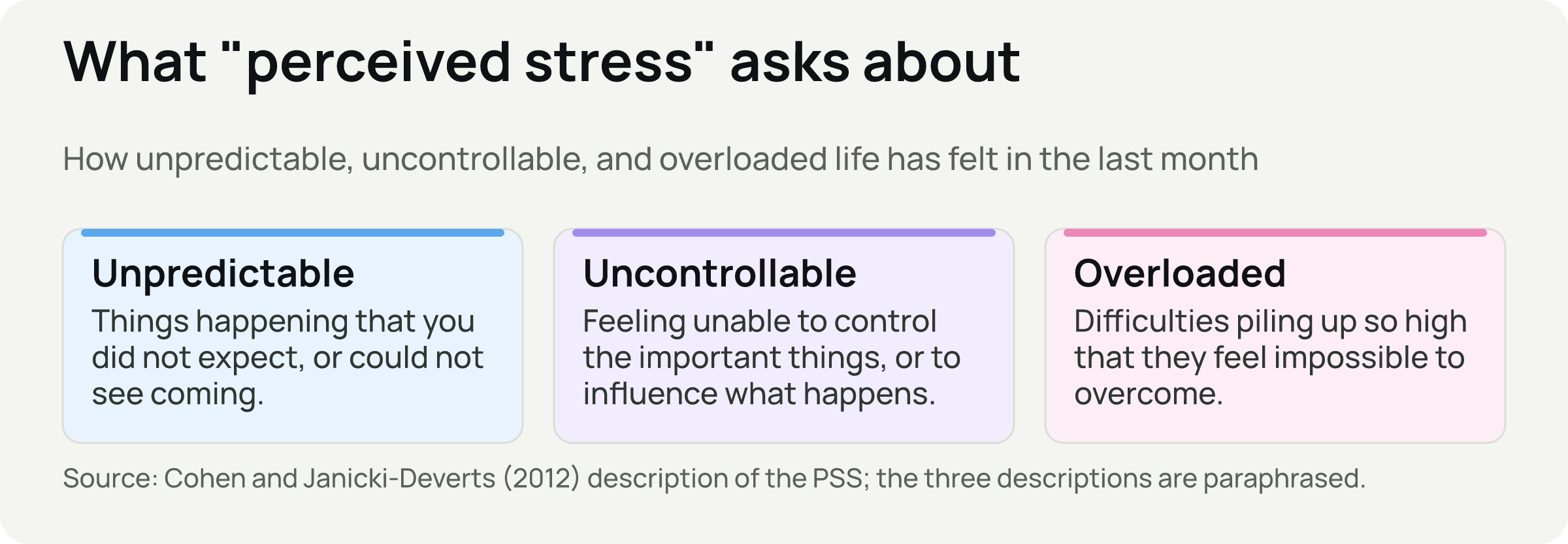
The Perceived Stress Scale (PSS-10) is a ten-question survey about how unpredictable, uncontrollable, and overloaded life has felt during the last month. Scores run from 0 to 40, and higher means more perceived stress. [1][5] The scale's developers state that it is not a diagnostic instrument and that there are no score cut-offs. [2]
What is the Perceived Stress Scale?
Sheldon Cohen, Tom Kamarck, and Robin Mermelstein developed it in 1983 to measure "the degree to which individuals appraise situations in their lives as stressful." [3][5] The items ask how unpredictable, uncontrollable, and overloaded you have found your life in the past month, in general terms rather than about specific events. [5]
The original has 14 items. A 10-item version was created five years later using data from 2,387 US residents, and a 4-item version exists for very short assessments. [5] The PSS-10 is the form LuriaLab offers. [1]
Can I use the PSS-10 as a job stress test?
Only partly. The PSS-10 reflects stress across your life, so it will include work pressure if work is the main load. But it cannot separate work from money worries, health, caring, or family. If your question is "how drained or detached am I from this job?", the Oldenburg Burnout Inventory fits better. If it is "how far is this reaching into my daily life?", the WSAS fits better.
Consider an invented example. Someone with a demanding job is also caring for a parent. Their PSS-10 total reflects both. It will not tell a doctor how much comes from work, so a few sentences about what has been happening matter as much as the score.
What can I find in these PSS-10 explainers?
If you already have a result, start with scoring or understanding results. If you are deciding whether to take it, start with what it measures and who it is for.
Where do I take the PSS-10 online?
JobStressCheck explains questionnaires and does not host them. The link opens LuriaLab in a new tab. LuriaLab lists the PSS-10 for ages 12 and over, at about 2 minutes. [1] Check its privacy policy first, and see our review for what we could and could not confirm.
Do I need a stress score before I get support?
No. You can ask for help without any test. The NHS says to see a GP if you are struggling to cope with stress or what you are trying yourself is not helping. [7]
Common questions
How long does the PSS-10 take, and is it free?
LuriaLab lists it at about 2 minutes and free to take, for ages 12 and over. [1]
Sources and further reading
These links open external research and health-information websites.
- LuriaLab: Perceived Stress Scale (PSS-10) test page
Ten items, 0 to 4 scale, past month, reverse-scored items 4, 5, 7, and 8, total 0 to 40, reference bands, age 12+, and disclaimers. Read on 24 October 2026. - Carnegie Mellon University: The Perceived Stress Scale
The developers' page: versions, "not a diagnostic instrument; there are no score cut-offs", comparison within your own sample, time-frame comment, and translations. Read on 24 October 2026. - Cohen, Kamarck, and Mermelstein (1983): A global measure of perceived stress. Journal of Health and Social Behavior, 24(4), 385-396
The original paper. The hosted copy is a scanned image, so we relied on how it is described in the review by Lee (2012) and on LuriaLab's citation. - Cohen and Janicki-Deverts (2012): Who's stressed? Distributions of psychological stress in the United States in probability samples from 1983, 2006, and 2009. Journal of Applied Social Psychology, 42, 1320-1334
PSS norms from three US surveys, with means and standard deviations by demographic group. The surveys were supported by Johnson & Johnson, which the authors say played no role in the analysis; the authors consult for it on stress measurement. Full text read. - Lee (2012): Review of the psychometric evidence of the Perceived Stress Scale. Asian Nursing Research, 6(4), 121-127
A review of 19 articles on the PSS's psychometric properties. Full text read. - Ng (2013): Validation of the 10-item Chinese Perceived Stress Scale in elderly service workers: one-factor versus two-factor structure. BMC Psychology, 1, 9
A study of 992 workers in Hong Kong. Convenience sample, over 83% women, self-report only. - NHS: Get help with stress
Signs of stress, when to see a GP, urgent help routes in the UK, and self-referral to NHS talking therapies.
This page is educational. A questionnaire score cannot establish a diagnosis or explain the cause of your symptoms. If you are struggling, speak with a doctor or mental health professional, whatever your score. Read when to get help for work stress or find a helpline in your country.