
Guide · Scripts
How to say no to extra work without damaging your reputation, with scripts
Five replies between yes and no, scripts for a manager, a colleague, and a client, and a one-page card to keep at your desk.

To say no to extra work without a fight, pause before you answer, check what the new task would push out, and offer a choice instead of a flat refusal: swap it for something, do it later, do a smaller version, or decline with a reason. Treat it as a request for a decision about priorities. Nobody can promise that a no costs nothing, but a specific, calm reply keeps the conversation on the work, not on you. HSE advises being specific about the cause of pressure and raising it early. [1] Feeling pressure to take on extra tasks was linked to job stress and to conflict between work and family or leisure time in a study of 245 employees, even after allowing for hours worked. [3]
What is saying no for?
It is for protecting the work you already agreed to do, and your health while you do it, not for avoiding work. Workload is the first of HSE's six areas of work design, called demands, which also covers work patterns and the work environment. [2] A manager can usually only change it if they know what is already on your plate.
This guide gives you ways to answer a request so that the real question, what comes first, is on the table. It is editorial advice, not legal or HR advice. Contracts and the law differ by country, so adapt it, and skip any part that does not fit your job.
Why is it so hard to say no?
Partly because there is often pressure to say yes. Bolino and colleagues surveyed 245 employees about "citizenship pressure", the sense that you are expected to go beyond your role. It was linked to more extra-role work, and also to work-family conflict, work-leisure conflict, job stress, and intentions to quit. Those links held even after the authors allowed for the extra work itself, role overload, and hours worked. [3]
Partly because not everyone is asked equally. Babcock and colleagues report that women volunteer for, are asked to volunteer for, and accept more of the tasks that everyone would prefer someone else did, such as writing a report or serving on a committee. They find that beliefs about who will say yes are an important part of why. [4] If you are always the one who takes the notes, books the room, or covers the gap, say so, and ask for a rota.
What should you ask yourself before you answer?
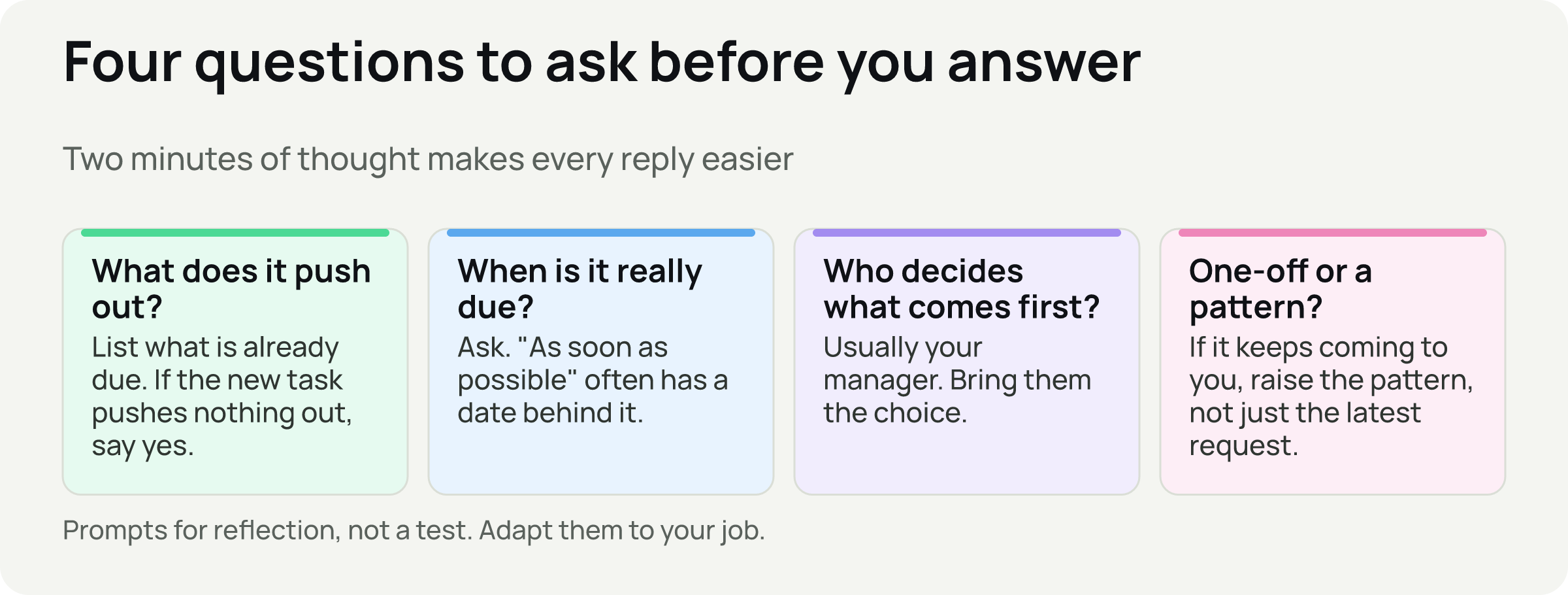
You do not have to answer on the spot. Four questions take two minutes and make every reply below easier.
What can you say instead of a flat no?
Think of five replies, from the softest to the firmest. Start with the first one that is true for you.
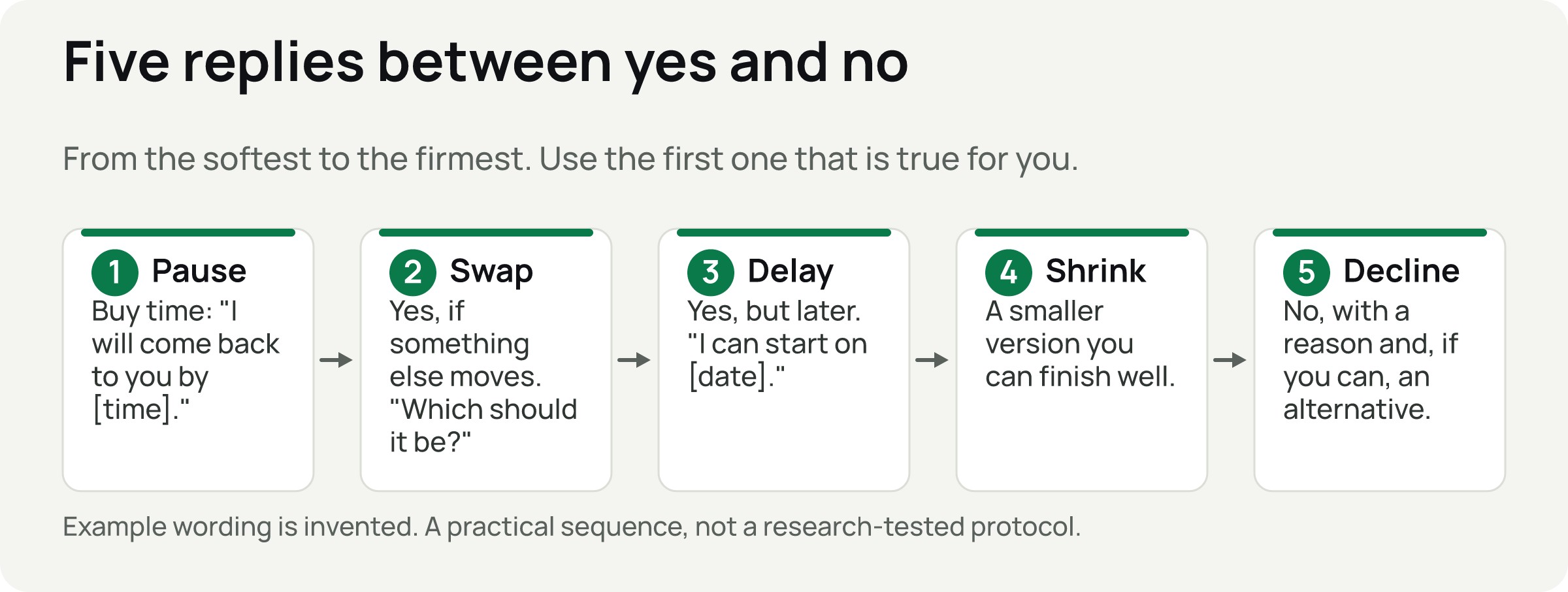
| Reply | Use it when | What it does |
|---|---|---|
| Pause | You need to check your load. | Buys time without agreeing or refusing. |
| Swap | The task matters and your plate is full. | Makes the manager choose what moves. |
| Delay | You can do it, just not now. | Moves the start, not the answer. |
| Shrink | The full version does not fit. | Offers a smaller piece you can finish well. |
| Decline | You cannot do it without harming other work. | Says no, with a reason and, if you can, an alternative. |
What can you say?
Put these in your own words. Short sentences work best when you are nervous, and you can say the first line and stop.
What are the steps?
A reply takes seconds. The preparation is what makes it hold.
- Pause. Use the first script, or just say you will come back to them. A short delay is a reasonable thing to ask for.
- Check your load. List what is already due and roughly how long each item takes. The workload audit guide shows how to measure it.
- Find what the new task would push out. If it pushes nothing, say yes. If it pushes something important, you have the swap.
- Pick the reply. Start with the softest one that is true: swap, delay, shrink, then decline.
- Say it briefly. State the facts, make the offer, then stop talking. Do not apologise three times.
- Write it down. Send a two-line message with what you agreed and when. That is how a swap survives a busy week.
A worked example
Here is an invented week for an analyst, Sam. Sam is asked on a Wednesday to produce a new dashboard for a director by Friday. The hours are estimates.
| Task | Hours | Due | Sam's reply |
|---|---|---|---|
| Quarterly forecast | 12 | Friday | Keep, top priority |
| Weekly sales report | 4 | Thursday | Keep |
| Ad hoc data pulls | 6 | Unpredictable | Pause new ones until Monday |
| New dashboard request | 10 | Friday | Swap: ask what moves, or offer a first version Friday and the rest next week |
What if they push back, or keep asking?
Repeat the facts calmly, and ask for the decision: "I understand. Which of these should I drop?" If you are asked again and again, name the pattern, not the latest request: "This is the third extra piece this month, and I am now working past [time]. Can we look at my workload together?" The manager conversation guide has a full plan for that.
If a line manager is the source of the pressure, HSE suggests checking your company's policies and speaking to a trade union or worker representative, HR, a counselling service, or your GP. [1] In Great Britain, employers have a legal duty to protect workers from stress at work by assessing the risk and acting on it. [5] Elsewhere, rules differ, so ask a union or an employment adviser about your rights. If the pressure is affecting your sleep or health, the NHS advises seeing a GP if you are struggling to cope. [6]
If you are the one asking
Before you add to someone's load, ask what it would displace, and offer to move something. The WHO lists heavy workloads, fast pace, understaffing, and little control as risk factors for mental health at work. [7] Notice who you always ask. Babcock and colleagues' findings suggest that some people are asked for the tasks nobody wants more often than others, so share them around. [4] If someone says no with a clear reason, thank them for telling you early.
Common questions
Can I refuse extra work?
That depends on your contract, your role, and the law where you work, and this guide cannot say. Asking "which of my current tasks should move so I can take this on?" is often more effective than a flat no. For your rights, ask a union, HR, or an employment adviser.
Will saying no hurt my career?
Nobody can promise it will not. A calm, specific reply with an offer is easier to accept than a flat refusal. If you are asked more often than others, or asked for tasks that do not help you progress, raise that pattern. [4]
What if my manager says "everyone is busy"?
Say that you are not asking for special treatment, and ask what you can stop, move, or share, because the current load is not sustainable. The manager conversation guide has wording for this.
What if I am a freelancer?
Treat extra requests as a change to what you agreed. You can quote for them as an extra, swap them for something in scope, or move the date. Check your contract for how changes are handled.
Keep reading
Sources and further reading
These links open external research and health-information websites.
- HSE: Help for workers on stress at work
Talking to someone early, being specific about the cause, and who to talk to if your manager is the source of pressure. - HSE: What are the Management Standards?
The six areas of work design, including demands and control. - Bolino, Turnley, Gilstrap, and Suazo (2010): Citizenship under pressure: What's a "good soldier" to do? Journal of Organizational Behavior, 31(6), 835-855
A study of 245 employees. Abstract-level details read through a university repository record; full text not opened. - Babcock, Recalde, Vesterlund, and Weingart (2017): Gender differences in accepting and receiving requests for tasks with low promotability. American Economic Review, 107(3), 714-747
Findings as stated in the abstract on the journal page. Full text not opened. - HSE: Work-related stress and how to manage it
Employers' legal duty in Great Britain to assess the risk of stress and act on it. - NHS: Get help with stress
When to see a GP, and self-help suggestions. - WHO: Mental health at work (fact sheet)
Risk factors including heavy workloads, fast pace, understaffing, and little control. Page dated 15 September 2026 when checked.
Educational guidance, not clinical, legal, or HR advice. If you need a person, skip the rest of the steps and talk to one.