
Understand
Sunday scaries: why work dread builds before Monday, and what helps
A knot in your stomach on Sunday evening is common and usually specific. Here is what feeds it, how to tell a bad Sunday from a bad job, and what to do about both.
The "Sunday scaries" is an everyday name for dread or tension on Sunday about the working week ahead. It is not a medical term, and it is not the same as burnout. Two small studies point to what feeds it. In a daily-diary study of 132 employees, those who thought negatively about work on Sunday started the week with poorer sleep. [1] In a study of 74 employed adults, weekends were linked to better mood and vitality, partly because they gave people more say over what they did and more time with people who matter to them. [2] Dread that is mild and stays on Sunday is worth a plan. Dread that fills the week, or comes with exhaustion, poor sleep, or constant worry, is a reason to look at the job and to talk to someone. [3][4]
What are the Sunday scaries?
It is a phrase, not a condition. People use it for the dread, restlessness, or low mood that arrives on Sunday afternoon or evening because Monday is coming. You may feel it in your stomach, in your sleep, or as a sudden urge to check your email.
The studies below do not use the phrase. They measure things close to it, such as how negatively people think about work on a Sunday, and how they sleep and feel across the week. That is worth remembering when you read a headline with a percentage in it. Figures about how many people get the Sunday scaries often come from commercial polls. We have not used them, because we could not check how the questions were asked.
Why does the dread build on Sunday?
No single cause explains it, but three threads from the research fit what many people describe.
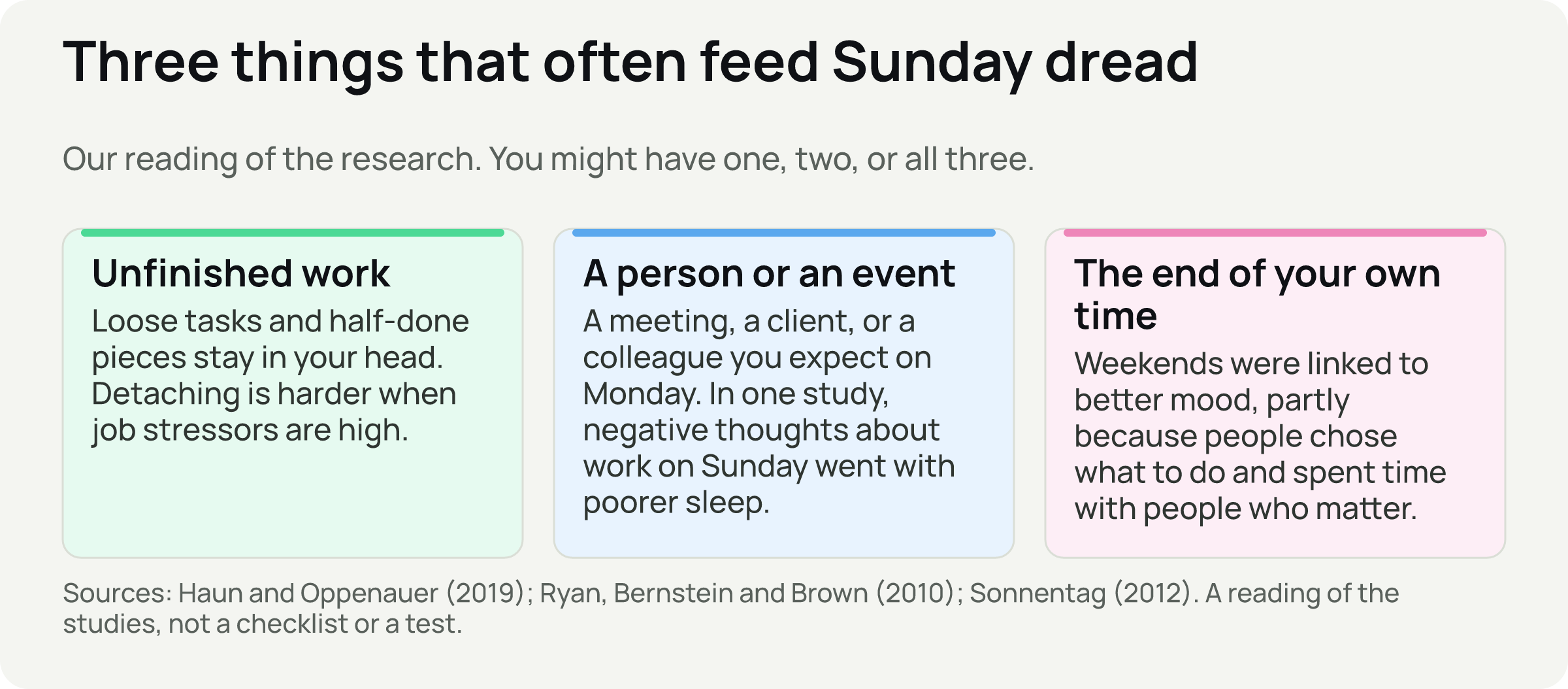
The first is the end of the weekend. Ryan and colleagues asked 74 employed adults, in a wide range of jobs, about their weekdays and weekends. Weekend and non-work time was linked to better mood and other well-being measures, and the authors found that this was partly or fully explained by two needs being met: autonomy (choosing what you do) and relatedness (time with people who matter to you). [2] Sunday evening is where that choice and company end, so the contrast is sharpest there. That is our reading of the study, not something it tested.
The second is thinking about work. Haun and Oppenauer followed 132 employees from Monday to Friday. Those who reported high negative thoughts about work on the Sunday started the week with lower sleep quality, which then rose across the days. On average, sleep quality did not change significantly over the week. The authors also found that chronic social stress at work, such as conflict with other people, was linked to the trajectory through those Sunday thoughts, and time pressure was not. [1] So the dread may be about people more than about volume.
The third is that work does not switch off easily. Sonnentag's review of research on "psychological detachment" finds that it is harder to mentally disconnect when job stressors are high, when you are strongly involved in your job, or when you tend towards negative emotions. [5] A later review links job stressors, especially workload, to lower detachment and to higher strain. [6] If you cannot leave work behind on Sunday, it is often a sign of load, not a flaw in you.
Is it a bad Sunday, or a sign of burnout?
Dread on its own does not tell you. The World Health Organization (WHO) describes burn-out as an occupational phenomenon in ICD-11, not a medical condition: a syndrome from chronic workplace stress that has not been successfully managed. It has three parts: energy depletion or exhaustion, increased mental distance from the job or cynical feelings about it, and reduced professional efficacy. [3] A rough sort looks at how long the feeling lasts and where else it shows up.
| What you notice | What it could mean | A sensible next step |
|---|---|---|
| Dread on Sunday evening that lifts on Monday morning | Mostly the transition, or one thing you expect in the week. | Name the one thing. Try the Sunday plan below. |
| Dread that starts on Friday or Saturday, or stays all week | The job may be asking for more than you have. | Look at the causes at work. Try the workload audit and talk to your manager. |
| Tired before the day starts, and caring less than you used to | Possible signs of the exhaustion and distance the WHO describes. [3] | Read the burnout article. Talk to someone you trust. |
| Worry most of the time that affects everyday life, or poor sleep for weeks | More than a Sunday feeling. The NHS suggests a GP for anxiety that is hard to control. [4] | See a GP. You do not need a score or a diagnosis to ask. |
What can you do on Sunday?
These are practical suggestions, not a treatment, and nobody has tested them as a package. Pick one or two. Skipping the rest is fine.
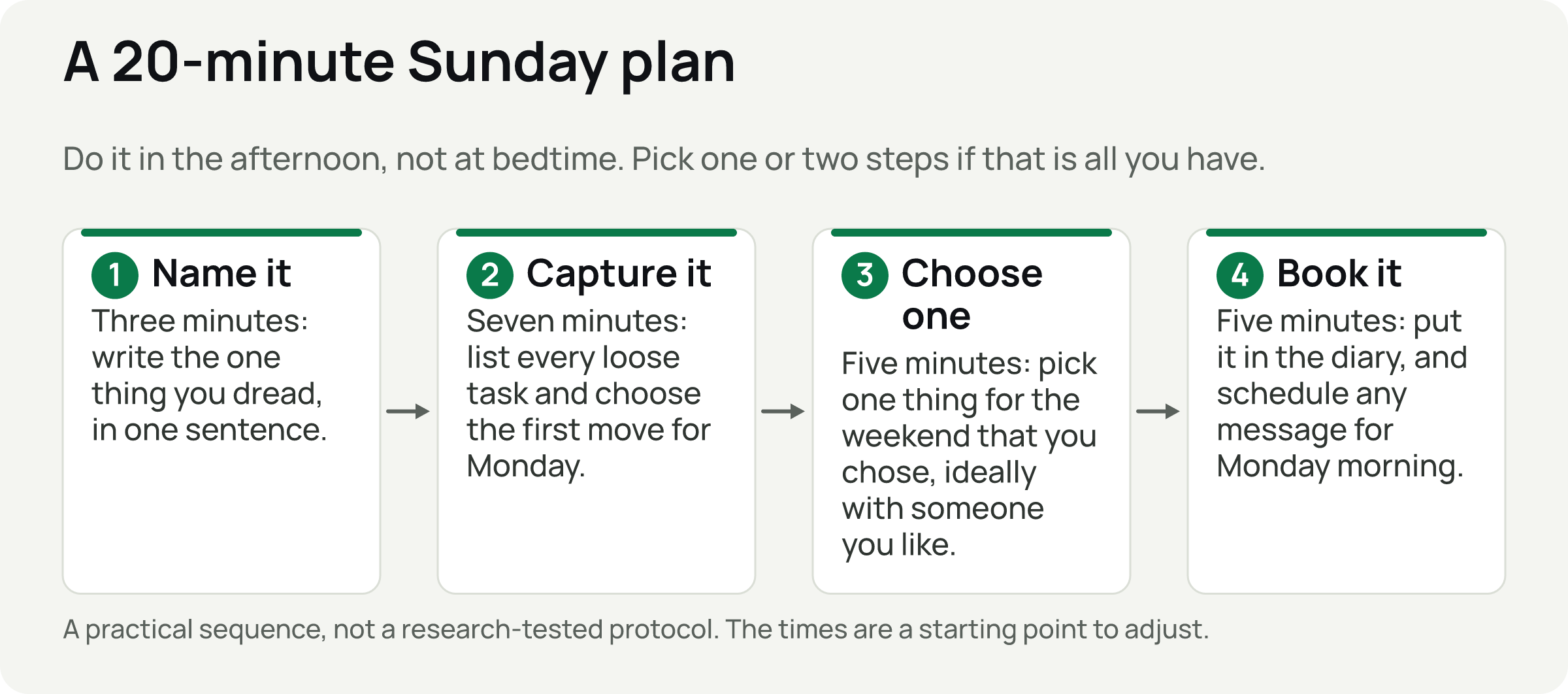
- Name what you are dreading in one sentence. "Monday" is too big. "The 9:30 review where I have not finished the numbers" is something you can act on. HSE advises being specific about the cause of pressure when you talk to someone about it. [7]
- Write down Monday's first move. Capture loose tasks on one list and choose the top three. It is the same idea as the evening shutdown routine, moved to Sunday.
- Do one thing in the weekend that you chose, with or for someone you like. That is the autonomy and relatedness the weekend study describes. [2]
- Keep work messages out of the evening. Checking keeps work within reach, which works against detaching. [5]
- Plan a gentler first hour on Monday, if you can. A walk, a coffee, or a task you like gives the day a start that is not an inbox.
- Do what the NHS suggests for stress in general: talk to someone about how you feel, plan ahead for stressful days, and put your energy into the things you can change. [8]
What if the cause really is the job?
Then a better Sunday only goes so far. If the dread is about a workload that does not fit the hours, a difficult relationship, or a role that is unclear, the fix lives at work. HSE says that if you are feeling stress at work it is important to talk to someone, for example your manager, and that talking early gives them the chance to help before things get worse. [7]
You are not asking for sympathy. You are giving information about how the work is set up. Bring the one thing you named on Sunday and a short list of tasks.
If you manage people
A message sent on Sunday evening lands in someone's rest, even if you do not expect an answer. Most email tools can schedule a send for Monday morning. Research on detachment ties job stressors such as workload to lower detachment, so reducing the load that blocks it matters more than any rule about timing. [6] If someone on your team seems to dread the week more than usual, ask what is coming up and what would help, rather than guessing at a cause.
When is it time to ask for help?
The NHS describes the main sign of generalised anxiety disorder as feelings of stress or worry that affect your daily life and are difficult to control, and says anxiety is more likely to be that when you feel anxious most of the time and it affects your everyday life. [4] If that sounds like you, or the dread is wearing down your sleep and health, speak to a GP. You do not need a diagnosis, a score, or a crisis first.
If you may harm yourself or cannot stay safe, contact emergency services now. In the UK, call 999, or NHS 111 for urgent help that is not an emergency. Samaritans are on 116 123. In the United States, call or text 988. Elsewhere, findahelpline.com lists services by country.
Common questions
Are the Sunday scaries a real condition?
It is an everyday phrase for a feeling, not a medical condition. The research that comes closest measures negative thoughts about work on a Sunday and how people sleep and feel across the week. [1][2]
Why do I feel worse on Sunday evening than on Saturday?
Weekend time has been linked to better mood, partly because people have more say over what they do and more time with people who matter to them. [2] Sunday evening is where that ends. The study did not test why Sunday feels worse than Saturday, so this is an explanation, not a finding.
Does Sunday dread mean I have burnout?
Not on its own. The WHO describes burn-out as exhaustion, mental distance from the job, and reduced efficacy, from chronic workplace stress that has not been managed. It is an occupational phenomenon, not a medical condition. [3] Dread that lasts all week, or comes with those signs, is worth taking seriously.
Should I quit my job because of it?
This page cannot say. Try to find out what the dread is about first. If it is about something at work that you have raised and nothing changes, then it is reasonable to think about your options. That is a decision for you, with advice from people who know your situation.
Keep reading
Sources and further reading
These links open external research and health-information websites.
- Haun and Oppenauer (2019): The role of job demands and negative work reflection in employees' trajectory of sleep quality over the workweek. Journal of Occupational Health Psychology, 24(6), 675-688
A study of 132 employees, with daily morning surveys from Monday to Friday and a Sunday measure. Abstract read through Europe PMC; full text not opened. - Ryan, Bernstein, and Brown (2010): Weekends, work, and well-being. Journal of Social and Clinical Psychology, 29(1), 95-122
A study of 74 employed adults on weekend and weekday well-being and basic psychological needs. Abstract read through a university repository record; full text not opened. - WHO: Burn-out an "occupational phenomenon" (2019)
The ICD-11 definition, the three dimensions, and the statement that it is not classified as a medical condition. - NHS: Generalised anxiety disorder in adults
The main symptom, the signs, and when to see a GP. Read on 2 November 2026. - Sonnentag (2012): Psychological detachment from work during leisure time. Current Directions in Psychological Science, 21(2), 114-118
Review of research on detachment and what makes it harder. Abstract checked through a university repository; full text not opened. - Sonnentag and Fritz (2015): Recovery from job stress: The stressor-detachment model. Journal of Organizational Behavior, 36(S1), S72-S103
Review of detachment, job stressors, and strain. Abstract checked through a repository record; full text not opened. - HSE: Help for workers on stress at work
Talking to someone early, being specific about the cause, and who to talk to. - NHS: Get help with stress
Self-help suggestions, and when to see a GP.
This article is educational. It is not a diagnosis or a treatment plan. If stress is affecting sleep, eating, or safety, talk to a GP, an occupational health service, or a local mental health service.