
Oldenburg Burnout Inventory (OLBI): a free burnout questionnaire explained
The Oldenburg Burnout Inventory (OLBI) is a 16-statement questionnaire about two parts of burnout at work: exhaustion and disengagement. [1] Higher scores mean more exhaustion or more disengagement. It describes how you answered, not whether you have burnout, which the WHO classifies as an occupational phenomenon and not a medical condition. [2]
What is the Oldenburg Burnout Inventory?
The OLBI was developed by Evangelia Demerouti and colleagues as an alternative to the Maslach Burnout Inventory, the most widely used research tool. [5][6] It has two subscales. Exhaustion covers feeling drained and needing longer to recover. Disengagement covers distance from your work and its content. LuriaLab describes the first as physical, cognitive, and emotional exhaustion, and the second as emotional distancing and detachment from work. [1]
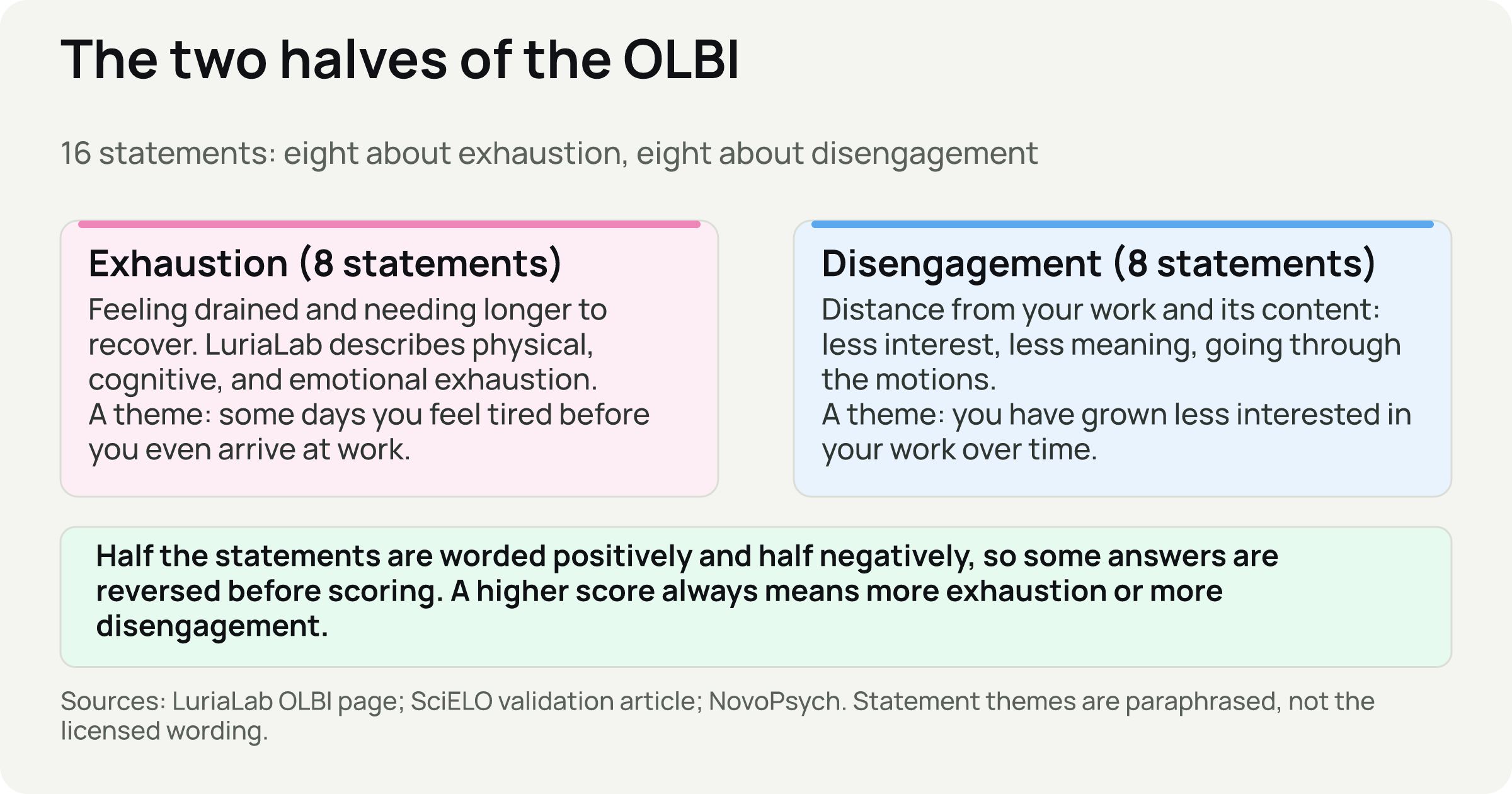
Maslach and Leiter note that the OLBI assesses two dimensions of burnout, where the Maslach inventory assesses three. [3] The WHO's description of burn-out has three parts: exhaustion, mental distance from your job, and reduced professional efficacy. [2] The OLBI covers the first two closely and does not include a separate efficacy scale.
Can I use the OLBI as a job burnout test?
It is one of the better-known free options, and it asks about your work specifically, so it is closer to the question many people have than a general stress questionnaire. It cannot diagnose burnout, depression, or any other condition, and it cannot tell you what in your job is causing a problem. [1][2]
Think of it as a structured way to put words to how drained or detached you feel, which you can then take to a conversation. If the result surprises you, check it against your own sense of how things are. If it does not surprise you, that is useful too.
What can I find in these OLBI explainers?
Each page answers a different question. If you already have a result, start with scoring or understanding results. If you are deciding whether to take it, start with what it measures and who it is for.
Where do I take the OLBI online?
JobStressCheck explains questionnaires and does not host them. The link opens LuriaLab in a new tab. Check its instructions and privacy policy before you decide to submit answers, and see our review of LuriaLab for what we could and could not confirm.
Do I need a score before I ask for support?
No. You can ask for help at any score, and without taking any test. A useful first sentence is: "Work has been wearing me down for [time], and I would like to talk about what could change." Our guides cover the conversation at work and the evening routine, and our article explains when to see a doctor.
Common questions
How long does the OLBI take, and is it free?
LuriaLab lists it at about 3 minutes and free to take. [1] You will find 16 statements about your work.
What is a good OLBI score?
There is no agreed good or bad score. Lower scores mean less exhaustion or disengagement. How a number reads depends on the version and the convention used, so compare only with guidance for the same version. [5]
Is the OLBI a burnout diagnosis?
No. It describes how you answered. The WHO classifies burn-out as an occupational phenomenon, not a medical condition. [2]
What is the difference between the OLBI and the Maslach Burnout Inventory?
The OLBI has two subscales, exhaustion and disengagement. The Maslach inventory has three dimensions, including professional efficacy. [3]
Sources and further reading
These links open external research and health-information websites.
- LuriaLab: Oldenburg Burnout Inventory (OLBI) test page
Sixteen items, two subscales, instant scoring statement, age 18+, disclaimers, and citation. Read on 24 October 2026. - World Health Organization: Burn-out an "occupational phenomenon" (2019)
ICD-11 definition of burn-out; not classified as a medical condition. - Maslach and Leiter (2016): Understanding the burnout experience. World Psychiatry, 15(2), 103-111
Notes that the Oldenburg Burnout Inventory assesses two dimensions, and discusses measurement and diagnosis. - Demerouti, Bakker, Nachreiner, and Schaufeli (2001): The job demands-resources model of burnout. Journal of Applied Psychology, 86(3), 499-512
Study of 374 workers: demands linked mainly to exhaustion, lack of resources mainly to disengagement. Abstract-level details only; full text not opened. - NovoPsych: Oldenburg Burnout Inventory (OLBI)
A commercial publisher's description of items, scoring ranges, its own cut-offs, and reliability figures it cites. Read on 24 October 2026. - SciELO: Oldenburg Burnout Inventory validation in Brazil (Ciencia & Saude Coletiva)
Describes the original 16-item structure, four-point agreement scale, balanced wording, and how the authors reversed items. Portuguese-language article read on 24 October 2026.
This page is educational. A questionnaire score cannot establish a diagnosis or explain the cause of your symptoms. If you are struggling, speak with a doctor or mental health professional, whatever your score. Read when to get help for work stress or find a helpline in your country.