
OLBI questions, answer choices, and why some answers are reversed
The OLBI has 16 statements about your work, answered on a four-point agreement scale from strongly agree to strongly disagree. Half the statements are worded positively and half negatively, so some answers are reversed when it is scored. [1][6]
What are the OLBI answer choices?
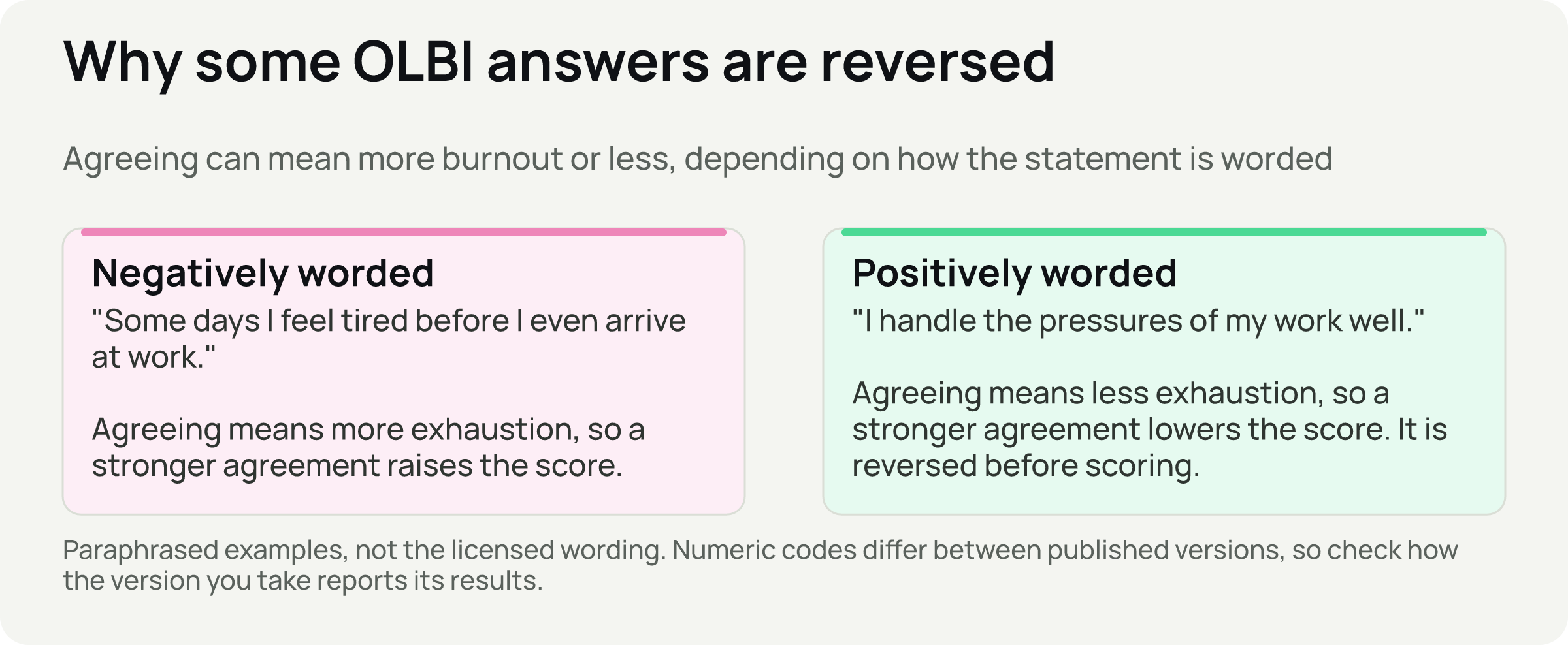
Each statement is rated on a four-point scale, from strongly agree to strongly disagree. [6] The exact numeric codes differ between published versions. Some code strongly agree as 1 and some as 4, and a reversal is applied to the items of one wording type so that a higher score always means more burnout. For that reason we do not publish a number-by-number table. What matters is the direction. [5][6]
| Statement wording | If you agree more strongly | Effect on the score |
|---|---|---|
| Negatively worded (for example, feeling tired before work) | It describes more exhaustion or disengagement | Raises the score |
| Positively worded (for example, handling pressure well) | It describes less exhaustion or disengagement | Lowers the score |
Why are some items reversed?
The designers built each subscale with both kinds of statement. The Brazilian validation article describes four positively and four negatively worded items per factor. [6] Mixing the two kinds is a standard way to reduce the tendency to agree with everything, and it means you have to read each statement rather than answer in a pattern.
What do the statements cover?
The themes, in paraphrase, include whether you feel tired before you arrive at work, whether you need more time to recover after work, whether you feel emotionally drained, whether you can handle the pressures well, whether you still find new and interesting things in your work, whether you talk about it negatively, and whether you do it almost mechanically. [6] We paraphrase because the instrument's wording belongs to its authors. You will see the exact statements on LuriaLab.
What time period should I answer about?
LuriaLab does not state a recall period for the OLBI, and the instrument generally asks about your work in general. [1] Answer about your current work as a whole, not about the worst day or the best. If your job changed recently, answer about the present job and keep the same frame if you take it again later.
What if I am not working, or work for myself?
The OLBI is designed for people in work, with validation samples across several occupations. [5] If you are not currently working, the questions will not fit well. If you are self-employed, answer about your work in general, and read the results with the same caution as anyone else.
Can I take it in my own language?
LuriaLab offers the OLBI in many languages. [1] Translations can behave differently from the original, and versions can differ in how many items they keep. The Brazilian adaptation, for example, dropped three items. [6] Compare a score only with guidance for the same version.
Sources and further reading
These links open external research and health-information websites.
- LuriaLab: Oldenburg Burnout Inventory (OLBI) test page
Sixteen items, two subscales, instant scoring statement, age 18+, disclaimers, and citation. Read on 24 October 2026. - World Health Organization: Burn-out an "occupational phenomenon" (2019)
ICD-11 definition of burn-out; not classified as a medical condition. - Maslach and Leiter (2016): Understanding the burnout experience. World Psychiatry, 15(2), 103-111
Notes that the Oldenburg Burnout Inventory assesses two dimensions, and discusses measurement and diagnosis. - Demerouti, Bakker, Nachreiner, and Schaufeli (2001): The job demands-resources model of burnout. Journal of Applied Psychology, 86(3), 499-512
Study of 374 workers: demands linked mainly to exhaustion, lack of resources mainly to disengagement. Abstract-level details only; full text not opened. - NovoPsych: Oldenburg Burnout Inventory (OLBI)
A commercial publisher's description of items, scoring ranges, its own cut-offs, and reliability figures it cites. Read on 24 October 2026. - SciELO: Oldenburg Burnout Inventory validation in Brazil (Ciencia & Saude Coletiva)
Describes the original 16-item structure, four-point agreement scale, balanced wording, and how the authors reversed items. Portuguese-language article read on 24 October 2026.
This page is educational. A questionnaire score cannot establish a diagnosis or explain the cause of your symptoms. If you are struggling, speak with a doctor or mental health professional, whatever your score. Read when to get help for work stress or find a helpline in your country.