
What does the OLBI measure? Exhaustion and disengagement explained
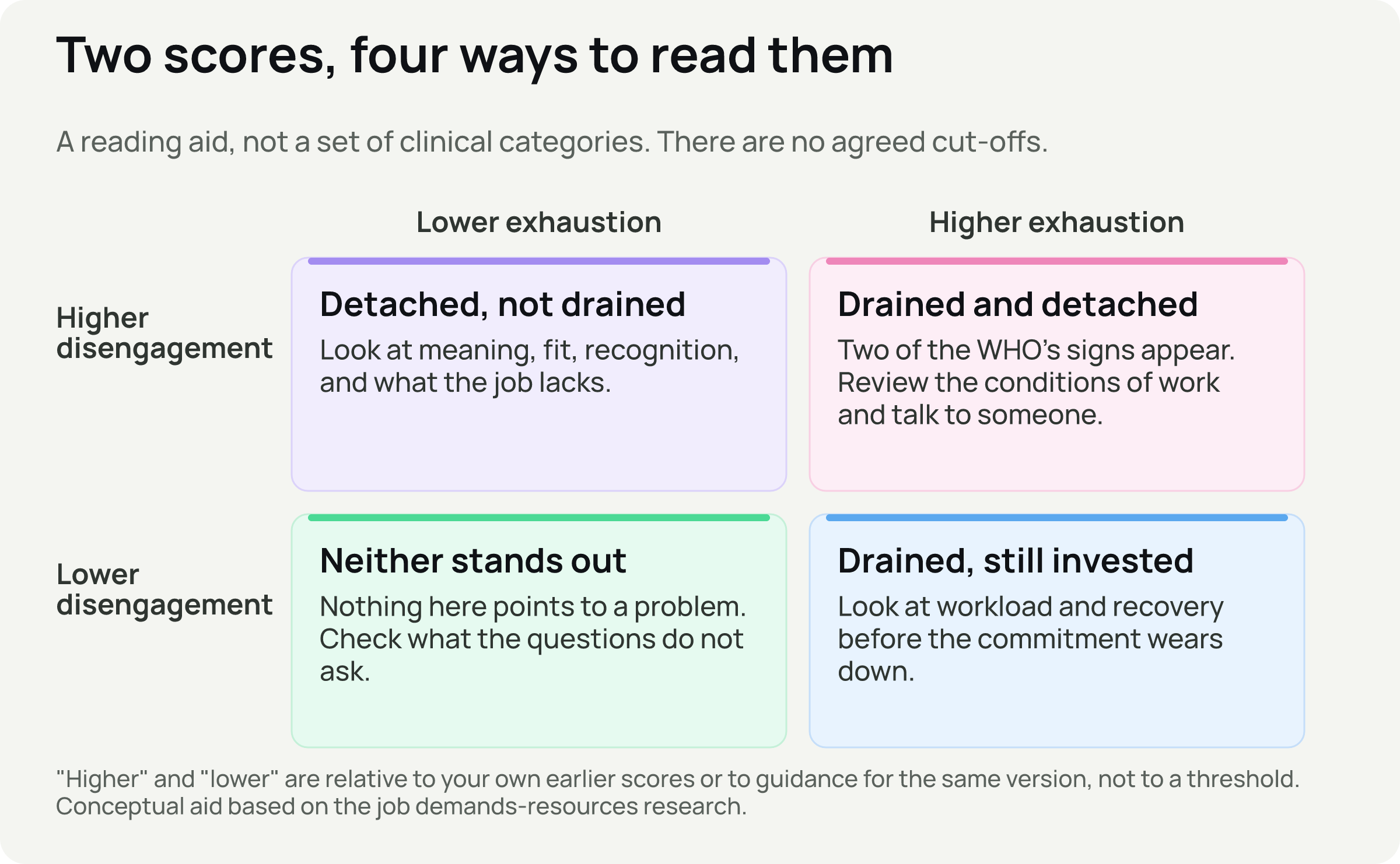
The OLBI measures two things about your work: how exhausted you feel, and how disengaged you feel. Each is scored separately. [1] Together they describe part of what the WHO calls burn-out. They do not describe the third part, reduced professional efficacy, and they do not describe why you feel as you do. [2]
What is exhaustion in the OLBI?
Exhaustion is feeling drained by work and needing more time to recover. LuriaLab describes it as physical, cognitive, and emotional exhaustion. [1] Typical themes include being tired before the day starts, needing a long time to recover after work, and feeling emotionally drained during it. [6]
It is not the same as being busy or tired after a hard day. The question is whether the tiredness is persistent and whether rest restores you.
What is disengagement?
Disengagement is distance from your work and its content: finding it less interesting, less meaningful, or more of a chore. It resembles the WHO's "increased mental distance from your job, or feelings of negativism or cynicism related to your job." [2] Typical themes include talking about work in a negative way, doing it almost mechanically, and growing disinterested over time. [6]
It is not the same as disliking one task. The question is whether your relationship to the work itself has cooled.
Why two scores, and how do they connect to causes?
The OLBI grew out of research on job demands and resources. In an original study of 374 workers, demands were linked mainly to exhaustion, and a lack of job resources, such as support, feedback, and a say in how you work, mainly to disengagement. [4] That is why two scores can be more useful than one: they point to different places to look.
Is the OLBI the same as a stress test?
No. A general stress scale such as the PSS-10 asks how overloaded and out of control life has felt, at work and outside it. The OLBI asks about your work. The experiences overlap, but the scores are not interchangeable.
If you are unsure which to choose, ask what you want to understand. If it is "how drained or detached am I from this job?", the OLBI fits. If it is "how stressful has my whole month been?", the PSS-10 fits.
What does the OLBI leave out?
It does not measure your sense of effectiveness at work, your mood, anxiety, sleep, or physical health. It does not ask about workload, control, or support, so it cannot tell you which of HSE's six areas, demands, control, support, relationships, role, and change, is the problem. [7] It does not diagnose.
If you want to understand the causes, use the six areas as a checklist, and see our article on what causes stress at work.
Sources and further reading
These links open external research and health-information websites.
- LuriaLab: Oldenburg Burnout Inventory (OLBI) test page
Sixteen items, two subscales, instant scoring statement, age 18+, disclaimers, and citation. Read on 24 October 2026. - World Health Organization: Burn-out an "occupational phenomenon" (2019)
ICD-11 definition of burn-out; not classified as a medical condition. - Maslach and Leiter (2016): Understanding the burnout experience. World Psychiatry, 15(2), 103-111
Notes that the Oldenburg Burnout Inventory assesses two dimensions, and discusses measurement and diagnosis. - Demerouti, Bakker, Nachreiner, and Schaufeli (2001): The job demands-resources model of burnout. Journal of Applied Psychology, 86(3), 499-512
Study of 374 workers: demands linked mainly to exhaustion, lack of resources mainly to disengagement. Abstract-level details only; full text not opened. - NovoPsych: Oldenburg Burnout Inventory (OLBI)
A commercial publisher's description of items, scoring ranges, its own cut-offs, and reliability figures it cites. Read on 24 October 2026. - SciELO: Oldenburg Burnout Inventory validation in Brazil (Ciencia & Saude Coletiva)
Describes the original 16-item structure, four-point agreement scale, balanced wording, and how the authors reversed items. Portuguese-language article read on 24 October 2026. - HSE: What are the Management Standards?
The six areas of work design that affect stress.
This page is educational. A questionnaire score cannot establish a diagnosis or explain the cause of your symptoms. If you are struggling, speak with a doctor or mental health professional, whatever your score. Read when to get help for work stress or find a helpline in your country.