
What does the WSAS measure? Impairment, not symptoms
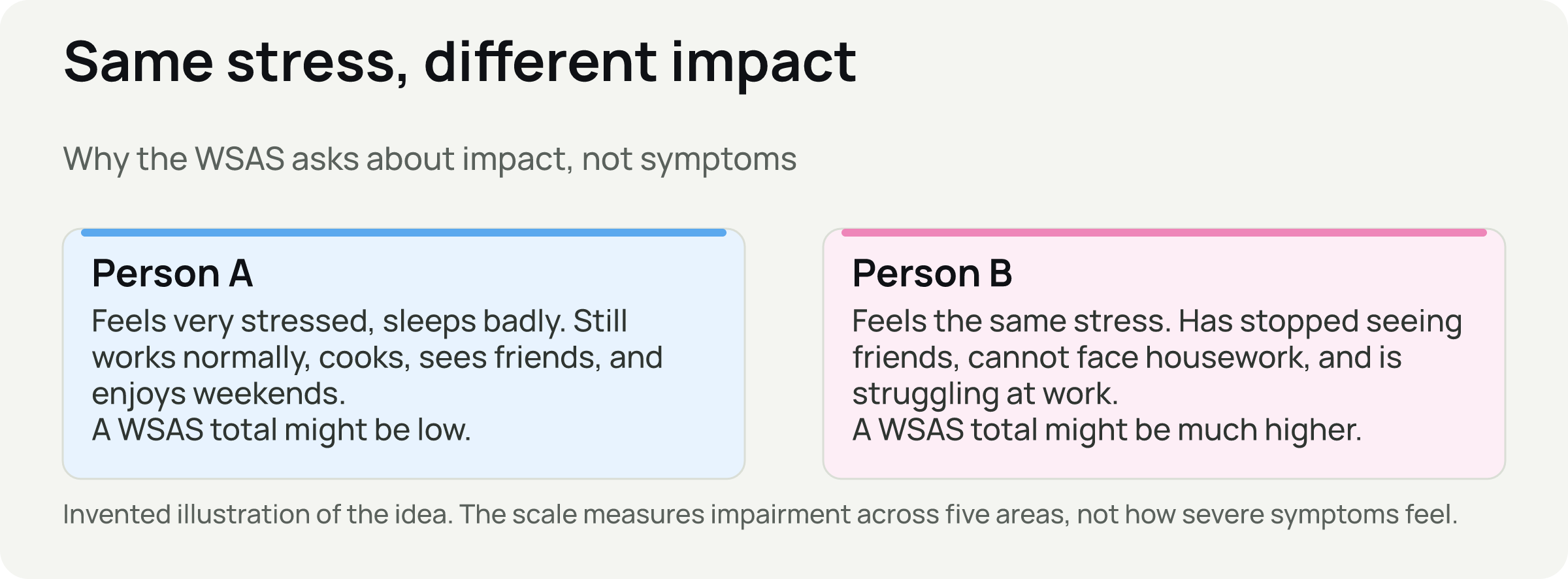
The WSAS measures functional impairment: how much a problem you name is interfering with five parts of daily life. [2][4] It does not measure how severe your symptoms feel, what the problem is, or why it is happening.
What is functional impairment?
Functional impairment is the degree to which symptoms interfere with everyday roles such as work, home, relationships, and leisure. LuriaLab notes that clinicians look at how much daily life is disrupted, not only at symptom counts, and that symptoms can exist without impairment. [4] That is the idea behind the WSAS.
Why does it matter for work stress?
Many people tell themselves work stress is "just work." The WSAS asks whether it is staying there. If your evenings, home chores, friendships, and close relationships are all affected, it is a sign the stress has moved beyond the workplace. That is useful information for a conversation with a manager or a doctor.
How is it different from a stress or burnout questionnaire?
A stress questionnaire asks how stressed you feel. A burnout questionnaire asks about exhaustion and distance from work. The WSAS asks about the effect on your life. It is neutral about the cause: the five items work for stress, low mood, anxiety, or a physical condition. [3] That makes it a useful companion to other questionnaires, but not a replacement.
| Question you have | Page to read |
|---|---|
| How drained or detached do I feel about my job? | Oldenburg Burnout Inventory |
| How stressful has the last month felt overall? | PSS-10 |
| How much is this getting in the way of my life? | WSAS (this page) |
| How have mood, anxiety, and tension been this week? | DASS-21 |
What does the WSAS leave out?
It does not tell you what the problem is, how severe symptoms are, or whether a condition is present. It does not ask about workload, control, or support, so it cannot point to what to change at work. It covers five areas only, and a score cannot capture everything that matters in a life.
What can it add to a conversation?
It gives you five concrete areas to talk about. "My work is affected a lot, my home life somewhat, my friendships hardly at all" is more useful to a doctor or counsellor than "I am stressed." It also lets you track whether life gets easier, if you repeat it with the same problem in mind. [3]
Sources and further reading
These links open external research and health-information websites.
- LuriaLab: Work and Social Adjustment Scale (WSAS) test page
Five areas of functioning, age 18+, about 1 minute, and disclaimers. Response options and scoring are not described on the page. Read on 24 October 2026. - Mundt, Marks, Shear, and Greist (2002): The Work and Social Adjustment Scale: a simple measure of impairment in functioning. British Journal of Psychiatry, 180(5), 461-464
The original paper: five items, 0 to 8, over 500 patients in two treatment studies (depression and obsessive-compulsive disorder), reliability, validity, and the tentative score bands. - NovoPsych: Work and Social Adjustment Scale
A commercial publisher's summary of items, scoring, alternative bands, percentile context, reliability figures, and populations. Read on 24 October 2026. - LuriaLab glossary: What is functional impairment?
Describes functional impairment as interference with everyday roles, and the WSAS as rating five areas. Gives no numeric thresholds.
This page is educational. A questionnaire score cannot establish a diagnosis or explain the cause of your symptoms. If you are struggling, speak with a doctor or mental health professional, whatever your score. Read when to get help for work stress or find a helpline in your country.