
WSAS scoring: adding to 40, score bands, and what a change means
Add the five item scores for a total from 0 to 40. Higher means more impairment. [2][3] The original authors suggested tentative bands, and other researchers have proposed different ones. All come from clinical samples, and none is a diagnosis. [2][3]
How do you calculate a WSAS total?
Add the five item scores. There are no reversed items. [3] If you chose "I am not working for reasons unrelated to my difficulties" on the work item, it counts as 0. [3]
Worked example
An invented person names work stress as their problem and rates the five areas.
| Area | Rating (0 to 8) |
|---|---|
| Work | 4 |
| Home management | 2 |
| Social leisure activities | 5 |
| Private leisure activities | 3 |
| Close relationships | 2 |
What are the score bands?
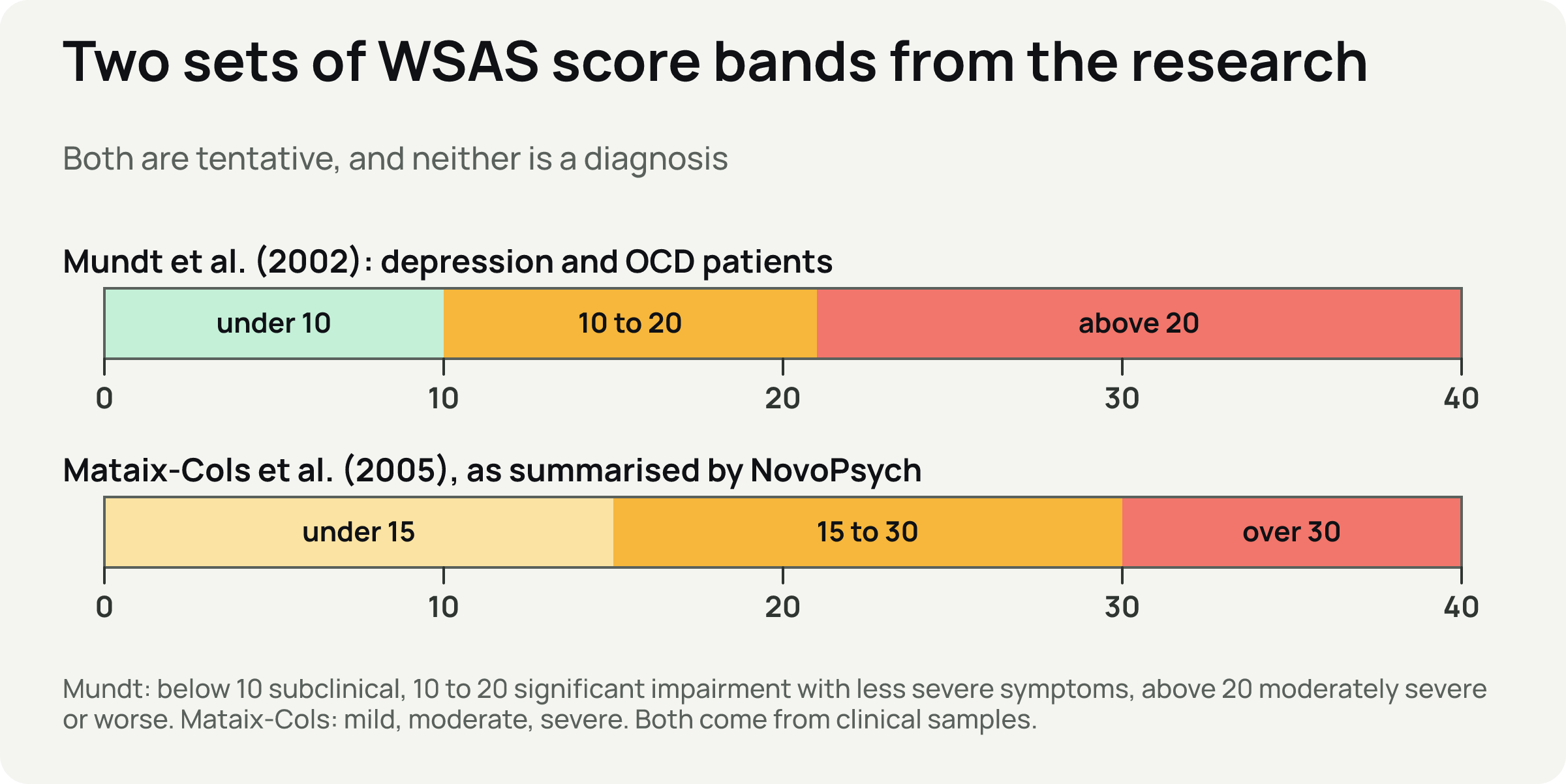
Mundt and colleagues wrote that a score above 20 appears to suggest moderately severe or worse psychopathology, scores of 10 to 20 are associated with significant functional impairment but less severe symptoms, and scores below 10 are associated with subclinical populations. They noted that this had not been tested outside depression and obsessive-compulsive disorder. [2]
NovoPsych reports a second set from Mataix-Cols and colleagues (2005): under 15 mild, 15 to 30 moderate, and over 30 severe. It says that set has stronger external validation evidence, though it uses the Mundt bands as its primary framework. [3]
How does my score compare with other people?
In a primary-care therapy intake sample reported by Zahra and colleagues (2014), the mean was 18.8 and the standard deviation 9.2. A score of 10 sat at about the 17th percentile, 19 at about the 50th, and 30 at about the 89th. [3] That is a sample of people seeking therapy, not of the general working population, so it says little about where you stand among workers.
How much change is meaningful?
NovoPsych treats a change of at least 5 points as significant, which it says matches what patients perceive as meaningful, and under 5 as minimal. Zahra and colleagues proposed 8 points on the basis of measurement error, so published thresholds differ. [3] Use the direction over time and how you feel, not one number.
Is the result a percentage or a probability?
No. It is a score from 0 to 40. It does not give the chance of a condition, and it does not predict what will happen to you.
Common questions
What is the highest possible WSAS score?
The highest possible WSAS score is 40. Each of five areas is scored from 0 to 8. [2]
What is a high WSAS score?
In the original paper, above 20 appeared to suggest moderately severe or worse problems, in patients with depression or obsessive-compulsive disorder. A second set of researchers uses over 30 as severe. Neither is a diagnosis. [2][3]
What if I am not working?
If you are not working for reasons unrelated to your difficulties, the work item has an option that scores 0. If you are not working because of the problem, rate the impairment. [3]
Sources and further reading
These links open external research and health-information websites.
- LuriaLab: Work and Social Adjustment Scale (WSAS) test page
Five areas of functioning, age 18+, about 1 minute, and disclaimers. Response options and scoring are not described on the page. Read on 24 October 2026. - Mundt, Marks, Shear, and Greist (2002): The Work and Social Adjustment Scale: a simple measure of impairment in functioning. British Journal of Psychiatry, 180(5), 461-464
The original paper: five items, 0 to 8, over 500 patients in two treatment studies (depression and obsessive-compulsive disorder), reliability, validity, and the tentative score bands. - NovoPsych: Work and Social Adjustment Scale
A commercial publisher's summary of items, scoring, alternative bands, percentile context, reliability figures, and populations. Read on 24 October 2026.
This page is educational. A questionnaire score cannot establish a diagnosis or explain the cause of your symptoms. If you are struggling, speak with a doctor or mental health professional, whatever your score. Read when to get help for work stress or find a helpline in your country.