
Maslach Burnout Inventory (MBI): the best-known burnout questionnaire explained
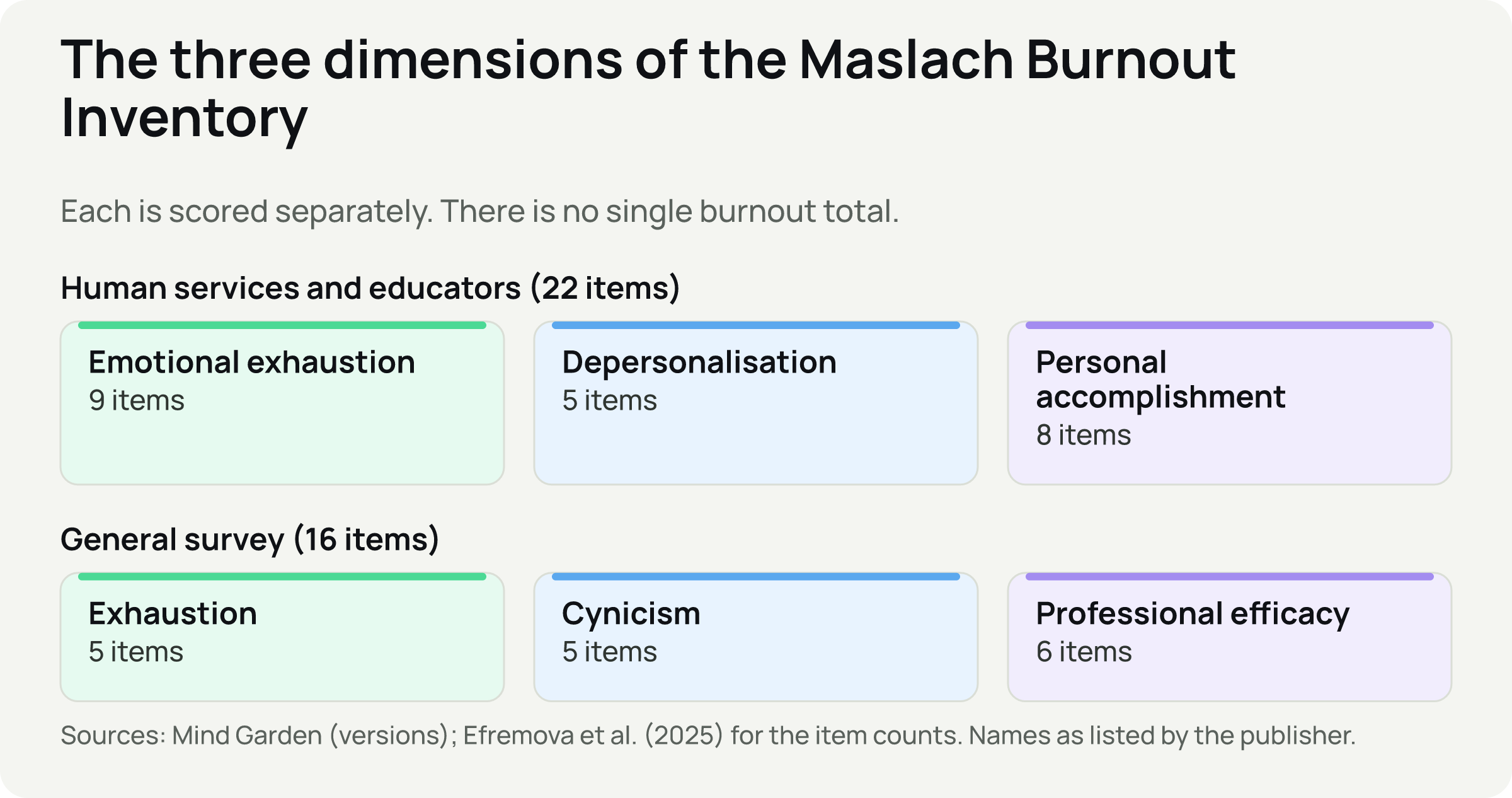
The Maslach Burnout Inventory (MBI) is a burnout questionnaire with several versions. The general-survey version (MBI-GS) has 16 items and gives three separate scores: exhaustion, cynicism, and professional efficacy. [1][2] The publisher advises against combining them into one burnout score, and says the MBI is not a clinical diagnostic tool. [1] A 2025 review of healthcare studies found the MBI-HSS the most used burnout scale, in 333 studies. [4]
What is the Maslach Burnout Inventory?
It is a family of questionnaires published by Mind Garden, written by Christina Maslach, Susan Jackson, Michael Leiter, and Wilmar Schaufeli. [3] The MBI-HSS (22 items) is for human services workers, the MBI-ES (22 items) for educators, and the MBI-GS (16 items) for general occupational use. [1] Versions adapted for medical personnel and for students are also listed. [1]
The publisher describes burnout as a continuum measured on three separate dimensions, not as a single thing. [1] The WHO describes burn-out in ICD-11 as an occupational phenomenon, not a medical condition, resulting from chronic workplace stress that has not been successfully managed. [5] A score on the MBI does not say whether someone meets that description.
Can I use the MBI if my problem is work stress?
It is about burnout at work, so it fits. The general survey refers to your job and is meant for occupations outside human services and education, such as customer service, maintenance, manufacturing, and management. [2] It does not ask what in your job is causing the exhaustion, and it does not measure stress as such. For stress, use the PSS-10.
What can I find in these MBI explainers?
If you have a result, start with scoring or understanding results. If you are deciding whether to take it, start with what it measures and who it is for.
Where do I take the MBI?
JobStressCheck explains questionnaires and does not host them. Mind Garden sells a single-use "Report About Me" for the MBI-GS. After you buy it, you get an email invitation to complete the survey, and then a second email with instructions to access your report. [3] The report includes your scale scores and percentiles compared with general population norms, and recommendations. [3] It was listed at $20 on 2 November 2026. Prices change, so check the page.
Do I need a score before asking for support?
No. The NHS suggests seeing a GP if you are struggling to cope with stress, or if what you are trying yourself is not helping. [6] You do not need to buy a questionnaire to do that.
Common questions
Sources and further reading
These links open external research and health-information websites.
- Mind Garden: Maslach Burnout Inventory (the publisher's MBI page)
The versions and item counts, the three dimensions, the seven-point frequency scale, the five burnout profiles, the advice against a single burnout score, and the statement that cut-offs were removed from the fourth edition. Read on 2 November 2026. - Mind Garden: MBI General Survey (MBI-GS)
The 16-item general survey, its three scales and what each describes, the occupations it is meant for, and the profile classification. Read on 2 November 2026. - Mind Garden: Report About Me, MBI-GS
The single-use report for an individual, how the survey is delivered by email after purchase, what the report contains, and the prices listed. Read on 2 November 2026. - Efremova et al. (2025): Burnout scales used in healthcare workers during the COVID-19 pandemic and their psychometric properties: a systematic review. Frontiers in Public Health
An open-access review that compares the MBI, CBI, and OLBI. First 100,000 of about 165,000 characters read through Europe PMC; the rest not read. - WHO: Burn-out an "occupational phenomenon" (2019)
The ICD-11 definition, the three dimensions, and the statement that it is not classified as a medical condition. - NHS: Get help with stress
Signs of stress, when to see a GP, urgent help routes in the UK, and self-referral to NHS talking therapies.
This page is educational. A questionnaire score cannot establish a diagnosis or explain the cause of your symptoms. If you are struggling, speak with a doctor or mental health professional, whatever your score. Read when to get help for work stress or find a helpline in your country.